Why did long-term government bonds decline?

The decline of long-term government bonds in this round began on November 18, mainly due to factors such as the impact of new fund redemption regulations on trading positions, the reduction of allocation positions caused by the contraction of bank liability duration, the outflow from the insurance liability side, and insufficient bond purchases by the central bank. Small and medium-sized banks and large state-owned banks have successively removed long-term deposit products, reflecting the need for banks to control liability costs
The recent decline of TL began on November 18.
TL has embarked on a long bearish journey without looking back.


The active 30Y bond, 6-year Treasury, has increased by 10 basis points over 10 trading days.
The trading logic for ultra-long bonds may have changed.
Institutional Behavior: Significant Easing in the Bull Camp
Since Q3, there has been significant easing in the bull camp.
First, the new redemption regulations have pressured fund trading.
This year, the profit effect of A bonds has been poor, and the market has not been very active. The new redemption regulations have further led to capital flowing out of A bonds.
Second, the duration of bank liabilities is shrinking.
This year and next, there has been a significant downward trend in the liability side of banks, which has directly reduced the demand for extending the duration of assets and caused a decrease in an important backbone force in allocation.
- Small and medium-sized banks have begun to shelve long-term fixed deposit products, with five-year deposit products being the first to be "shelved."
According to a report from Financial Associated Press on November 11, following the inversion of deposit rates and the "low interest on long-term deposits," some small and medium-sized banks have begun to shelve long-term fixed deposit products to further adjust their liability structure. In the future, will more banks follow suit in adjusting long-term deposit products? In this regard, several industry insiders have stated that the current net interest margin of banks still has a downward trend, and commercial banks indeed need to control liability costs, so it is not ruled out that more long-term deposit products will be included in the adjustment scope.
- State-owned large banks' apps have shelved five-year large certificates of deposit.
Currently, five-year large certificates of deposit products can no longer be found in the mobile apps of state-owned large banks and several joint-stock banks. For example, the maximum term for personal large certificates of deposit at China Construction Bank is three years, with an interest rate of 1.55%, which is on par with its fixed deposit rate; the maximum term for large certificates of deposit sold by CITIC Bank and China Merchants Bank is only two years, with an annual interest rate of 1.40%.
Third, the outflow of liabilities from insurance.
After several reductions in the scheduled interest rate, the liability situation for insurance is also not optimistic. Q3 was very poor, and Q4 has marginally improved a bit, but in the face of such significant market selling pressure, it is not enough:
The growth rate of premium income in the entire industry has shown a downward turning point since last year's peak. The growth rate of premium income for the entire year of 2024 is 11.15%, which has dropped to 7.99% by October 2025.
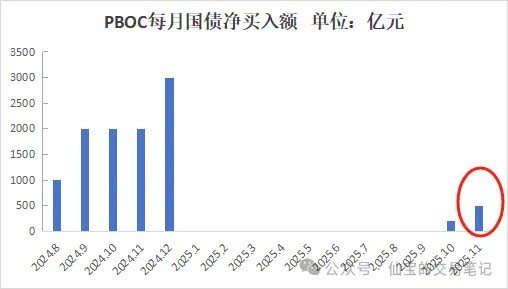
Finally, the central bank's bond purchases are a drop in the bucket.
In November, it purchased 50 billion, which is a significant difference compared to last year; this 50 billion will hardly include ultra-long bonds.
Therefore, the biggest bulls in ultra-long bonds: the trading positions of funds, the allocation positions of banks, and the allocation positions of insurance have all shown a collective absence.
Supply (Expectations) Still Exists
In recent years, the issuance of government bonds has shown a trend towards longer maturities, with an average duration significantly extended.
Extending the maturity helps to disperse future peak maturities and also helps to actively lock in long-term financing costs during years with lower interest rate centers.
Sell-side estimates that the supply of ultra-long bonds next year will be close to 7 trillion (accounting for 26% of the new government bond scale), which is significantly more than this year.
Lack of Profitability Effect, Weaker Willingness to Go Long
Adding insult to injury:
1. The fundamentals have not triggered a reduction in policy interest rates.
The fundamentals in Q4 this year are quite poor.
Everyone feels it is not good.
Economic data showed signs of decline in Q3.
However, the pressure on the annual GDP target is not great; last year's Q4 was a high base, and making this year's Q4 a bit lower is good for next year.
The management's attention may be focused on next year, and the central bank has also reintroduced cross-cycle adjustments.
Monetary policy follows the fundamentals, and total easing will not happen until at least Q1 next year, so the current time is essentially a waste. There is also concern about the upcoming two meetings: the Central Economic Work Conference + how to deploy for next year in the bureau meeting, which is likely to bring another round of impact.
2. Interest rate levels are overdrawn and need to repay debts.
Since November last year, there has been a rush to implement moderately loose monetary policy.
The starting point for the 10Y was around 2.04%.
At that time, the expectation was for a rate cut of 30-50BP this year.
However, only a 10BP cut has occurred so far.
Thus, there is considerable overdrawn space, and the downward space for interest rates has been squeezed after the expectations for monetary policy easing have decreased.
3. The recovery of inflation indicators is a gray rhino that A bonds must face.
A troublesome issue is:
Price indicators are recovering, with PPI bottoming out and CPI rising.
Overall, there are indeed many bearish factors.
Moreover, the macroeconomic outlook for next year is not weak - the bearish buff for ultra-long bonds is fully stacked.
We completely cut our positions in ultra-long bonds around November 20, only implementing one strategy: buying short and TF, plus flexible TL intraday.

Starting from November 30, we recommend intraday shorting TL strategies.

Finally, let's talk about trading habits:
In this wave of rising interest rates, many funds must have participated in bottom fishing.
Our view is that bottom fishing is a very alluring trading method, often carrying huge odds. Once successful, the profits can be very substantial, often leading to both fame and fortune, but it is also a very dangerous behavior The bottom is not copied, but rather the countless corpses of those who have been trapped at the bottom.
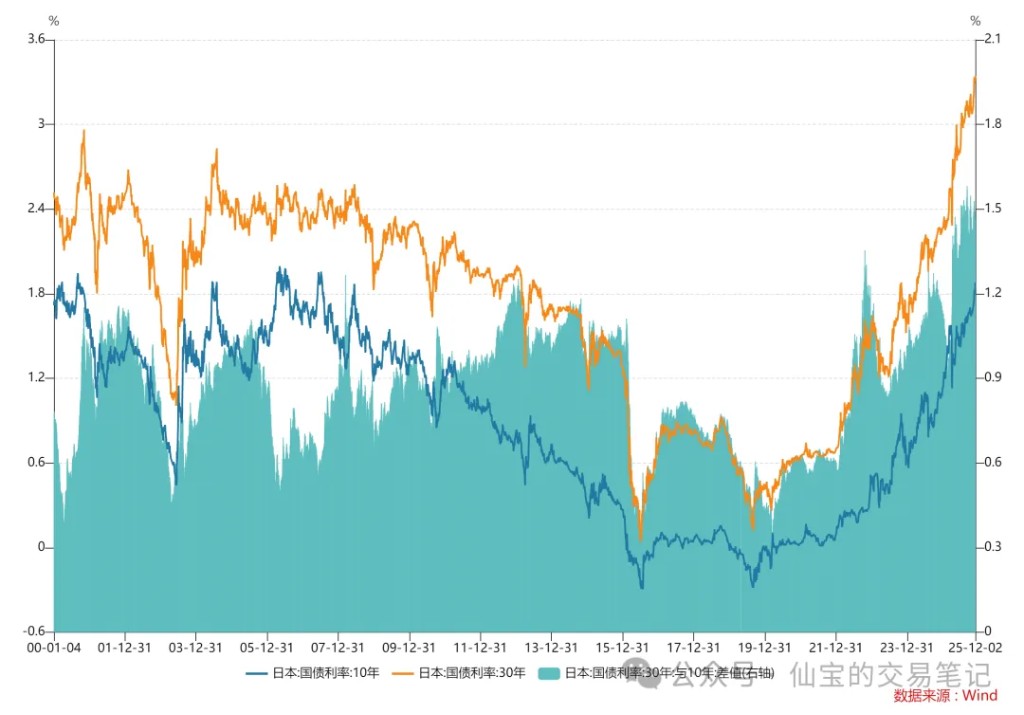
The current spread between the 30Y and 10Y has already decoupled, with Japan currently able to reach 150 basis points.

The domestic macro environment is incomparable to that of Japan.
But will the endpoint be similar?

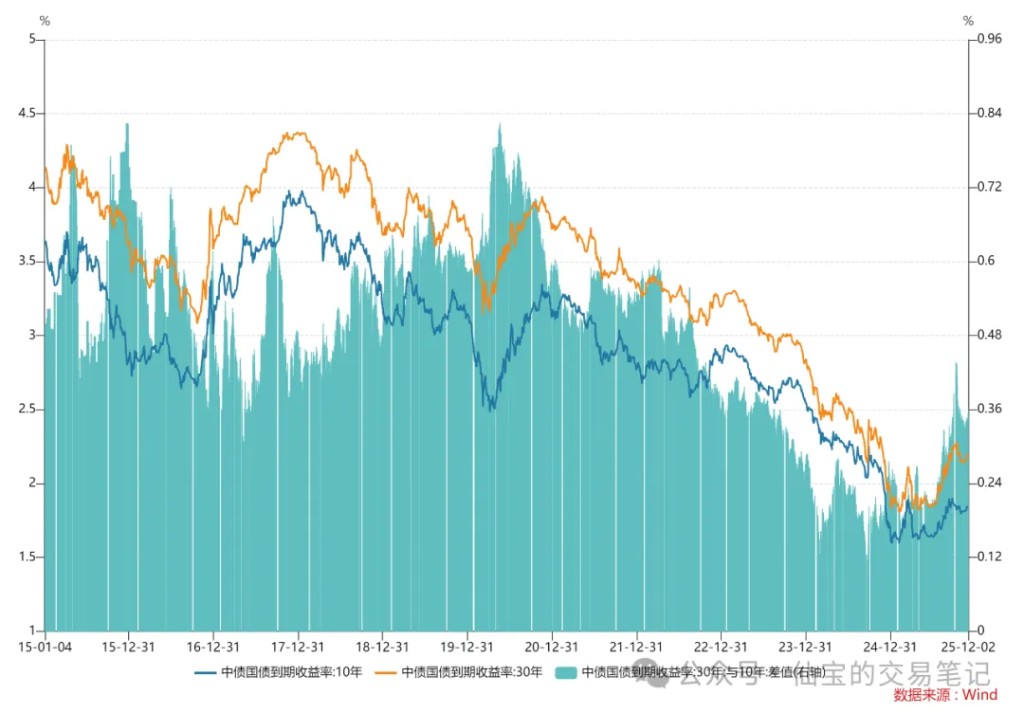
The highest spread between CN's 30Y and 10Y is over 80 basis points, currently at over 30.
There is still a lot of room for growth.
Behind the compression of the 30-10 spread is the support of increased trading activity in the 30Y, which boosts liquidity premium.
As can be seen from the above chart.
From 2019 to the end of 2024, the 30-10 spread has been declining, with the proportion of ultra-long bond trading rising from 9% to around 25%.
If we mentioned earlier.
The absence of ultra-long bond players.
Then the liquidity premium will inevitably return, and the 30-10 spread will also rise.
How can the bulls be redeemed?
The upper limit of the 30Y government bond depends on several factors:
One is whether there are institutions suffering severe losses that pose risks, similar to Silicon Valley Bank, which could trigger a strong market rescue mechanism from the central bank.
Second is the rising issuance cost of local bonds, which could pressure local finances, and whether the joint working group between the central bank and finance can play a role (during the period of intensive government bond issuance).
Third is extreme pessimism in sentiment, where short positions are closed and long positions are cut to reach a new balance.
Fourth is the warming expectation of comprehensive monetary policy easing or just before it lands.
Fifth is whether the central bank's demand for stability in the bond market can arrive quickly.
.......
In the current market, the bulls are the bears, and the bears are the bulls (dog head).
Xianbao's trading notes.
Risk warning and disclaimer.
The market has risks, and investment requires caution. This article does not constitute personal investment advice and does not take into account the specific investment goals, financial conditions, or needs of individual users. Users should consider whether any opinions, views, or conclusions in this article align with their specific circumstances. Investing based on this is at your own risk