The Reserve Bank of India cut interest rates by 25 basis points for the first time in six months and announced a trillion rupee bond purchase plan

The Reserve Bank of India will purchase bonds worth 1 trillion rupees (11 billion USD) this month and conduct 5 billion USD in foreign exchange swap operations. The central bank governor stated that this move aims to address the threat of high tariffs from the United States and support the rupee, which has been the worst-performing currency in Asia this year. Following the announcement, the rupee initially rose against the dollar but then fell back into decline. The yield on India's 10-year benchmark government bonds decreased by 6 basis points to 6.45%, marking the largest drop since August 28
The Reserve Bank of India (RBI) lowered interest rates by 25 basis points on Friday and announced a trillion-rupee bond purchase plan to inject liquidity into the economy as inflation falls to historic lows. Central Bank Governor Sanjay Malhotra stated that this move aims to address the threat of high tariffs from the United States and support the rupee, which is the worst-performing currency in Asia this year.
In this rate decision, the Monetary Policy Committee of the Indian central bank unanimously decided to cut the repo rate from 5.50% to 5.25%, marking the first rate cut in six months. At the same time, the central bank will purchase bonds worth 1 trillion rupees (USD 11 billion) this month and conduct USD 5 billion in foreign exchange swap operations.
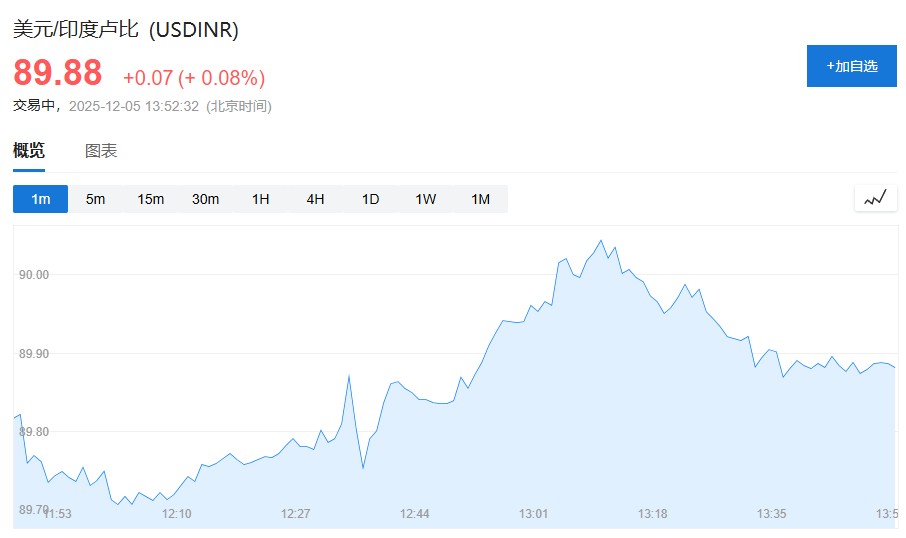
After the announcement, the rupee initially rose against the dollar but then fell back, dropping from 89.78 to 89.92 rupees per dollar, continuing its weak trend with a 5% decline this year. Weak trade and capital flows, combined with severe U.S. trade tariffs, caused the rupee to briefly fall below the 90 mark earlier this week. The yield on India's 10-year benchmark government bonds fell by 6 basis points to 6.45%, marking the largest decline since August 28.

Low Inflation Creates Space for Policy Adjustment
Malhotra stated that low inflation and strong economic growth mean that India is in a "rare golden period."
The central bank lowered its inflation forecast for the current fiscal year from 2.6% to 2%, while raising its growth forecast from 6.8% to 7.3%. The inflation rate in October fell to 0.25%, well below the central bank's target of 4%, primarily driven by falling food prices.
Most of the 44 economists surveyed by Bloomberg expected this rate cut, but some analysts anticipated that the central bank would keep rates unchanged after the rupee fell to historic lows. The economy grew by more than 8% in the previous quarter, but exports plummeted after Trump imposed a 50% tariff on Indian goods.
Dhiraj Nim, an economist at ANZ Bank, stated that since the Federal Reserve is expected to ease policy in December, this rate cut should not excessively weaken the rupee, as it will maintain the interest rate differential between the two markets. He believes this may be the last rate cut, and the central bank will mainly support the economy through liquidity going forward.
Bond Purchase Plan Aims to Hedge Against Dollar Intervention Impact
The central bank's bond purchases are expected to offset the capital outflow caused by its dollar sales in the foreign exchange market to support the rupee.
VRC. Reddy, head of funds at Karur Vysya Bank, stated that this policy is conducive to policy transmission, providing liquidity supply and lowering bond yields. He expects the 10-year yield to further decline to 6.40% by the end of December. On Friday, the one-year onshore forward premium fell by 16 basis points to 2.37% in the secondary market.
The central bank will also conduct USD 5 billion in foreign exchange swap operations, purchasing dollars and selling them back in three years.
Malhotra emphasized that the main purpose of the open market bond purchases is to inject base liquidity, rather than to affect bond yields. Despite facing challenges from an unfavorable external environment, the Indian economy has shown significant resilience, and the space provided by the inflation outlook allows the central bank to maintain support for growth