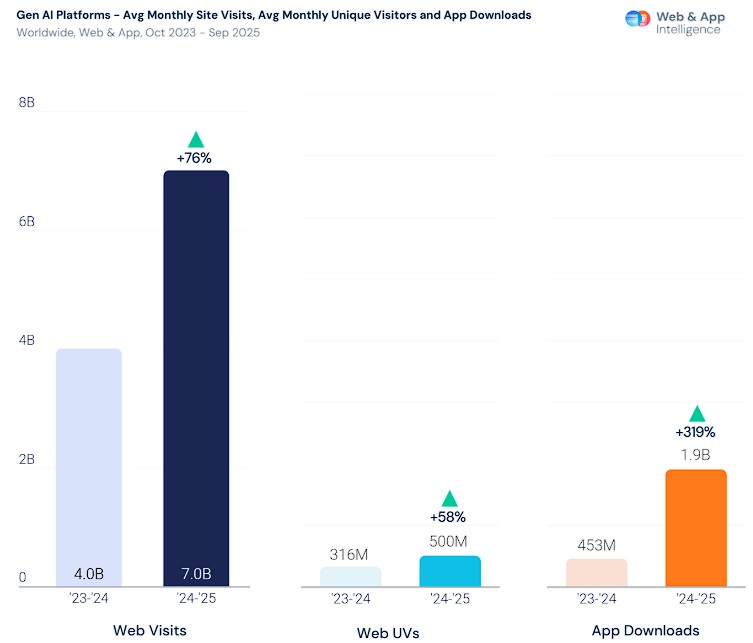
In September, global AI monthly visits reached 7 billion, a year-on-year increase of 76%, with traffic approaching that of social networks

Wallstreetcn
2025.12.06 01:09
portai
I'm PortAI, I can summarize articles.

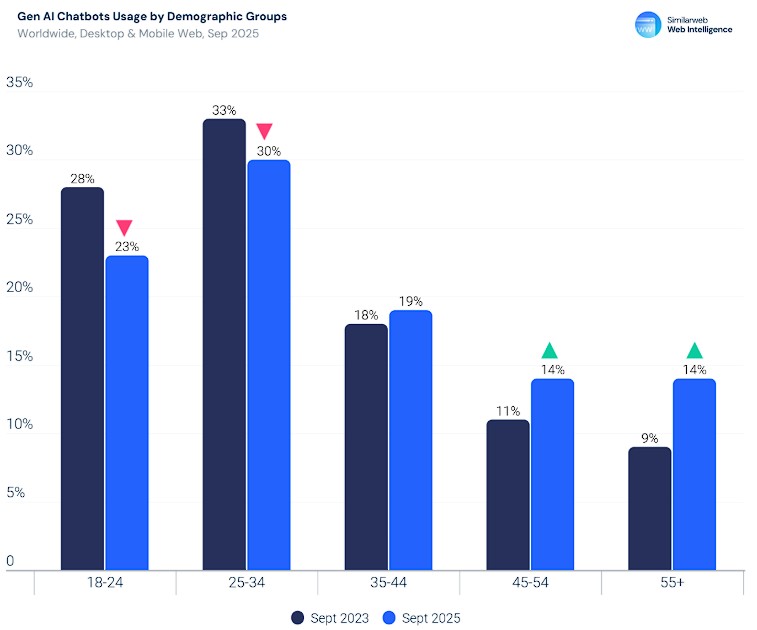
Data shows that ChatGPT occupies nearly 80% of the market share with 5.9 billion visits, ranking among the top five websites globally. The user demographic is showing differentiation: those aged 18-34 still dominate, but the group aged 45 and above is growing the fastest, accounting for nearly 30%. Notably, 95% of ChatGPT users also use Google, indicating a parallel usage model between AI and search engines rather than a substitution relationship

Generative AI is evolving from a novelty tool to a core layer of internet infrastructure.

Recently, data released by Similarweb shows that by September 2025, global monthly visits to AI services will reach approximately 7 billion, a year-on-year increase of 76%, with traffic scale comparable to mainstream social networks.

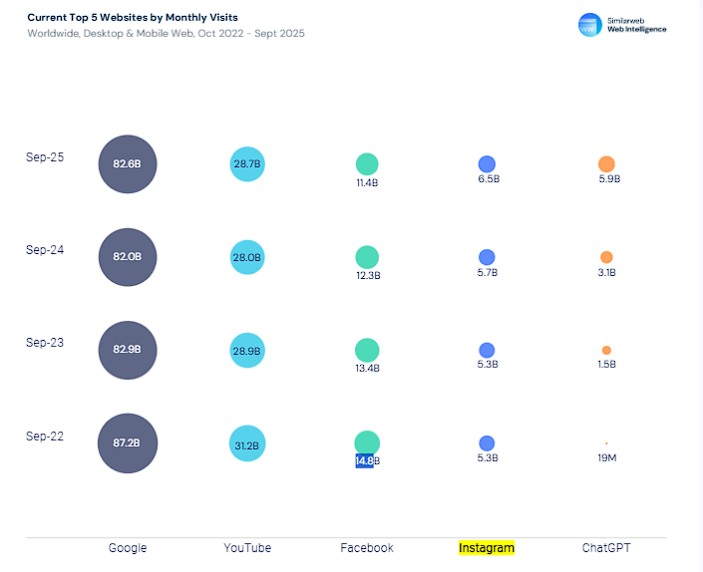
This growth is not only reflected on the web. The expansion on mobile is even more rapid, with AI application conversation volume increasing fivefold over the past year and application downloads soaring by 778%. ChatGPT remains the traffic leader, with visits reaching approximately 5.9 billion in September, ranking among the top five websites globally.

The user demographics are also changing. Although users aged 18 to 34 still dominate, the fastest-growing group is those aged 45 and above, currently accounting for nearly 30% of total visits. This indicates that AI technology is breaking through the early adopter circle and penetrating a broader audience.

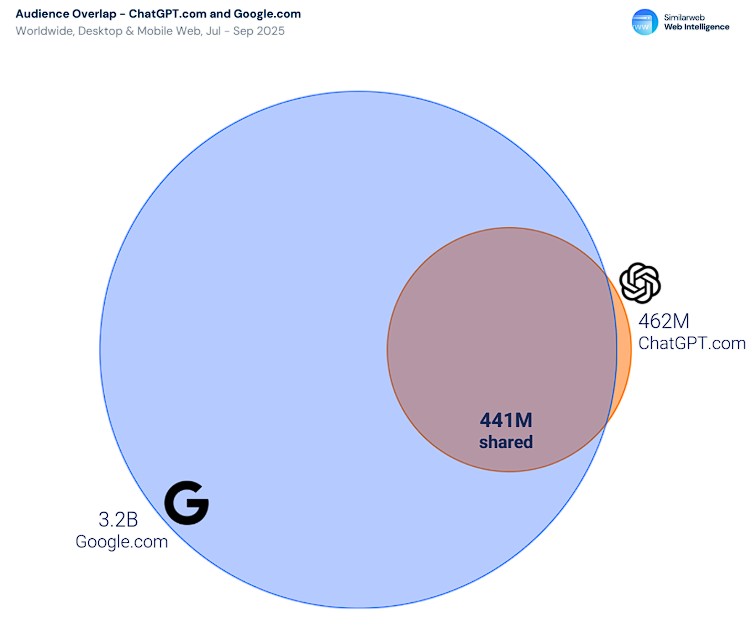
Data also shows that AI chatbots have not replaced traditional search engines. Among the 462 million ChatGPT visitors, 95% also use Google, indicating that users switch between conversational AI and search engines based on different tasks.

ChatGPT Accounts for 80% of Global AI Traffic

ChatGPT's market dominance remains solid. OpenAI's platform has grown from approximately 19 million monthly visits in 2022 to about 5.9 billion in September 2025, making it one of the top five websites globally, on par with Instagram's 6.5 billion monthly visits.

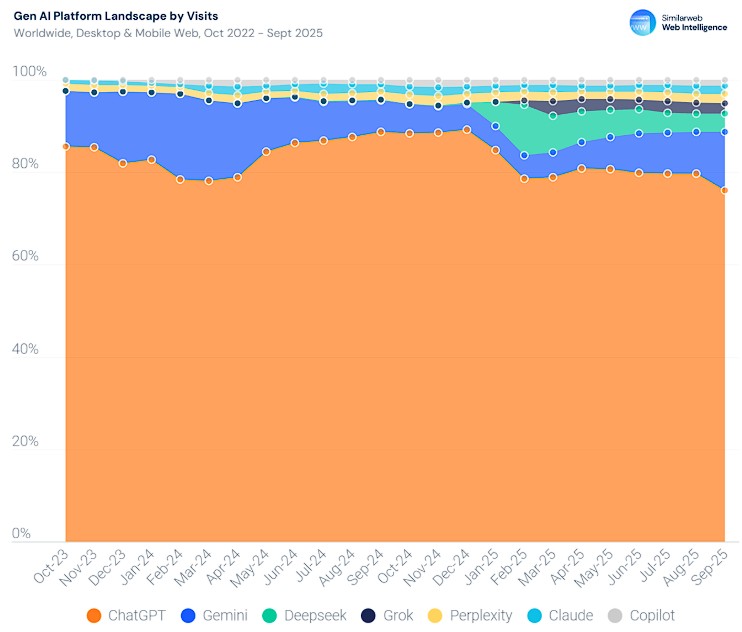
Despite facing challenges from competitors like Gemini, Claude, and Perplexity, ChatGPT still accounts for nearly 80% of global generative AI traffic. This overwhelming advantage reflects the barrier effect of early platforms in user habit formation.

AI and Search Engines Exhibit Parallel Usage Patterns

According to Similarweb data, AI chatbots have not replaced traditional search engines but have formed a parallel usage pattern.

Among the 462 million ChatGPT visitors, 95% also use Google, with overlapping users reaching 441 million. This indicates that users switch between conversational AI and search engines based on specific tasks.

In terms of user engagement, ChatGPT shows a significant lead. In the U.S. market, the ChatGPT mobile app has 41.3 million monthly active users, with 33% opening the app daily.

In contrast, Perplexity (3.4 million monthly active users) and Microsoft's Copilot (3.1 million monthly active users) have daily active rates of only 5% to 17%, indicating a more sporadic usage pattern.

Middle-aged and elderly users become the fastest-growing group

The age structure of users is undergoing significant changes. Although users aged 18 to 34 still represent the largest group, with 1.9 billion users (accounting for 53%), the growth rate of users aged 45 and above is the fastest, currently accounting for nearly 30% of all visitors.

This trend indicates that generative AI is moving beyond the early adopter phase and spreading to the mainstream population. The accelerated influx of middle-aged and elderly users signifies that the ease of use and practical value of AI tools have gained broader recognition.

AI feature integration is still in the experimental stage

The integration of AI technology into existing platforms is expanding. Google's "AI mode" has become the fastest generative AI feature to reach 100 million visits in the U.S. market, thanks to the company's large user base.

However, data shows that the usage of such integrated features is still in the experimental stage. During a two-month observation period, more than half of the users interacted with the feature only on a single day, indicating that users have not yet formed stable usage habits.

This phenomenon highlights that deeply embedding AI capabilities into existing product ecosystems still requires time to cultivate user behavior