


China's rare earth exports in November increased by 26.5% month-on-month, while refined oil imports saw an increase in volume but a drop in price. Copper ore experienced both an increase in volume and price, and soybean imports decreased by 14.5% month-on-month
China's rare earth exports in November increased by 26.5% month-on-month, while the import volume of refined oil rose but prices fell. Both the volume and price of copper ore increased, and soybean imports decreased by 14.5% month-on-month. The growth rate of goods trade rebounded in November, with a total import and export value of 3.9 trillion yuan, an increase of 4.1%. The import side showed a separation of volume and price, with energy import volumes increasing while prices fell, and the import value of electromechanical products grew steadily. The import volume and price of integrated circuits both rose, reflecting demand from the electronics manufacturing industry. Soybean imports increased by 13.32% year-on-year
In November, China's major commodity imports showed a distinct divergence, with key agricultural products and high-end manufacturing-related products performing strongly, while imports of refined oil and natural gas exhibited characteristics of "increased volume but decreased prices." Copper ore saw both "increased volume and prices," while coal experienced "decreased volume and prices."
On December 7, the General Administration of Customs announced that in November, the growth rate of China's goods trade rebounded, with a total import and export value of 3.9 trillion yuan, an increase of 4.1%. Among them, exports were 2.35 trillion yuan, up 5.7%; imports were 1.55 trillion yuan, up 1.7%.
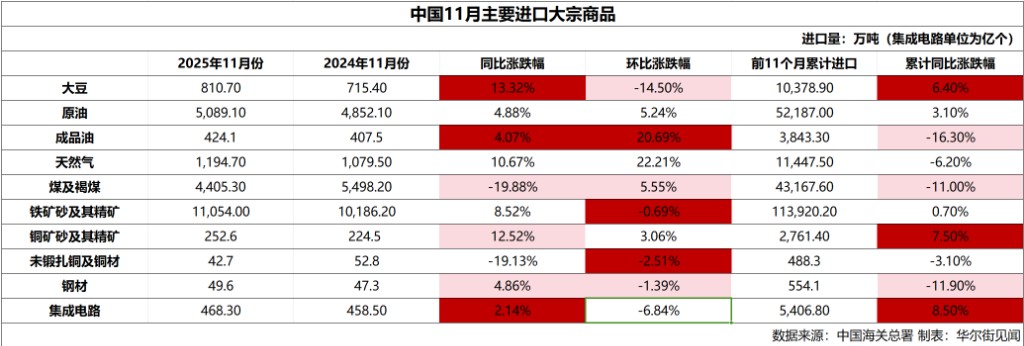
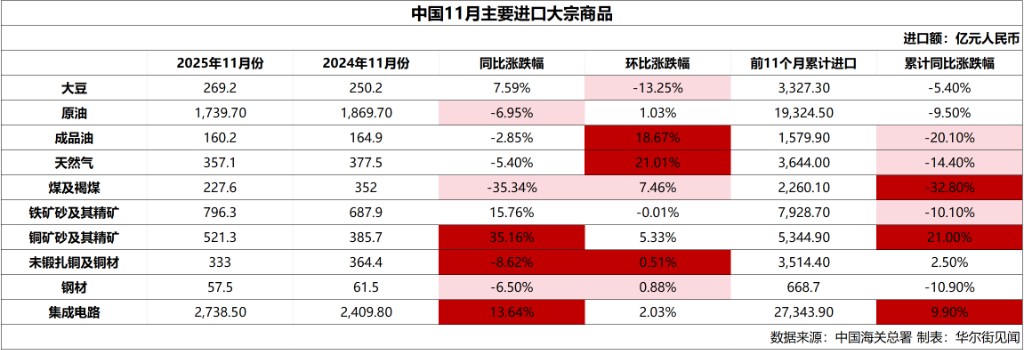
On the import side, commodities displayed a complex "volume-price separation" trend. On one hand, products related to manufacturing upgrades and food security, such as integrated circuits, soybeans, and copper ore, saw both volume and price increases or stable prices with increased volume; on the other hand, energy imports showed significant divergence: imports of refined oil and natural gas increased by 4.07% and 10.67%, respectively, but the import values decreased by 2.85% and 5.40%, highlighting the "increased volume but decreased prices" pattern. During the same period, imports of electromechanical products, as representatives of high technology, maintained a steady growth of 5.5% in the first 11 months.
Among key mineral exports, China's rare earth exports surged by 26.5% month-on-month in November.
Integrated Circuit Imports Increased by 2.14% Year-on-Year
As the largest single commodity category in China's imports, integrated circuits continued to perform well in November. According to the General Administration of Customs, the import value of integrated circuits increased by 13.64% year-on-year to 273.85 billion yuan, but the import volume only slightly increased by 2.14% to 46.83 billion units.
From cumulative data, the total import value of integrated circuits in the first 11 months reached 2.73439 trillion yuan, a year-on-year increase of 9.9%, with cumulative import volume increasing by 8.5%, showing a clear trend of both volume and price increases.
The stable growth of imports of these products reflects the ongoing development needs of China's electronic manufacturing and high-end equipment industries.
Agricultural Product Imports: Soybean Import Volume Increased by 13.32% Year-on-Year
In terms of agricultural products, soybean imports performed outstandingly. In November, the import value of soybeans reached 26.92 billion yuan, a year-on-year increase of 7.59%, with import volume increasing by 13.32% to 8.107 million tons.
From cumulative data, the total soybean import volume in the first 11 months reached 10.4 million tons, a year-on-year increase of 6.9%, but the average import price fell by 10.7%, resulting in a total import value of 332.73 billion yuan, a year-on-year decrease of 5.4%.
Metals and Their Ores: Copper Ore Import Volume Increased by 12.54%, Steel Import Volume Decreased by 6.5%
The import of metals and their ores shows a differentiated trend. In November, the import volume of copper ore and its concentrates increased by 12.52% year-on-year, while the import value surged by 35.16% to 52.13 billion yuan, indicating strong support on the price side.
Iron ore imports also performed steadily, with a November import volume of 110.54 million tons, up 8.52% year-on-year, and an import value increase of 15.76% to 79.63 billion yuan.
In contrast, imports of steel and unwrought copper and copper products saw a decline. In November, steel imports fell by 6.5% year-on-year, with a cumulative decline of 11.9% over the first 11 months; unwrought copper and copper products saw a cumulative import volume decline of 4.7% over the first 11 months.
Energy Products: Refined Oil and Natural Gas "Volume Increases, Price Drops," Coal "Volume and Price Both Drop"
The import of energy products presents a complex differentiated pattern. Refined oil and natural gas imports exhibit a "volume increases, price drops" characteristic—November import volumes increased by 4.07% and 10.67%, respectively, but import values decreased by 2.85% and 5.40%.
In contrast, coal imports showed a "volume and price both drop" trend, with November import volumes down 19.88% year-on-year, and import values plummeting by 35.34% to 22.76 billion yuan.
In terms of average prices, the average price of coal imports fell by 23.9% over the first 11 months, the average price of crude oil imports dropped by 12.1%, and the average price of natural gas imports decreased by 9.4%. This general price decline provides room for reducing domestic energy costs.
Key Mineral Exports: Rare Earth Exports Surge 26.5% Month-on-Month
In October, rare earth exports were 4,343.5 tons, and in November, China's rare earth export volume reached 5,493.9 tons, a month-on-month surge of 26.5%.
In October, China's rare earth exports ended a three-month decline, with a month-on-month increase of 9%.
Risk Warning and Disclaimer
The market has risks, and investment should be cautious. This article does not constitute personal investment advice and does not consider the specific investment goals, financial conditions, or needs of individual users. Users should consider whether any opinions, views, or conclusions in this article align with their specific circumstances. Investing based on this is at one's own risk
