AI concerns outweigh interest rate cut benefits, U.S. stock futures collectively decline, gold and oil under pressure, copper retreats after challenging high levels

Wallstreetcn
2025.12.11 08:28
portai
I'm PortAI, I can summarize articles.

Oracle's disappointing earnings report has raised concerns about the AI bubble, dampening the optimism brought by the Federal Reserve's interest rate cuts. U.S. stock index futures fell collectively, Asian stocks retraced early gains, gold and oil prices declined, copper prices retreated after approaching high levels, silver fluctuated at high levels, cryptocurrencies faced pressure, and Bitcoin rebounded slightly after falling below $90,000

The upward momentum of global stock markets, boosted by the Federal Reserve's interest rate cuts, has faded, and Oracle's disappointing earnings report has reversed market sentiment. Concerns are growing that the commercialization cycle for AI infrastructure may take longer than expected, leading to widespread profit-taking, with global stock markets, cryptocurrencies, and risk assets like crude oil all experiencing a pullback.

On December 11, U.S. stock index futures collectively fell, European stocks were mixed, and Asian stocks retraced early gains, with most markets declining. U.S. Treasury prices rose, and the dollar rebounded slightly. Commodity trends were mixed, with silver and copper rising, while gold and crude oil fell. Cryptocurrencies faced pressure, with Bitcoin briefly dropping below $90,000.

Billy Leung, an investment strategist at Global X Management, stated:

“While the market's focus is largely on the Federal Open Market Committee (FOMC) meeting, a key risk facing the overnight market is Oracle, given its role as a bellwether in hyperscale data center spending. The outcome of its meeting is a critical test for AI infrastructure trades and exacerbates broader pressures in the tech sector.”

Core market trends are as follows:

  • U.S. stock index futures collectively fell, with S&P 500 futures down over 0.8%, Nasdaq 100 futures down over 1.1%, and Dow futures down over 0.4%.

  • The German DAX 30 index opened down 0.10%, the UK FTSE 100 index opened down 0.10%, and the French CAC 40 index opened up 0.21%.

    The European Stoxx 50 index opened down 0.03%.

  • The Nikkei 225 index closed down 0.9%, at 50148.82 points, the Tokyo Stock Exchange index closed down 0.9%, and the Korea Composite Stock Price Index closed down 0.66%, at 4107.77 points.

  • The yield on 10-year U.S. Treasury bonds fell 3 basis points to 4.12%.

  • The dollar index rose 0.03% to 98.67, while the pound fell 0.2% to $1.3362.

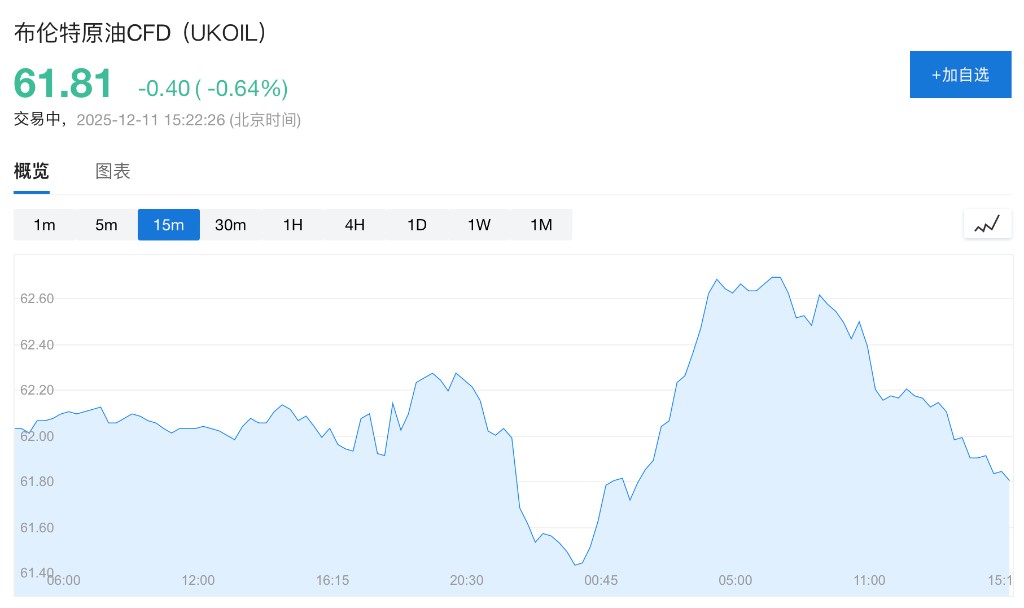
  • Spot gold fell 0.3% to $4215.05 per ounce, spot silver rose over 0.3% to $62 per ounce, London copper rose over 0.5% to $11618 per ton, and Brent crude oil fell over 0.6% to $61.84 per barrel.

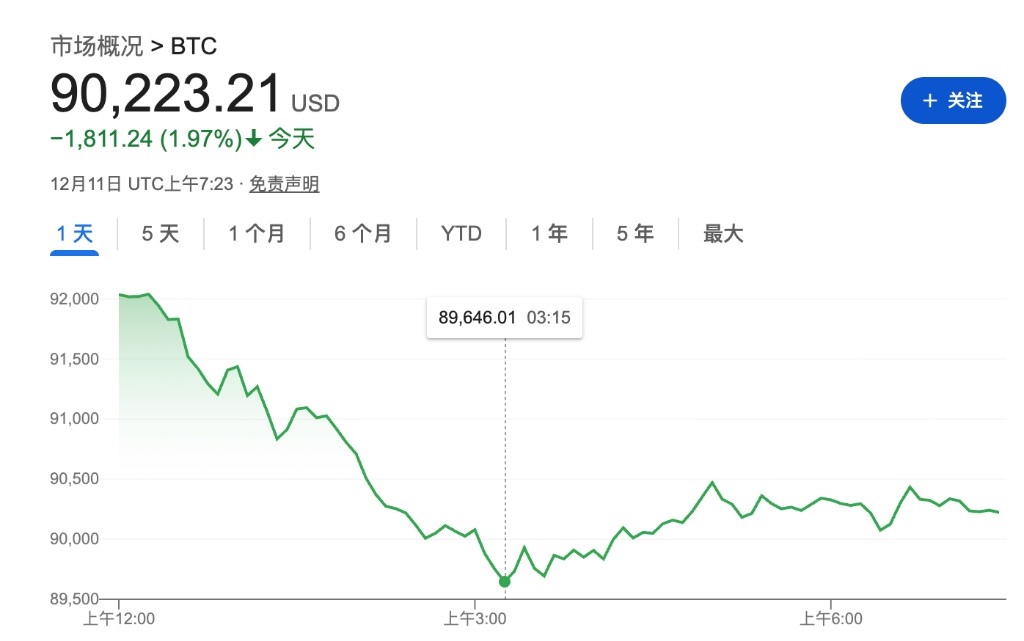
  • Bitcoin fell 2.3% to $90224.89, and Ethereum fell 4.1% to $3204.4.

U.S. stock index futures fell, and market sentiment quickly reversed after a surge overnight. On one hand, the benefits of the Federal Reserve's interest rate cuts, the initiation of a $40 billion monthly Treasury bond purchase program (viewed by the market as "implicit QE"), and dovish comments have been fully digested; on the other hand, Oracle's post-market plunge due to disappointing revenue has exposed performance pressures as a key player in AI, raising concerns about investment returns in the AI sector.

According to Wall Street Journal, the market originally expected a "hawkish rate cut" from the Federal Reserve, but the actual results showed no additional dissenters and no higher dot plot, and the anticipated strong statements from Powell did not materialize Wall Street analysts expect that the actual interest rate cuts next year may exceed the 25 basis points indicated by the dot plot. The personnel changes in the new chairmanship and policy uncertainty have become potential drivers of market volatility in 2026.

Oracle's after-hours stock price plummeted by 11%. According to Wall Street Journal, U.S. stock index futures fell, reflecting a rapid reversal of market sentiment after an overnight surge. On one hand, the favorable factors such as the Federal Reserve's interest rate cuts, the initiation of $40 billion monthly asset purchases (viewed by the market as "implicit QE"), and dovish remarks have been fully digested; on the other hand, Oracle's significant drop in after-hours trading was due to revenue falling short of expectations, exposing performance pressures as a key player in AI, raising market concerns about investment returns in related fields. The company announced its fiscal year 2026 second-quarter results after the market closed on Wednesday, with revenue and cloud business income both below analyst expectations, and quarterly free cash flow (FCF) at -$10 billion, with annual capital expenditures expected to exceed previous estimates by about $15 billion.

Emarketer analyst Jacob Bourne stated, In the context of uncertainty surrounding AI spending prospects, Oracle is facing increasing scrutiny due to its debt-driven data center expansion and customer concentration risks. This revenue miss may exacerbate already cautious investors' concerns regarding its OpenAI partnership and aggressive AI spending strategy.

As global stock markets and other risk assets generally decline, macro risk aversion sentiment dominates the market, and oil prices retrace earlier gains. Previously, concerns about oil supply risks and escalating geopolitical conflicts, influenced by the U.S. seizure of Venezuelan sanctioned oil tankers, had once pushed oil prices higher.

According to Wall Street Journal, crude oil supply is unprecedentedly oversupplied. However, Brent crude prices remain stable at $61-66, primarily because the market struggles to determine whether crude oil from sanctioned countries like Russia and Iran (which account for 15% of global supply) should be counted as effective supply. Analysts believe that sanctions have led to an unpredictable market, and once offshore inventories shift to land, oil prices could plummet significantly.

London copper futures retraced some gains, currently up nearly 0.5% to $11,610.5 per ton. In the early session, buoyed by the favorable news of the Federal Reserve's interest rate cuts, London copper approached historical highs. Since the beginning of this year, copper prices have risen over 30%, driven not only by liquidity expectations but also by a series of mine shutdowns, concerns over overseas supply shortages, and traders rushing to purchase in the U.S. market ahead of potential tariffs coming into effect

Oracle's disappointing earnings report has impacted market sentiment, with Bitcoin experiencing a significant drop, briefly falling below the $90,000 mark. Tony Sycamore, a market analyst at IG in Sydney, stated: "The cryptocurrency sector indeed needs to see stronger evidence that the sell-off on October 10th has completely ended, but currently, such evidence does not seem to exist."

Standard Chartered has significantly lowered its forecast for Bitcoin to reach $200,000 by the end of 2025, revising it down to $100,000. Geoff Kendrick, the global head of digital asset research at Standard Chartered, stated: "We believe that the buying activity from Bitcoin digital asset fund companies may have come to an end. Therefore, we now think that the future rise in Bitcoin prices will actually be driven by just one factor — ETF purchases."