Wall Street comments on Oracle's earnings report: Appears to exceed expectations, but profits are "inflated"; investment logic has shifted from "looking at orders" to "looking at fulfillment"

Wallstreetcn
2025.12.11 08:57
portai
I'm PortAI, I can summarize articles.

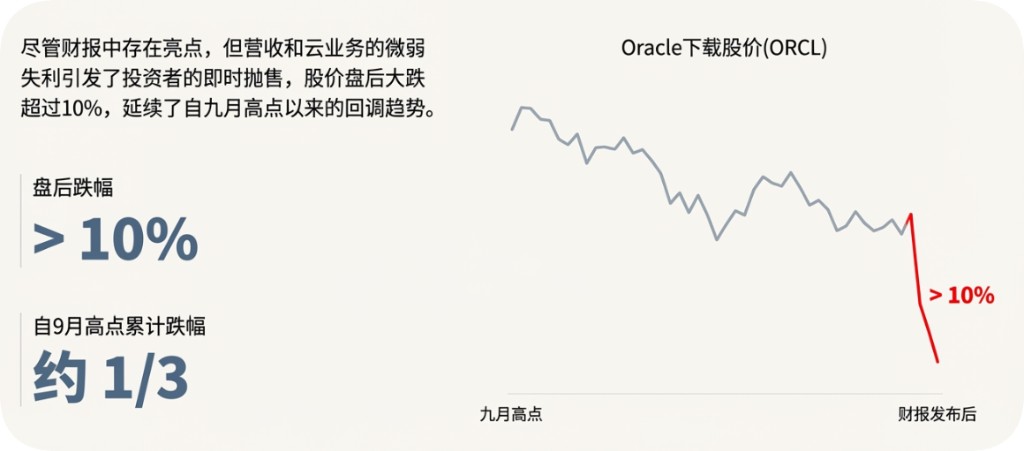
Oracle's earnings report has sparked heated discussions on Wall Street: despite a significant beat on non-GAAP EPS and a record high backlog of $523 billion, the real profit was "boosted" by a one-time gain of $2.7 billion, putting pressure on core earnings and cash flow. Order growth cannot mask the anxiety over conversion, with cloud business growth falling short of expectations, and a surge in capital expenditures leading to negative free cash flow. Following the earnings report, the stock price plummeted by 10%, UBS and Bank of America lowered their target prices, and Morgan Stanley placed its rating under review, with market attention shifting to earnings quality and order fulfillment

Oracle Q2 Fiscal Year 2026 Earnings Report has sparked heated discussions on Wall Street: on the surface, the non-GAAP earnings per share exceeded expectations, and the order backlog (RPO) reached a new high of $523 billion, but in reality, profits rely on non-recurring income, creating a "fat illusion." Investors are no longer satisfied with just the "order story."

After the earnings report was released, Oracle's stock plummeted over 10% in after-hours trading. According to reports from trading desks, this led several investment banks, including UBS, Morgan Stanley, and Bank of America, to lower their target prices or reassess their ratings.

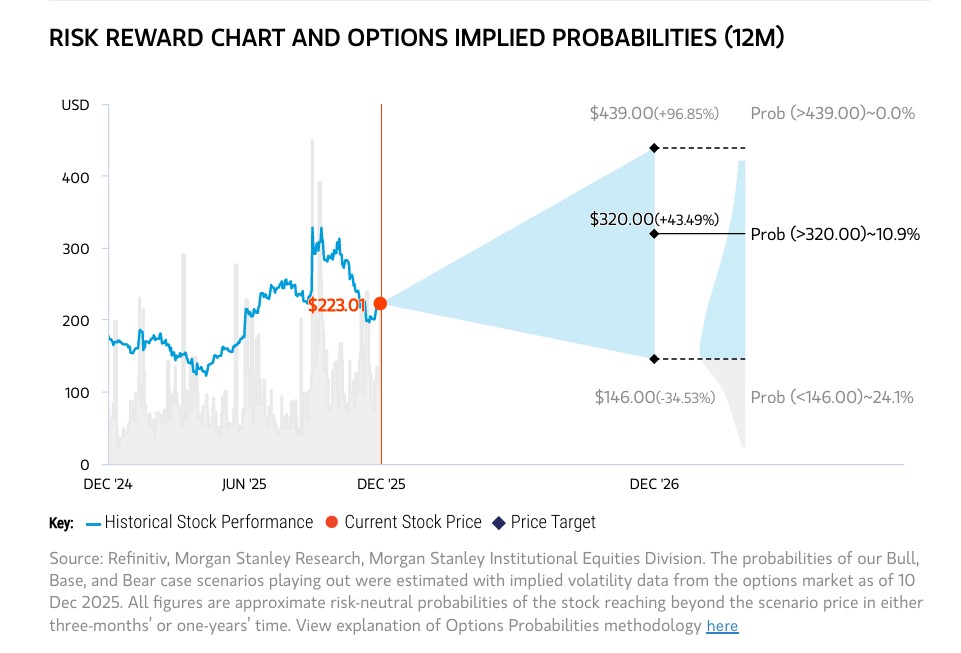
Morgan Stanley's Keith Weiss team stated in a report on the 11th that, given the declining certainty of backlog orders converting into profits, market concerns have intensified, and the firm has placed Oracle's target price and model under review. Oracle's current stock price lacks clear catalysts, and investors need more evidence that its emerging GPUaaS business can drive profit and free cash flow growth.

UBS's Karl Keirstead team believes that although Oracle's Q2 performance slightly fell short of investor expectations and the communication regarding financing leverage prospects was not clear enough, the potential for its massive backlog orders to convert in the second half of the year and fiscal year 2027 is highly attractive, so UBS maintains a "buy" rating on the company.

Bank of America's Brad Sills team expressed a more optimistic view, stating that although Oracle is in the most intensive phase of AI infrastructure construction and faces a mismatch between spending expansion and revenue conversion timing, this is an investment curve issue rather than a fundamental change, thus reiterating a "buy" rating on the company.

Hidden Concerns Behind the Order Myth: $523 Billion RPO Fails to Conceal Conversion Anxiety

Oracle delivered its strongest order performance ever this quarter: RPO increased by $67.7 billion to $523 billion, with implied order amounts surging 583% year-on-year to $83.8 billion, driven primarily by AI computing power purchases from giants like Meta and NVIDIA. Among these, the current confirmable cRPO reached $53.1 billion, a 40% year-on-year increase, indicating some support for short-term order realization.

However, Wall Street's focus has shifted from "order growth" to "conversion efficiency."

Morgan Stanley pointed out, despite the continuous expansion of order scale, investors are losing confidence in its conversion into "sustainable profitable revenue." Data shows that total revenue this quarter grew 13% year-on-year (at constant exchange rates), slightly below market expectations; cloud infrastructure (OCI) revenue was $4.079 billion, a 66% year-on-year increase, lower than UBS's 68% forecast and market consensus of $4.168 billion; software business revenue declined 3% year-on-year, becoming a drag on overall growth UBS believes that the lag in order conversion is a common issue in the industry, and the construction of Oracle's Abilene data center is progressing as planned, with OCI growth expected to accelerate to over 80% in the third quarter.

However, Morgan Stanley warns that the global restructuring of the sales team may lead to execution risks, and flexible contract models such as "Bring Your Own Chip" (BYOC), while reducing Oracle's capital expenditure pressure, could weaken the profit margins in its GPU sales segment, further exacerbating the uncertainty in converting profitability.

The Truth Behind "Inflated" Profits: Non-Recurring Income Masks Core Pressure

The most significant contradiction in Oracle's quarterly financial report lies in the divergence between "better-than-expected EPS" and "weak profitability."

The report shows that non-GAAP earnings per share reached $2.26, significantly exceeding the market expectation of $1.65, but this impressive performance did not stem from improvements in core business.

Morgan Stanley's analysis reveals that the EPS beat was primarily due to $2.7 billion in pre-tax non-recurring income from Oracle's sale of its stake in Ampere. Excluding this factor, its core profitability is actually under significant pressure: non-GAAP gross margin fell sharply by 470 basis points year-on-year to 41.9%, far below the market expectation of 68.7%; non-GAAP operating margin declined by 150 basis points year-on-year, also falling short of the consensus expectation of 42.2%.

The core reason for the weakened profitability is the surge in capital expenditure. This quarter, Oracle's capital expenditure reached $12 billion, soaring over 200% year-on-year, far exceeding UBS's forecast of $9.2 billion and Morgan Stanley's $8.4 billion, directly leading to free cash flow turning negative at -$10 billion. Management has raised the capital expenditure target for fiscal year 2026 by $15 billion to $50 billion, equivalent to 75% of the expected annual revenue, with high investment and slow conversion time further squeezing short-term profit margins.

Bank of America characterizes this as a "mismatch in investment cycles," rather than a deterioration in fundamentals, emphasizing that capital expenditure is a necessary investment to match AI computing power demands.

However, Morgan Stanley is concerned that as the "arms race" in the AI industry intensifies, leading companies will continue to increase capital expenditures, and if Oracle cannot quickly achieve economies of scale, gross margins may come under further pressure, thereby affecting the long-term profitability model.

Valuation Logic Reconstruction: Target Prices Lowered Collectively, Catalysts Shift to Profit Verification

Following the release of the financial report, Wall Street's valuation logic for Oracle underwent a fundamental shift, moving from "premium reflecting order potential" to "discount addressing realization risks." Three investment banks have lowered their target prices, reflecting a reassessment of its growth certainty and profit quality.

UBS maintains a "Buy" rating but lowers the target price from $380 to $325, with the valuation basis dropping from 44 times PE for fiscal year 2027 to 37 times, citing short-term performance below expectations and uncertainty in financing prospects. Bank of America also retains a "Buy" rating, lowering the target price from $368 to $300, adjusting the valuation anchor from 12.4 times EV/sales for fiscal year 2027 to 10 times, in line with the overall trend of valuation contraction in the current AI sector Morgan Stanley takes a more cautious approach, announcing that it will put its rating and target price under "review," becoming the only one of the three investment banks not to maintain its original rating. Its core concern lies in the continued weakening of investor confidence in order conversion, gross margin trends, and cash flow improvement, and these uncertainties may be further amplified in a high-interest-rate environment. Without clear catalysts for profit improvement, the current valuation level of 28 times the fiscal year 2026 PE (on par with Microsoft and Amazon) may lack support.

The essence of the valuation divergence is the difference in judgment regarding Oracle's "AI transformation quality."

UBS and Bank of America remain optimistic about its long-term realization potential of the $523 billion RPO, believing that the current valuation reflects short-term pressures. With the acceleration of OCI growth in the third quarter and order conversion taking shape, there is still room for stock price recovery.

However, Morgan Stanley emphasizes that the market needs clearer signals: whether it is accelerated revenue growth, stabilized gross margins, or positive free cash flow, only substantial improvements in core indicators can rebuild confidence in the profitability of its AI computing business.