


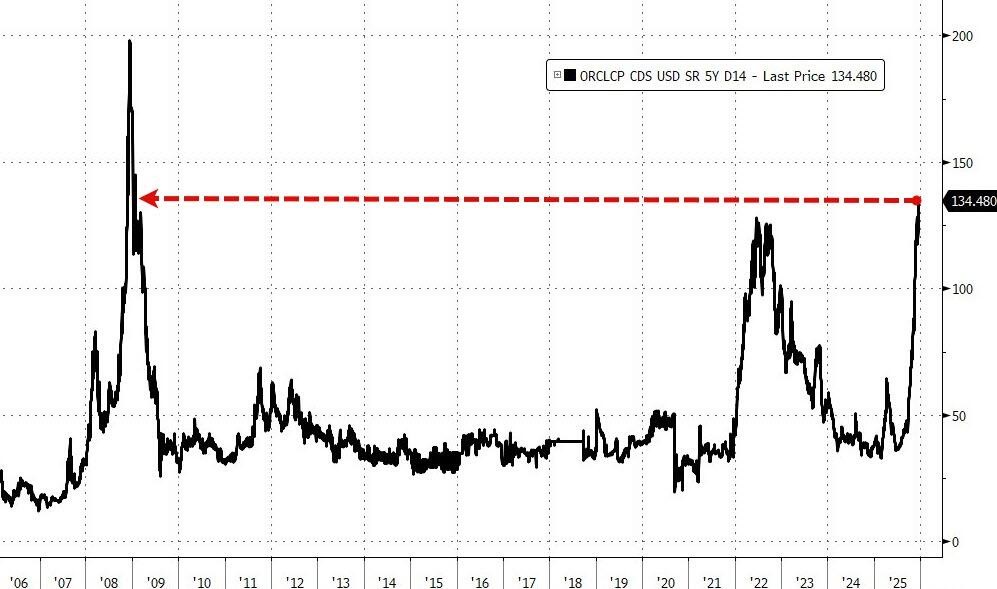
A piece of news triggered a massive sell-off, Oracle bonds were treated as junk bonds, and CDS soared to the highest level since 2009

Oracle is becoming a key indicator for measuring AI risks in the credit market. Compared to other cloud computing giants, Oracle has become the focus of market attention due to its weaker credit rating and expanding debt. Some of the company's bonds have maturity dates extending to 2065, making this timeframe particularly long amid the uncertain AI outlook
On Friday, a report about Oracle Corporation's data center delays triggered severe fluctuations in the AI infrastructure-related stock and bond markets, with the Philadelphia Semiconductor Index experiencing a single-day drop of up to 5%, marking its largest decline in nearly two months. This news, combined with Broadcom's disappointing earnings report earlier, heightened market concerns about the sustainability of AI infrastructure spending.
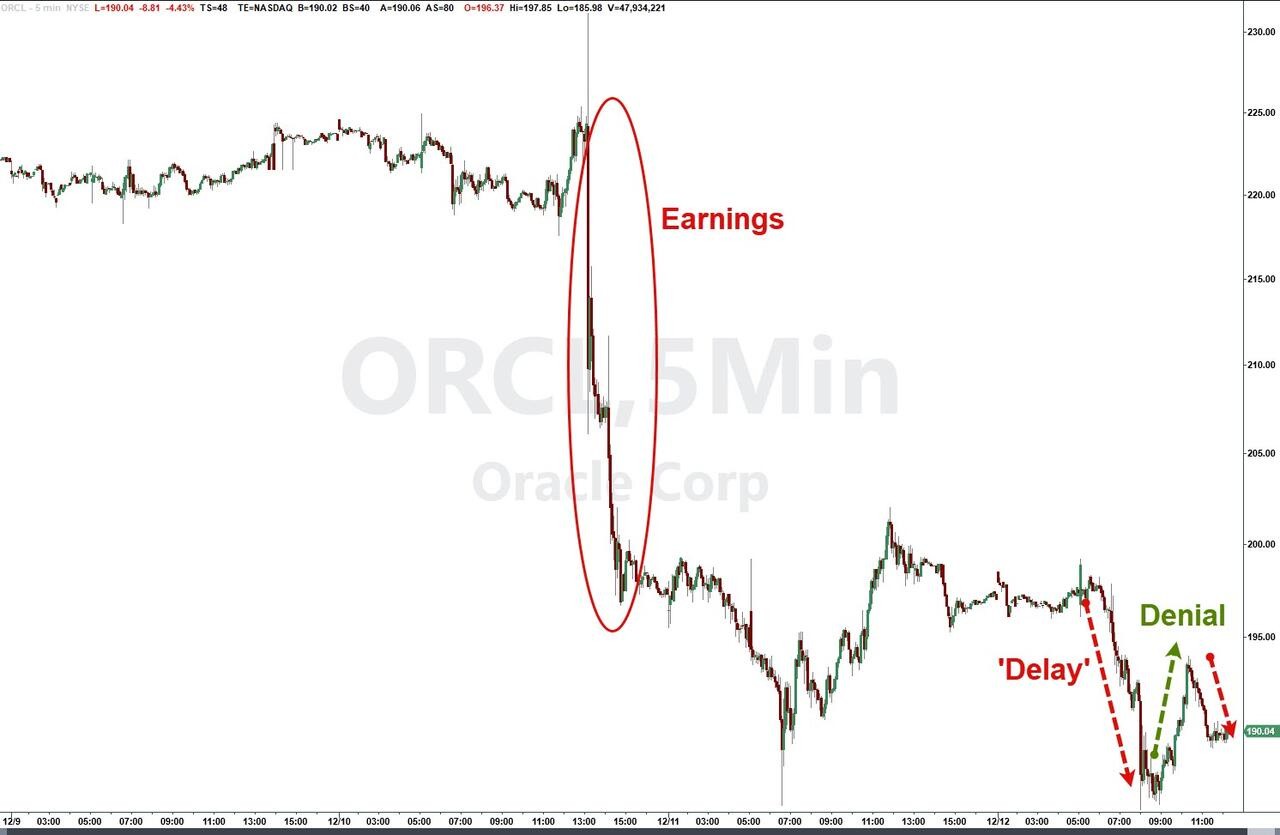
Oracle's stock price plummeted over 6% during the trading session. Although a company spokesperson later denied the rumors of delays, the stock still closed down nearly 4.5%, resulting in a cumulative drop of 14.8% over two trading days following the earnings report.
Market panic spread throughout the entire tech sector. Nvidia, the world's most valuable company and a giant in AI chips, saw its stock price fall over 3%. AI computing service provider CoreWeave dropped 11%, and the sell-off even affected the energy sector, with power-related stocks such as Constellation Energy, Vistra, GE Vernova, and Cummins all declining, with Constellation down 7%.
Oracle's corporate bonds faced even more severe selling, with the yield on its 5.2% coupon bond maturing in 2035 rising to 5.9%, surpassing the average yield of 5.69% for the highest-rated junk bonds.
This turmoil highlights that Oracle has become a barometer for measuring AI risk in the credit market, with its relatively weak credit rating and expanding debt size making it particularly sensitive to market sentiment.
Data Center Delay Rumors Trigger Chain Reaction
Wall Street Insight mentioned earlier that reports emerged during Friday's early trading session indicating that Oracle had postponed the completion date for some data centers being developed for OpenAI from 2027 to 2028. This news led to a widespread decline in AI infrastructure-related stocks.
The 30 chip-related stocks covered by the Philadelphia Semiconductor Index saw a drop of up to 5% on Friday. Besides Broadcom's decline of up to 12%, companies like Astera Labs and Coherent Corp. also saw declines exceeding 10%.
An Oracle spokesperson responded in a statement that the company remains confident in fulfilling its obligations and future expansion plans. The spokesperson stated, "All addresses required to fulfill contractual obligations (for the data centers) have not experienced delays and are expected to meet all milestones as planned," adding that "site selection and delivery timelines are determined in close coordination with OpenAI."
Broadcom's earnings call on Thursday had already disappointed some investors, as CEO Hock Tan revealed that the backlog of AI business orders did not meet market's high expectations and did not provide a complete AI revenue guidance for the current fiscal year, laying the groundwork for this sell-off. The negative news from these two AI star companies compounded concerns about the sustainability of infrastructure spending supporting AI computing
Investment-Grade Bonds Face Junk Bond Treatment
Oracle's investment-grade bonds were severely impacted on Friday, with media commentary suggesting their trading performance resembled that of junk bonds.
Trace data shows that on Friday, the spread on Oracle's 5.2% coupon bond maturing in 2035 widened by 0.17 percentage points to 1.71 percentage points. When issued, the spread on these bonds compared to U.S. Treasuries was only 1.05 percentage points. The yield on Oracle's bond has reached 5.9%, surpassing the average yield of 5.69% for the highest-rated junk bond basket with a shorter duration.
According to media analysis, investors who purchased Oracle's $18 billion investment-grade bonds issued in September are currently facing a total paper loss of approximately $1.35 billion. The issuance of these bonds coincided with the company's increased spending on AI projects.
The surge in credit default swap (CDS) spreads further reflects the level of market panic. The CDS, which measures the cost of protecting against Oracle's debt default over the next five years, rose by as much as 14.4 basis points to 151.3 basis points on Friday, marking the highest level since the 2009 global financial crisis for the second consecutive trading day.
AI Investment Risks Concentrated Exposure
Oracle is becoming a key indicator for the credit market's assessment of AI risks. As a core participant in the "Stargate" project, which aims to invest $500 billion in building AI infrastructure, Oracle has been aggressively borrowing in the public and private debt markets to finance AI projects this year.
Compared to other cloud computing giants, Oracle has become a focal point for market attention due to its weaker credit rating and expanding debt levels. Some of the company's bonds have maturity dates extending to 2065, making this timeline particularly lengthy amid uncertain AI prospects.
Mike Contopoulos, Deputy Chief Investment Officer at Richard Bernstein Advisors, stated, "No one knows what the future holds for these data centers."
He pointed out that more efficient chips could lead to millions of square feet of vacant data center infrastructure, "Funding such technology investments is what credit investors should be concerned about. Funding speculative activities in one of the tightest markets in history is not the secret to success."
It is reported that banks involved in Oracle's construction loans have been purchasing credit default swaps on the company's debt to hedge their exposure. Investors and hedge funds are also increasing their hedging efforts.
Oracle's two co-CEOs, Clay Magouyrk, stated on Wednesday that the company is committed to maintaining its investment-grade debt rating and added that the company's borrowing may be lower than analysts' expectations.
After two days of sharp declines, Oracle's stock price has still seen a cumulative increase of over 10% this year, while the Philadelphia Semiconductor Index has risen over 40% this year, outperforming the S&P 500 Index, which has risen over 10% this year. Nevertheless, Friday's sell-off indicates that market confidence in the returns on AI infrastructure investments is being tested
