


The stock market "long-term buyers" are taking shape
The channel for Chinese insurance funds to increase their allocation to A-shares is being systematically opened up. With the continuous growth of life insurance premiums, it is gradually becoming a stable "supply line" of long-term capital for the A-share market
In this year's intensive disclosure of financial data, the most easily overlooked yet most noteworthy aspect is the "surging tide" of life insurance premiums.
On the surface, it belongs to a business indicator of the insurance industry, but the deeper turning point is: with the reallocation of household assets, the approaching wave of maturing fixed deposits, and the migration of investment preferences in a low-interest-rate environment.
Several forces are working together to expand a "long-term capital pool."
As the core income of life insurance companies continues to rise, the A-share market is welcoming a proactively assembled "long-term buyer."
"Life Insurance Leader" Reports Good News
According to an announcement disclosed by China Life on the evening of December 9, the market has seen this "life insurance leader" "report" that total premiums have crossed an important threshold at the year-end node.
According to the announcement, as of November 30, 2025, China Life's cumulative original insurance premiums for the year have surpassed RMB 700 billion.
Such announcements specifically addressing the "annual cumulative premium scale breakthrough" are rare in the information disclosure of life insurance companies.
Wall Street Insight and Capital Research found that the last time China Life independently released a premium income announcement was on January 11, 2025, and it was a monthly update.
It is evident that China Life's independent announcement of "reporting numbers" is itself a high-profile "good news."
Life Insurance Premiums "Rise Together"
Extending from China Life's independent disclosure, the premium trend in the life insurance industry this year shows a highly consistent growth rhythm.
Capital Research observed that two other listed insurance companies disclosed premium data in the first ten months, all pointing to a "steady state" of premium growth.
According to previously disclosed data from New China Life, the cumulative original insurance premiums from January to October 2025 reached RMB 181.973 billion, a year-on-year increase of 17%. As a company with strong asset-liability management capabilities and very flexible investment, New China Life's scale and growth rate are already representative.
China Pacific Insurance also disclosed that its life insurance subsidiary achieved cumulative original insurance premiums of RMB 241.322 billion in the first ten months of 2025, a year-on-year increase of 9.9%.
According to statistics from third-party platforms, the turning point for life insurance premiums has gradually emerged over the past two years. (As shown in the figure below)
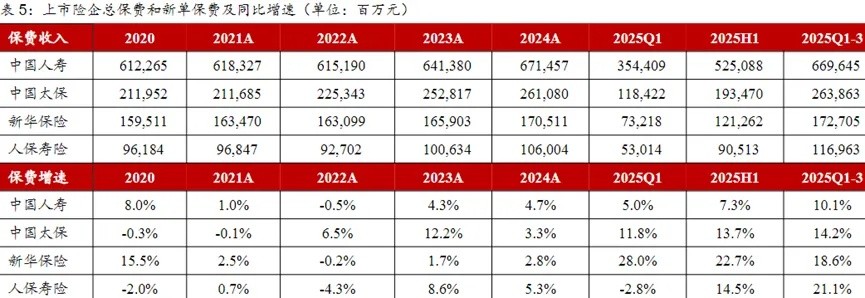
Since 2023, the premium growth rate of four listed insurance companies (China Life, China Pacific Insurance, New China Life, and Pacific Insurance) has overall turned positive, and a clearer upward trend is forming in 2024.
Entering 2025, the premium growth rate further increases, and the industry shows clear signs of emerging from the pressure cycle that has persisted for several years.
Trillion Yuan Premium Increment
Life insurance premiums have always been regarded as the most typical long-term funding source for insurance institutions, including participating insurance, annuity insurance, and increasing amount whole life insurance, characterized by long funding terms and stable cash flow.
Since the beginning of this year, listed insurance companies have seen a simultaneous rise in life insurance premiums, but more crucially: the sources of incremental life insurance premiums for the next 1 to 2 years are becoming clearer According to the latest research report from Western Securities, approximately 113.06 trillion yuan in time deposits will mature over the next 12 months. A significant portion of this comes from high-interest deposits made 2 to 3 years ago. With current time deposit rates remaining low, these deposits are more likely to seek new asset directions upon maturity.
This sell-side institution conservatively estimates: Assuming 2% flows back into life insurance products in the future, it means the industry could see an increase in new premium scale exceeding one trillion yuan.
The views in the aforementioned research report can be "translated" into the following layman's explanation:
Many Chinese households will find that the interest rates on their maturing time deposits are considerably lower than before, and the money they have on hand needs to find a new place to go. Life insurance products that combine savings and protection functions naturally enter their list of options.
Dividend Insurance Becomes the "Main Attraction for Capital"
The presence of dividend insurance in the industry is continuously rising, with more institutions viewing it as an important source of future life insurance premium growth.
Huatai Securities predicts: By 2026, the insurance industry may fully shift towards dividend insurance in a low-interest-rate environment. Compared to traditional insurance, the interests of customers in dividend insurance are relatively aligned with those of insurance companies, making it more suitable for a low-interest-rate environment.
From a policy perspective, this direction is also being reinforced.
In 2025, the National Financial Regulatory Administration issued the "Guiding Opinions on Promoting the High-Quality Development of Health Insurance," clearly supporting well-rated insurance companies in developing dividend-type long-term health insurance business.
It is evident that the regulatory attitude makes the future growth path of dividend insurance clearer.
Dividend insurance is a type of life insurance product that combines protection and investment attributes. Policyholders receive basic risk protection while also participating in sharing a portion of the insurance company's operating profits. Common forms include dividend annuity insurance, dividend critical illness insurance, and dividend whole life insurance.
Huatai Securities' report also points out two points:
First, for insurance companies, the predetermined interest rate of dividend insurance or rigid costs is relatively low, which helps alleviate the pressure of interest rate spreads. (Simply put, insurance companies do not need to promise a very high fixed return in advance, reducing funding pressure.)
Second, for customers, they can enjoy potential returns from equity investments or future interest rate increases, which is beneficial in the long term to resist inflation's erosion of insurance benefits. (Simply put, customers can share a portion of the profits earned from investments in the future, making returns more flexible.)
30% of New Premiums Invested in A-shares Annually
The impact of new premiums each year depends on where they are directed.
With the intensive implementation of regulatory policies, the allocation direction of insurance funds is being further clarified.
In January 2025, regulatory authorities issued the "Implementation Plan for Promoting the Entry of Medium and Long-term Funds into the Market," focusing on the bottlenecks and blockages in the entry of medium and long-term funds such as public funds, commercial insurance, social security funds, and pension funds.
Previously, senior officials also stated that they strive for large state-owned insurance companies to invest 30% of their new premiums in A-shares each year starting in 2025.
In December 2025, the National Financial Regulatory Administration released the "Notice on Adjusting Risk Factors Related to Insurance Companies' Businesses." The document specifies that the risk factor for the CSI 300 Index constituent stocks and the CSI Dividend Low Volatility 100 Index constituent stocks held by insurance companies for more than 3 years has been adjusted down from 0.3 to 0.27; the risk factor for ordinary shares listed on the STAR Market held for more than 2 years has been adjusted down from 0.4 to 0.36.
For insurance companies, a lower risk factor means that the invisible cost of a stock investment in internal assessments decreases, thereby expanding potential investment space.
The "actual flow" of insurance funds is also changing.
It can be seen that the channel for insurance funds to increase their allocation to A-shares is being systematically opened up. With the continuous growth of life insurance premiums, it is gradually becoming a stable "supply line" of long-term funds for the A-share market
