From AI trading, the new chair of the Federal Reserve to copper, these are the "five most important trading themes for 2026" listed by Goldman Sachs

Goldman Sachs believes that the change of the Federal Reserve Chairman in 2026 will lead to a significant depreciation of the US dollar; the AI market is at the "end of the prologue," with increasing differentiation among AI beneficiaries, emphasizing that now is the best time for structural long-term investment "innovation"; Goldman Sachs highlights the importance of diversified allocation, with copper assets being attractive, predicting that by 2030, global power grids and electricity infrastructure will drive over 60% of copper demand growth, equivalent to adding another US demand level
Goldman Sachs shares five key investment themes for 2026, covering the turning point of the artificial intelligence investment cycle, the impact of the Federal Reserve leadership change on the dollar, the strategic revaluation of commodities, the necessity of portfolio diversification, and the structural transformation of the European market.
As U.S. stock indices return to high levels this week and the market digests the major risks of this year, Goldman Sachs' top trader Mark Wilson has proposed five key investment themes for 2026.
Goldman Sachs believes that the change in the Federal Reserve chair next year will be seen as a potential key turning point. The market generally expects Hassett to take over, which may lead the Federal Reserve to allow the economy to "run hot," with inflation considerations giving way to nominal growth, potentially resulting in a continued weakening of the dollar. Goldman Sachs' foreign exchange team has predicted a significant depreciation of the dollar by 2026.
In terms of artificial intelligence investment, Goldman Sachs believes the market is at the "end of the prologue." The era of believing that the value creation of AI primarily belongs to large language models, and the widespread rise of all AI-related assets, may have come to an end. The differentiation among beneficiaries is intensifying—companies providing computing hardware, data centers, electricity, and other infrastructure, as well as those successfully deploying AI and demonstrating productivity improvements, will remain attractive.
In asset allocation, given that U.S. stock valuations are at the highest relative level to global markets in 25 years, the index is highly concentrated, and the dollar may structurally weaken, Goldman Sachs emphasizes the importance of diversified allocation.
Trading Theme 1: The AI Story is at the "End of the Prologue"
Goldman Sachs compares the current AI investment cycle to a modern version of the "space race."
Wall Street Insight mentions that at the end of November, U.S. President Trump officially signed the "Genesis Plan," gathering U.S. resources to promote AI research. The firm believes that those companies investing the most to "win" this race may face highly uncertain investment returns for a considerable time.
In contrast, companies supporting AI development, including computing hardware, data centers, electricity suppliers, infrastructure builders, and those successfully deploying AI in their businesses and demonstrating productivity improvements, remain attractive.
Wilson believes we are currently at the "end of the beginning" of the AI story in the market—the bullish sentiment that most of the value created by AI will belong to large language models, and the widespread optimism for all assets "related to AI concepts," is likely coming to an end. The market's identification of true beneficiaries will become more stringent.
Wilson believes that the current funding in the AI industry will inevitably lead to unexpected scientific and technological breakthroughs, such as topics like space data centers, which not long ago seemed like science fiction. Wilson emphasizes that now is the best time for structural long-term investment in "innovation."
Trading Theme 2: The Appointment of the Federal Reserve Chair May Become a Turning Point for a Weaker Dollar
Goldman Sachs pointed out that over the past 12 months, the policy intentions and actions of the new U.S. government have often sent clear signals. Therefore, the market widely expects that Hassett is likely to be appointed as the next chairman of the Federal Reserve.
If this situation occurs, the Federal Reserve may allow economic activity to "run hot," with inflation becoming a secondary consideration in nominal growth, and the dollar may experience sustained weakness.
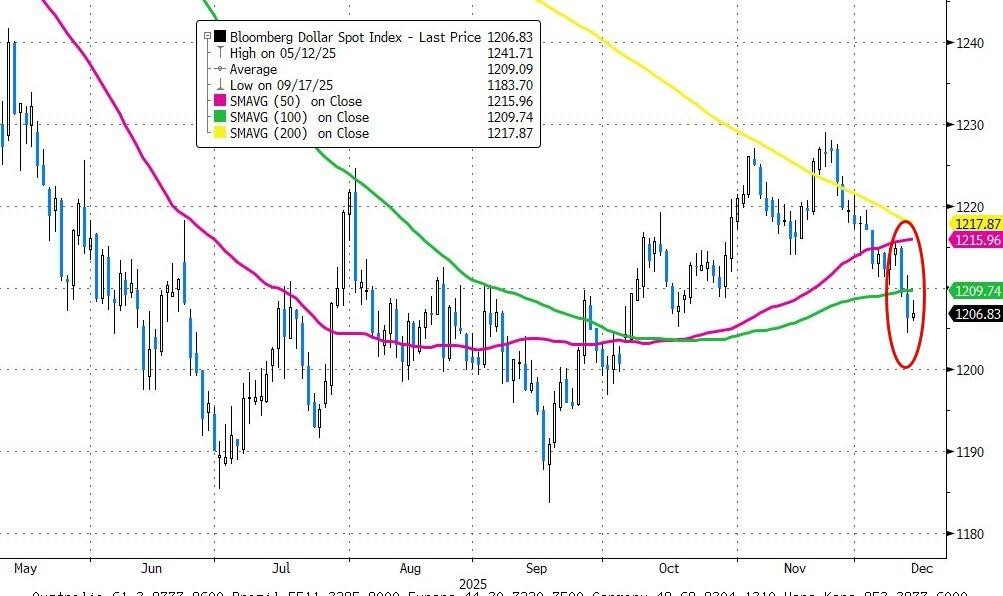
Goldman Sachs' foreign exchange team predicts that the dollar will depreciate significantly by 2026. In fact, the dollar index has already shown signs of weakness, declining for three consecutive weeks, and has fallen below the 50-day and 200-day moving averages since December, approaching a three-month low.

Mark Wilson mentioned that during his recent visits to Geneva and Zurich, every client conversation revolved around the challenges of managing the appreciation of the Swiss franc.
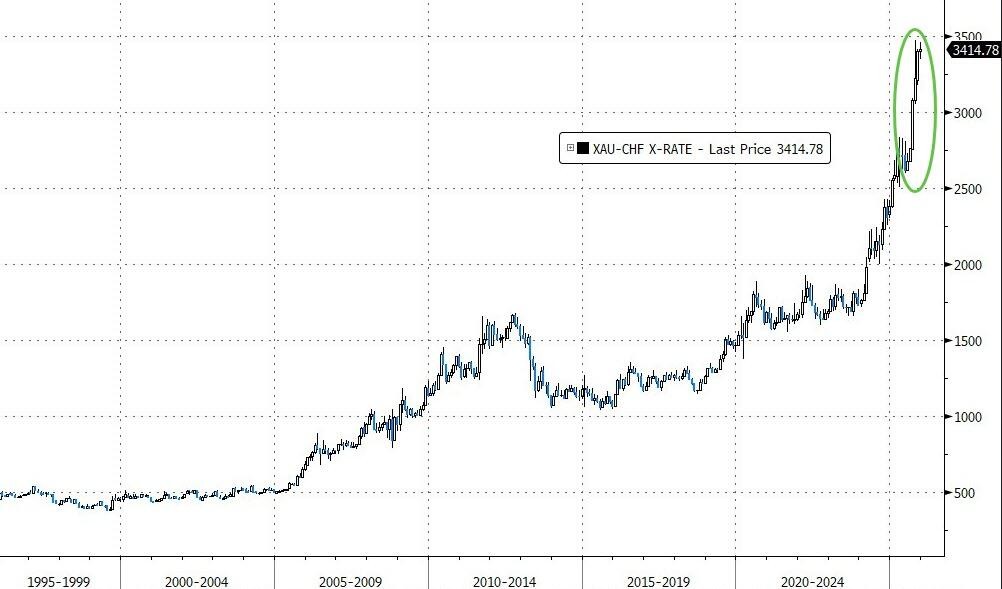
However, even the world's strongest currency has seen a degradation in purchasing power at the gold level. The chart of gold prices denominated in Swiss francs shows that over the past 20 years, this "hardest" legal tender has lost more than 80% of its purchasing power.
(Over the past 20 years, gold prices denominated in Swiss francs have cumulatively increased by over 80%)
The weakness of the dollar is a major feature of the first half of 2025. During this period, the Federal Reserve has stubbornly maintained its interest rates, while other central banks have cut rates to alleviate tariff concerns.
Wilson predicts that the Federal Reserve will cut rates three times in the next six months and will cut rates twice more in the first half of 2026. He hinted that as the interest rate differential narrows in the next six months, the currently high dollar exchange rate may decline, which could be beneficial for the stock market.
Trading Theme Three: Is Copper the New Gold?
Mark Wilson pointed out that the performance of precious metals this year is sufficient to prove the necessity of investing in "hard assets."
In an environment of a weakening dollar, with supply and demand clearly tightening, the investment logic for specific commodity exposures, especially copper, becomes more attractive.
Analysts believe that the recent breakthrough of copper prices to historical highs is not coincidental, but an inevitable result driven by fundamentals. According to Goldman Sachs' forecast, by 2030, the demand growth for copper driven by the power grid and electricity infrastructure will account for over 60% of the increase, equivalent to adding another U.S. demand to global demand.
Although the complexity on the supply side poses a challenge to the valuation of copper companies, it also provides key support for copper prices.
Goldman Sachs believes that the market is currently sluggish in responding to the strategic value of copper, the premium required for supply security, and the scale of new demand drivers. With ongoing merger and acquisition activities, related valuations have not been re-rated, and this situation is unlikely to persist into next year, making copper assets extremely attractive.
Trading Theme Four: Diversification is a Must
Given that the valuation of the U.S. stock market is at a 25-year high compared to other regions of the world, and the concentration of indices is extremely high, maintaining a sustained outperformance has become increasingly difficult.
Mark Wilson points out that considering the possibility of a structural weakening of the dollar and the high valuation of U.S. stocks, "diversification" has become the "price" that investors must pay to stay in the market and maintain an overweight in stocks.
Wilson notes that this strategy has been validated through practical experience by 2025. The return rates of markets outside the U.S. have performed strongly, with returns in the UK and France even surpassing those of the Nasdaq when measured in U.S. dollars.
Capital flow data shows that funds from Eurozone investors have once again turned to flowing out of U.S. stocks, and the share of emerging market assets in global assets is rebounding from decades-low levels.
Trading Theme Five: Global Turning Point and Opportunities in European Markets
The World Economic Forum has referred to 2025 as the "global turning point" year.
Goldman Sachs points out that if the "Genesis Plan" establishes a new strategic framework for U.S. industries, then the latest "National Security Strategy" is the geopolitical blueprint of the Trump administration. Its strategic focus shifts from tactical to long-term strategy, which has guiding significance for global asset allocation.
Within this framework, the European market, though controversial, is worth paying attention to.
Although JPMorgan CEO Jamie Dimon’s comments about "anti-business issues" in Europe hit the nail on the head, Goldman Sachs believes that external shocks (such as tariffs, competition, and energy crises) are the "compelling mechanisms" driving Europe to undergo substantial changes.
Goldman Sachs' report cites page 26 of the U.S. "National Security Strategy" report:
From manufacturing to technology to energy, various industries in Europe remain the strongest globally. Europe has cutting-edge research and world-leading cultural institutions.
Mark Wilson emphasizes that the European stock market is not a barometer of the domestic political outlook in Europe; its leading companies and private sector remain strong. As Europe begins to confront the issue of underinvestment and attempts to address punitive regulations, combined with valuation factors, European assets occupy an important position in diversified allocations.