The DC Energy Bill Investors Are Watching Next

Talkmarkets
2025.12.13 19:00
portai
I'm PortAI, I can summarize articles.

The U.S. House of Representatives passed the Electric Supply Chain Act, a bipartisan bill requiring the Department of Energy to analyze supply chain risks affecting power generation. The bill aims to strengthen the electric grid's reliability and support AI data centers. It now moves to the Senate, with potential implications for energy prices and infrastructure. The bill has garnered support from key energy players and could influence the 2026 midterm elections.

Image Source: Unsplash


This month, global headlines buzzed from tensions around Venezuela to a peace deal in Ukraine – and what it could all mean for supply chains and energy prices.

Amongst the barrage of information, it may have been easy to miss a rare and stealthy bipartisan bill that passed this week in the U.S. House of Representatives. Yet, from Wall Street to Main Street, the “hidden” in plain sight House bill could have critical infrastructure implications over the near and long-term.

The Electric Supply Chain Act, legislation introduced by Congressman Bob Latta (OH-5), passed by a vote of 267-159 – meaning that more than 50 Democrats offered a yes for energy. Among the House Democratic votes, representatives stretching from California to Virginia cast an “aye” at a time when party lines are often firmly divided. Why? Because, in many ways, electricity prices and the future of Artificial Intelligence will be on the ballot during the midterm elections in 2026.

Nationally, electricity prices are up just over 10% but in some locations near data centers, wholesale electricity costs are up as much as 267% compared to five years ago. Consumers and businesses feel this every day. The reality is that those rising costs are being passed on to customers and large load customers across the private sector.


Why the Electric Supply Chain Act Matters

The landmark bill from the House would require the U.S. Department of Energy to analyze and transparently report on supply chain risks and trends affecting power generation and transmission.

As Rep. Bob Latta, Chairman of the House Energy and Commerce Subcommittee on Energy, put it, “The Electric Supply Chain Act will strengthen the reliability of our electric grid, expand domestic energy production, and ensure we can power the artificial intelligence data centers of the future.”

Leaders in the private sector have also taken notice.

The National Electrical Manufacturers Association (NEMA) – which includes key energy players like Schneider Electric, Siemens, Eaton, ABB, GE Grid Solutions, and Tesla – not only support the bill, but they have put out a statement saying that the legislation would help “provide the energy sector with greater clarity around their current and future capacity, opportunities for growth, and challenges related to maintaining a secure and resilient supply chain.”

When companies like Siemens and Tesla speak collectively, markets and policymakers listen.

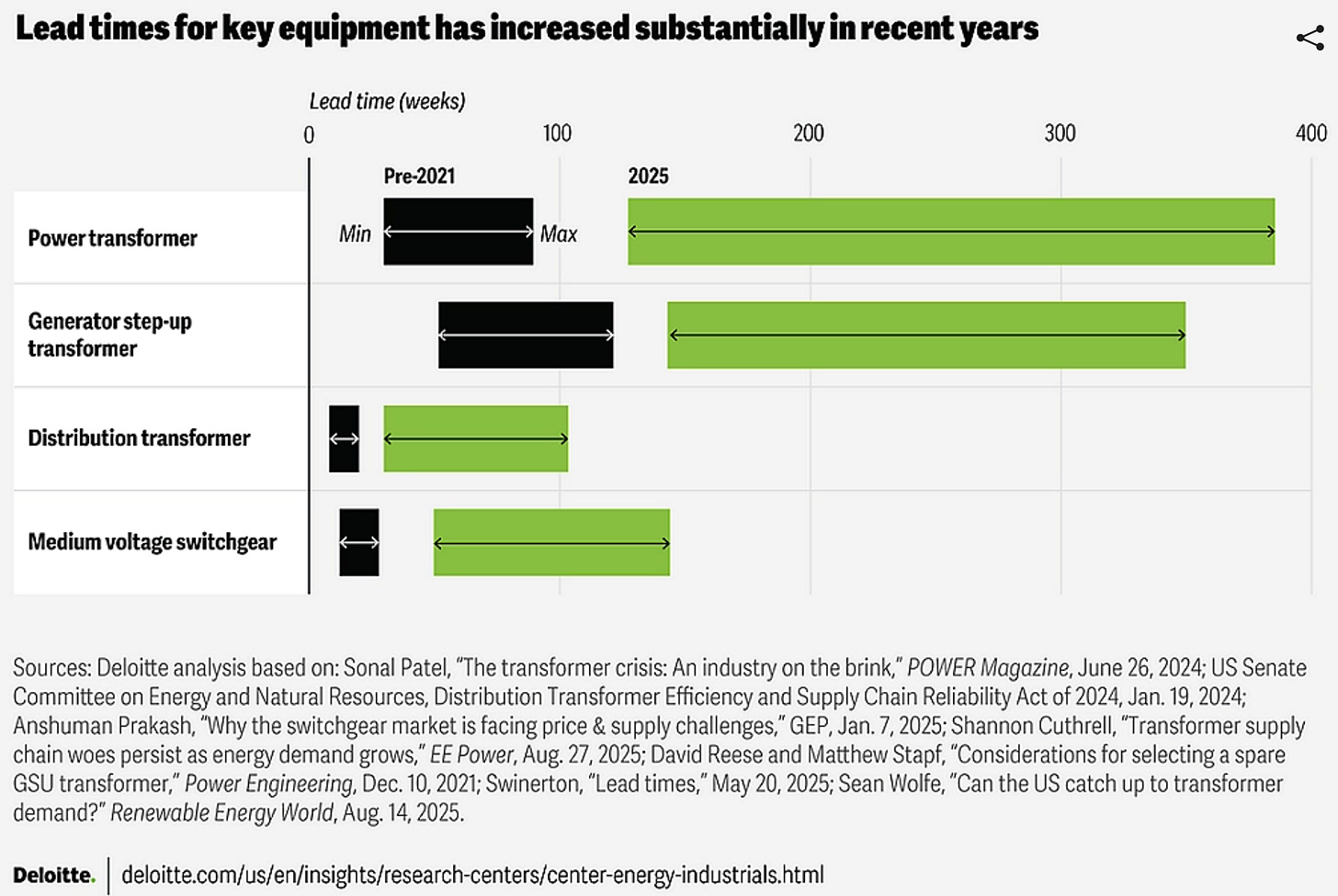
From my conversations on the Hill and with those connected to policymakers around the DC beltway, what you often hear is that supply chain issues remain a constant business planning issue. That’s because nearly any energy-related project has to contend with long timelines to acquire transformers, and they continuously face growing backlogs of natural gas turbines.

(Click on image to enlarge)

Image Source: Deloitte


This also matters to leaders in the tech and AI space because they are the large energy load drivers, with increasing demands driven by vast data centers.

Stretching back for more than a year now, we’ve detailed how data centers and energy demands are not only growing, but they’re big business. In our October 2024 Prinsights Pulse Premium monthly issue, we shared how reports indicate that data centers could consume up to 9% of U.S. electricity per year by 2030. That’s like plugging an extra 11 million homes into the power grid.


What’s Next for the Energy Legislation

Now, the bill heads to the U.S. Senate at a time when the backdrop of U.S. midterm elections looms large and energy demands are surging.

So, will it survive? The signal that more than four dozen House Democrats were able to cross party lines offers a reason to be cautiously optimistic that the bill has a strong chance of passing in the Senate.

To note: Also waiting in the wings that passed in the House (among a more GOP part line) is the State Planning for Reliability and Affordability Act, which would require “the establishment of measures regarding the reliable availability of electricity.” The bill also faces a much steeper uphill battle in the U.S. Senate, but it could also be one to watch as we head into 2026. Though, notably, the bill would be a massive win for energy generation sources like natural gas and nuclear.

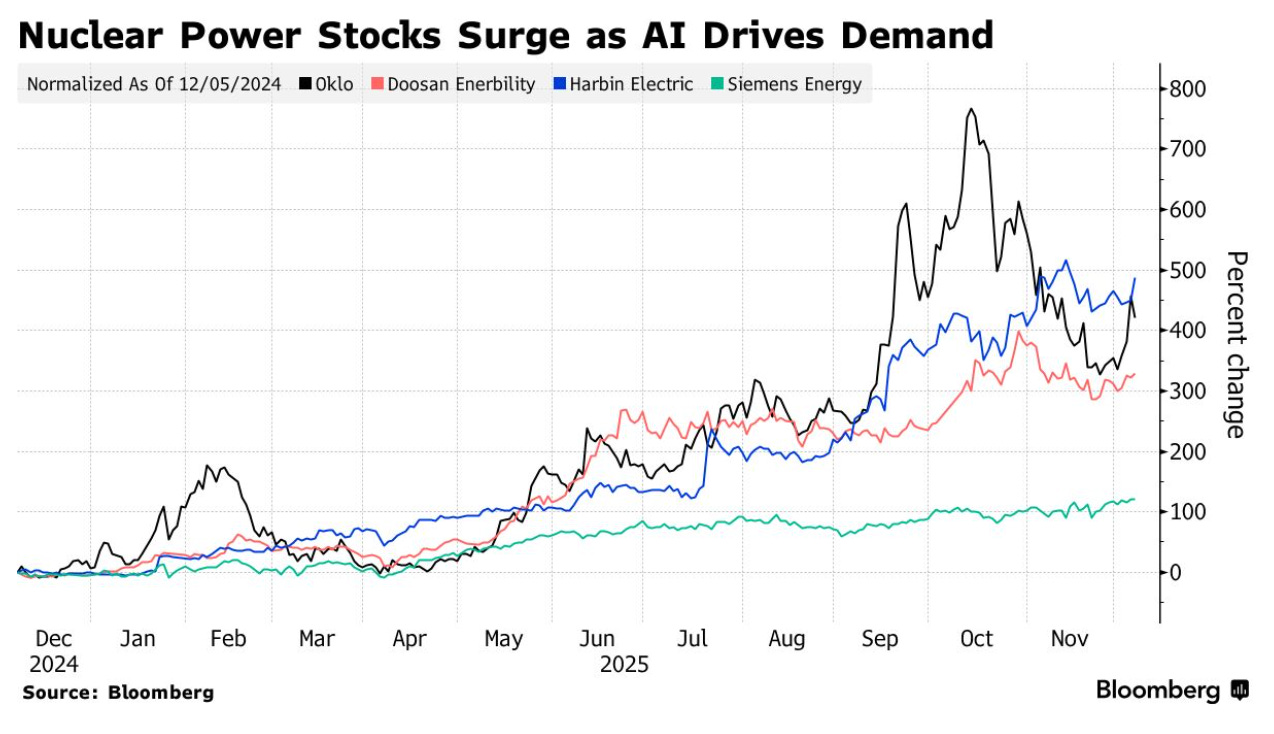
For strategic investors and utility households alike, energy legislation means an opportunity for companies to step up and have a more predictable, reliable, and resilient energy future. Already, Wall Street has been looking to nuclear energy plays for sizable returns.

(Click on image to enlarge)

Image Source: Bloomberg


As we round out 2025 and explore what’s next for 2026, the companies that are able to harness both energy transmission and generation in ways that support data-driven decisions will be in a prime position. Being able to fine-tune measurements of energy loads and forecasts can help boost investor confidence while also driving potential innovations, increasing the potential for returns in the energy sector.

Staying tuned to energy-related bills like the Electric Supply Chain Act can be a very clear signal and opportunity for strategic investors looking for an advantage amongst all the AI headline noise.

It is also why our next Prinsights Pulse Premium issue this month will focus on an energy leader that sits at the cornerstone of energy reliability and is making the strategic investments that have many expecting a sizable upside. We can’t wait to share our latest research and the key actionable recommendation with you.


More By This Author:

The Gold Supply Crisis Nobody’s Talking About
The New Monetary Map: Gold Is The Anchor
The Material Reality: Why Hard Assets Win, Regardless Of AI Hype