The advertising company "Xianyu Fanshen" has become an AI revenue stock? "AI disrupts the industry, but it does not eliminate intermediaries."

After a stock price crash due to AI threats, the advertising industry is being re-evaluated by the market. Some analysts believe that the disruption brought by AI will not lead to the "disintermediation" of agencies; instead, it will highlight their strategic value due to the increasingly complex media environment. The advantages of agencies in cross-channel budget optimization and consumer data insights are difficult to be replaced by technology platforms
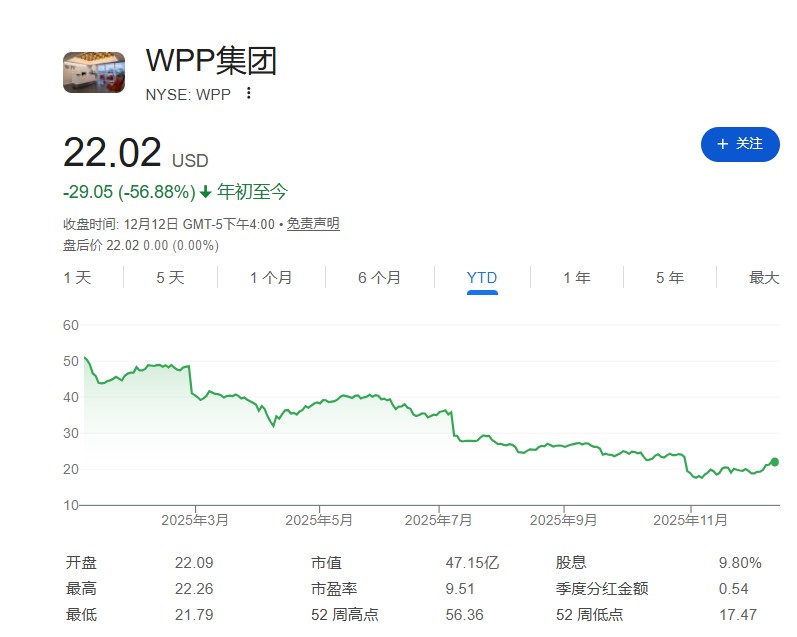
Since the beginning of this year, the advertising industry has suffered a heavy blow in the capital market. The stock price of British advertising giant WPP has fallen by 57% this year, and its competitors Publicis and Omnicom have not been spared either. The main concern in the market is that the proliferation of AI tools will enable brands to bypass agencies and handle advertising creativity and placement on their own.
However, some analysts are presenting the opposite argument. They believe that as media platforms become increasingly fragmented and complex, large brands will rely more than ever on the professional navigation capabilities of agencies. Morningstar analyst Mark Giarelli succinctly summarized this: “The industry is being disrupted, but it is not being disintermediated—I think that is key.”
Behind this shift in perspective is a reassessment of the core value of advertising agencies. Despite the industry valuation being under pressure, the analyst recommendation ratings for Publicis and Omnicom are nearing their highest levels in years. This indicates that beyond the panic, some investors are beginning to see that AI brings not only threats but also opportunities for the industry.

AI Shockwave: Tech Giants Entering the Arena and Client Loss
However, for advertising agencies, the threat posed by AI is real and direct. This year, AI models capable of generating images and videos based on text prompts, such as Google's Nano Banana and OpenAI's Sora 2, are gaining momentum. Coca-Cola has aired AI-generated Christmas ads for the second consecutive year, marking a shift from concept to practice in the application of AI in creative generation.
The greater pressure comes from tech giants. Companies like Google and Meta are launching new tools to help brands design advertising campaigns independently, without relying on third-party consulting firms. The core concern is that businesses may use these automated tools to build internal marketing teams, thereby cutting external agency fees. Cybersecurity company Palo Alto Networks announced in September that it had developed a complete set of advertising campaigns entirely in-house, exemplifying this trend.
New Value in Complexity: Why Agencies Remain Indispensable
Despite the impact, bullish analysts on the advertising industry believe that the complexity created by AI is precisely an amplifier of agency value. Bloomberg Industry Research analyst Matthew Bloxham pointed out that AI technology will allow for “almost real-time” creation of personalized digital content for each consumer, making the advertising ecosystem unprecedentedly complex.
“Agencies will play a strategic role,” Bloxham stated, “the higher the complexity, the more you need valuable advice to help you navigate, whether it’s overall marketing strategy or media strategy.”
Morningstar's Giarelli added that tools from Google or Meta cannot help brands effectively allocate advertising budgets across different channels. And this is precisely the core value of agencies—they can help clients avoid redundant investments across different platforms like Instagram Reels and Google Search This capability is based on the vast consumer behavior data they have accumulated since the direct mail advertising era of the 1980s. "Advertising agencies are very good at understanding various characteristics of consumers. They know where we are, what we are thinking, and can tailor marketing messages accordingly," Giarelli said.
Of course, not all companies can weather this transformation unscathed. WPP has downgraded its performance guidance twice this year and has lost a number of well-known clients, even facing the risk of being removed from the FTSE 100 index for the first time in 27 years. Furthermore, any AI-driven market rebound could pose risks to the sector, as the stocks of these companies are often categorized by brokers into thematic baskets affected by technological disruption