


Morgan Stanley's Heavyweight Robotics Yearbook (Part One): AI Moves Towards Physicalization, Robots Welcome a Cambrian Explosion, China's Leading Advantage is Obvious

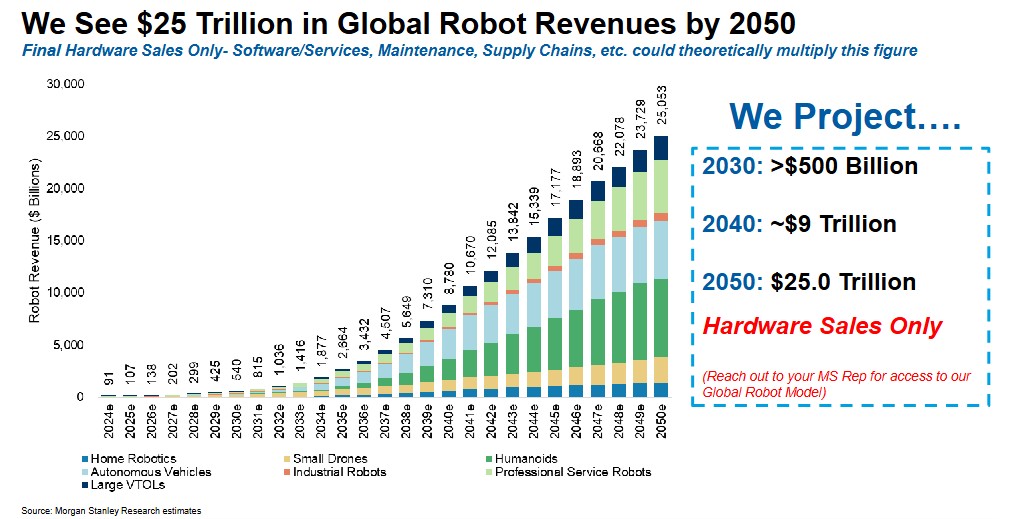
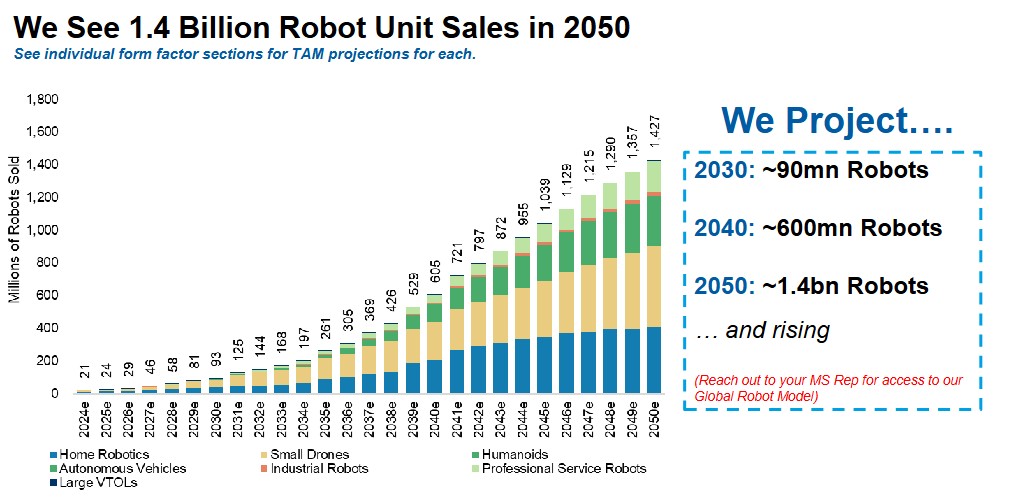
Morgan Stanley predicts that by 2050, global robot hardware sales will surge from approximately USD 100 billion in 2025 to USD 25 trillion, with sales volume increasing from 24 million units to 1.4 billion units. China shows a clear leading advantage, particularly in terms of policy, control of key materials, and manufacturing capabilities. It is expected that by 2050, China will account for about 26% of global robot sales
Artificial intelligence is undergoing a fundamental shift—from the digital world to the physical world. According to the latest global robotics model from Morgan Stanley, this transition will give rise to a global robotics hardware market worth up to $25 trillion. As AI technology expands from processing "bits and bytes" in the knowledge economy to manipulating "atoms and photons" in the physical economy, a "Cambrian explosion" in the robotics field is on the horizon.
According to news from the Chasing Wind Trading Desk, Morgan Stanley's global embodied AI team predicts in the latest "Robotics Yearbook" that under the baseline scenario, global robotics hardware sales will surge from approximately $100 billion in 2025 to $500 billion in 2030, reach $9 trillion by 2040, and climb to $25 trillion by 2050. This forecast only covers hardware sales; if software services, maintenance, and supply chain-related revenues are included, the market size could multiply.
In this transformation, China demonstrates a clear leading advantage, particularly in manufacturing capabilities, control of rare earth materials, and policy support. As Chinese companies accelerate the mass production and application of robots, the global market landscape is undergoing profound changes. Morgan Stanley believes that China's leading position is expected to continue to expand over the next decade.
Five Catalysts for Exponential Growth in the Global Robotics Market
Morgan Stanley predicts through its Global Robotics Model (GROM) that by 2050, 1.4 billion robots will be sold globally, with the total number of operational robots reaching 6.5 billion.
The forms of robots will be highly diversified, including industrial robots, service robots, drones, autonomous vehicles, humanoid robots, and household robots, covering various application scenarios from manufacturing to healthcare, agriculture, transportation, defense, and space exploration.
According to Morgan Stanley's estimates, approximately 90 million robots will be sold globally in 2030, and this number will increase to 600 million by 2040. Among them, small drones and household robots have the most market potential in the near term, while humanoid robots are expected to begin large-scale deployment between 2029 and 2030.
Surge in Demand for Key Components
The explosive growth of the robotics industry will bring tremendous opportunities for upstream component suppliers.
Morgan Stanley estimates that to support the sale of 1.4 billion robots by 2050, it will require: 5.7 billion cameras (a 95-fold increase from 2025), 27 billion motors (a 260-fold increase), 41 billion bearings (a 200-fold increase), 12.5 million ExaFLOPS of edge computing capacity (a 40,000-fold increase), 1.7 million tons of rare earth magnets (a 480-fold increase), and 26 terawatt-hours of battery capacity (a 1,450-fold increase)
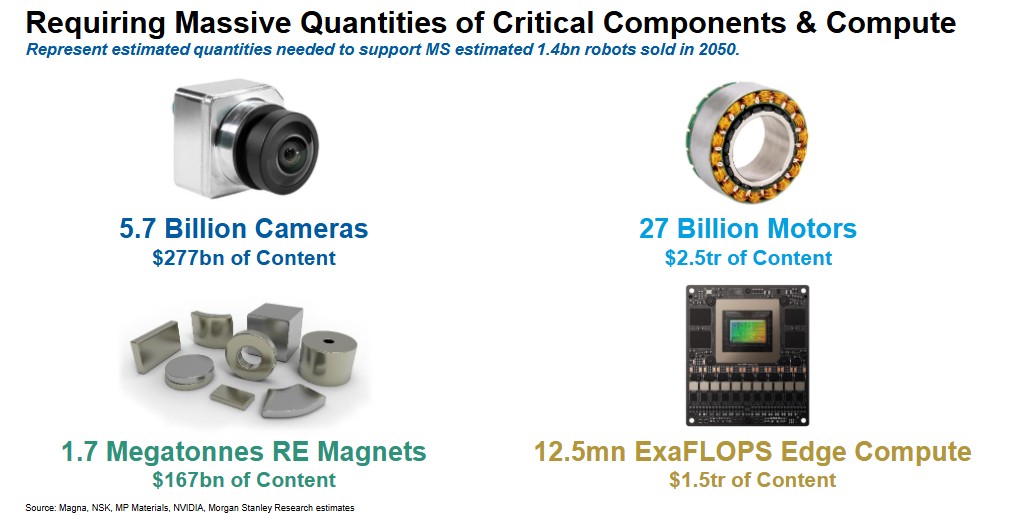
This surge in demand will bring significant opportunities to suppliers of motors, bearings, rare earths, cameras, sensors, AI chips, batteries, and more.
Morgan Stanley believes that small drones and low-altitude robotic systems (LARS) are the investment areas with the greatest opportunities in the near term. This is primarily based on three factors: the relative ease of navigation in three-dimensional space, the increased government priorities stemming from the lessons of the Russia-Ukraine conflict, and the gradual maturation of regulatory frameworks.
China's Manufacturing Advantage Highlights Dominance in Robot "Bodies"
Morgan Stanley's report specifically points out that in the competition for embodied intelligence, data collection and manufacturing capabilities are inseparable. To produce excellent robots, a large number of "imperfect" robots must first be manufactured for data collection and model training. Prototyping is relatively easy, but scaling up production is the real challenge.
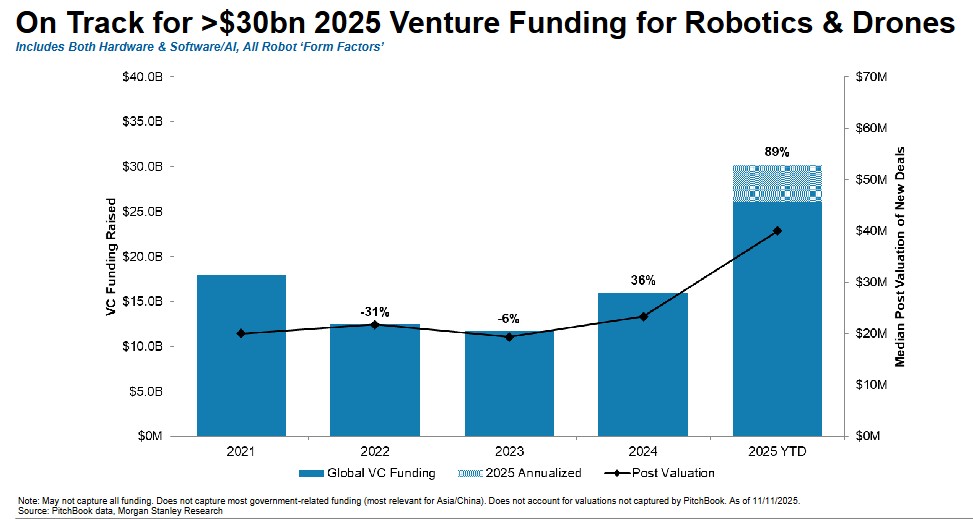
In this regard, China shows a clear advantage. According to Morgan Stanley's statistics, venture capital in the robotics and drone sectors is expected to exceed $30 billion by 2025, with total financing for AI-related companies reaching $260 billion, where Chinese companies hold an important position. Among the list of humanoid robot developers, there are many Chinese companies, including UBTECH ROBOTICS, XPeng Robotics, and Leju Robotics.
From a segmented market perspective, China has achieved mass production and scaled applications in industrial robots, service robots, drones, autonomous driving, and medical robots. Morgan Stanley expects that in the next decade, China's robot sales and industry scale will continue to be higher than those of major economies such as the US and Europe. Control over supply chain segments such as rare earths, key components, and computing power also provides Chinese companies with long-term competitive barriers.
Morgan Stanley predicts that by 2050, China will account for approximately 26% of global robot sales, with an even higher share in the fields of industrial robots and drones.
In fact, as early as February of this year, Morgan Stanley systematically sorted out 100 core listed companies in the global humanoid robot industry chain from the three core links of "brain," "body," and "integrator," and pointed out that China occupies 63% of the humanoid robot supply chain, holding a dominant position, especially with significant advantages in the "body" segment.
Morgan Stanley believes that manufacturing capability will become the core competitiveness in the era of embodied intelligence, contrasting sharply with the previous digital AI era that focused on software and algorithms. Data, software, manufacturing, and hardware form a recursive cycle, mutually defining and promoting each other
