Platinum rare limit up, palladium surge, what happened? How long can it last?

The prices of platinum and palladium have surged, mainly influenced by expectations of macro liquidity easing, tight spot supply, and resilient demand. The weakening of the US dollar and rising expectations of interest rate cuts by the Federal Reserve have lowered US Treasury yields and the holding costs of precious metals. Issues such as power shortages in South African mining areas have exacerbated supply-demand imbalances, driving prices up
The expectation of macro liquidity easing, combined with supply-demand imbalances and other factors, has ignited a long-dormant market for platinum group metals.
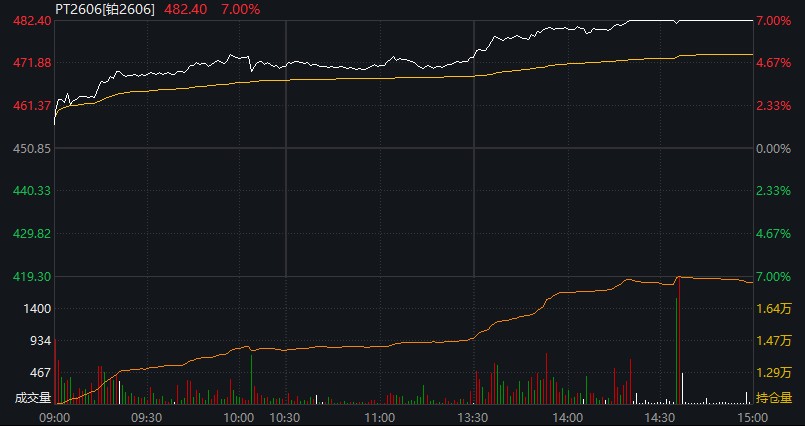
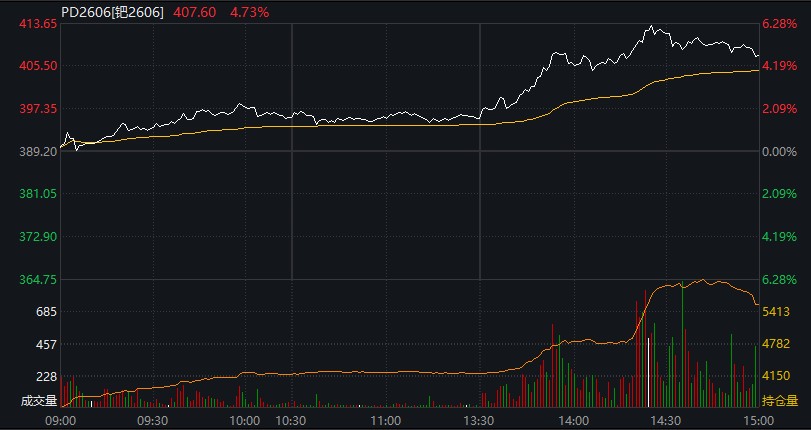
On Monday (December 15), the main contract for platinum futures on the Guangzhou Futures Exchange hit a 7% limit-up during trading, closing at 482.4 yuan/gram, marking the first limit-up record since its listing; the main contract for palladium also strengthened, closing up 4.73% at 407.6 yuan/gram.

(Guangzhou Futures Exchange platinum main futures intraday chart)

(Guangzhou Futures Exchange palladium main futures intraday chart)
At the same time, trading sentiment significantly warmed up, with the trading volume of the platinum main contract surging 237% month-on-month to 41,832 lots, and open interest increasing by 60%; the trading volume of palladium skyrocketed by 498% month-on-month.
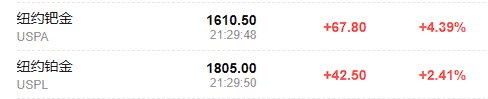
In the international market, New York platinum futures rose over 2%, closing at $1,805 per ounce, while New York palladium futures increased by 4% to $1,610.50 per ounce.

Analysts point out that this rare market movement is driven by multiple factors, including expectations of macro easing, tight spot supply, resilient demand, and the resonance of the precious metals sector.
On the macro level, the weakening of the dollar and the rising expectations of interest rate cuts by the Federal Reserve—especially the market's bets on Kevin Warsh potentially being nominated as Fed Chair—have lowered U.S. Treasury yields and the holding costs of precious metals.
On the micro level, tightening liquidity in the spot market has become a direct trigger, with the one-month leasing rate for platinum soaring to about 14.12%. This unusually high level is interpreted by the market as a sign of tight deliverable resources, further amplifying bullish sentiment in the futures market. This technical indicator typically signals an imbalance in supply and demand in the physical market.
It is worth noting that institutions generally believe that the current rise in platinum and palladium has solid fundamental support. The supply side, concentrated in South African mines, continues to face structural issues such as power shortages and aging infrastructure, while the demand side benefits from increased usage of traditional automotive catalysts and the emerging growth point of the hydrogen energy industry. The mid-term supply-demand gap is expected to continue to widen.
Macro Resonance: Weak Dollar and "Dovish" Expectations
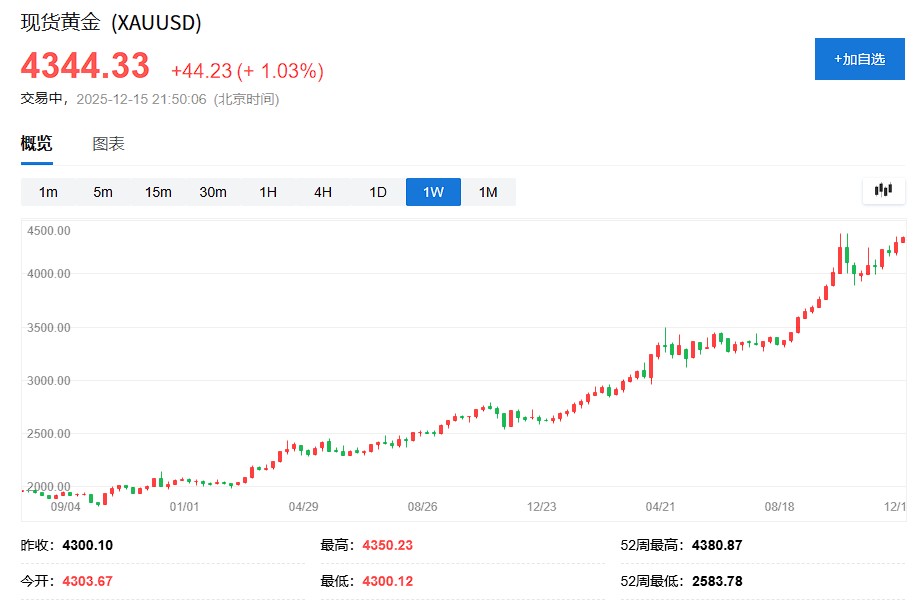
The explosion of platinum and palladium markets is not an isolated event but reflects the overall market risk-return of the precious metals sector under a warming macro environment. On Monday, spot gold briefly rose by 1% and hovered near a seven-week high, mainly benefiting from the weakening dollar and the decline in U.S. Treasury yields

(Current Spot Gold Weekly Chart)
The market is actively trading on the Federal Reserve's policy shift. On one hand, the Federal Reserve lowered interest rates by 25 basis points last week, and the market is pricing in two rate cuts next year; on the other hand, the competition regarding the next Federal Reserve Chair is affecting expectations. Reports indicate that Trump has stated Kevin Warsh is the top candidate and hopes for lower interest rates. This potential "dovish" signal has weakened the dollar, boosted gold prices, and subsequently driven the performance of the precious metals sector.
UBS analyst Giovanni Staunovo pointed out that strong investor demand, continued central bank purchases, and expectations for lower interest rates in 2026 are all supporting precious metal prices.
In this context, funds have partially taken profits from historically high gold and silver prices and shifted towards relatively undervalued and more volatile platinum and palladium sectors, creating a significant capital overflow effect.
Spot Market Short Squeeze Concerns: Leasing Rates Soar to 14.12%
The tension in the spot market is a key catalyst driving this surge. Some analysts point out that the one-month leasing rate for platinum, which reflects the tightness of the spot market, has recently climbed to a high of 14.12%.
This phenomenon typically indicates that the metals available for borrowing in the spot market are extremely scarce, forcing industrial users to buy metals directly from the market rather than borrowing them, thereby pushing up spot premiums. Jinrui Futures noted that this shortage, combined with changes in NYMEX inventories and rising global ETF holdings, constitutes "paper evidence" of a resonance between futures and spot prices.
For the domestic market, the platinum and palladium futures on the Shanghai Futures Exchange are still in their early listing stages, with a small market size and relatively low margin costs, making them susceptible to speculative disturbances. When overseas leasing rates remain high and domestic prices expand their premium over international markets, bullish sentiment is self-reinforcing, leading to this "amplified" surge.
Supply Shortage + Demand Resilience = Surge in Platinum and Palladium
The fundamental logic supporting the rise in platinum still lies in the fragility of the supply side. Over 70% of the world's platinum is produced in South Africa, which is currently suffering from aging mines, power shortages, and extreme weather conditions.
According to SCI analysis, due to insufficient investment, South Africa's platinum group metals production fell by 13% year-on-year in the first quarter, and it is expected to decline by 6% for the entire year of 2025. Coupled with geopolitical risks in Russia (the main source of palladium), disruptions on the supply side have become the norm.
Data from the World Platinum Investment Council (WPIC) further supports bullish confidence: it is expected that the global platinum market will face a shortage for the third consecutive year in 2025, with the gap potentially widening to 30 tons. This structural supply-demand mismatch leads the market to believe that the current rise is not merely speculation but a pricing correction for a long-term supply deficit The demand for traditional automotive catalysts has shown unexpected resilience. Despite the rapid development of electric vehicles, the number of existing and newly added fuel vehicles in the world remains large, and stricter emission regulations require an actual increase in the amount of platinum used per vehicle. The decision by Europe to relax the ban on fuel vehicles by 2035 further solidifies the automotive industry's demand expectations for platinum.
The rise of the hydrogen energy industry has opened up a new growth avenue for platinum. The "14th Five-Year Plan" positions hydrogen energy as a "key piece," and platinum, as an irreplaceable catalyst in the processes of fuel cells and electrolysis for hydrogen production, is regaining strategic value recognition. The potential for this emerging demand is vast and is expected to become a medium- to long-term price support.
In addition, investment demand is also active. As the world's largest platinum consumption market, the listing of platinum and palladium futures options provides enterprises with new investment and hedging tools, bringing incremental demand. The continuous growth of ETF holdings indicates a significant recovery in investor sentiment.
How far can this round of market rally go?
Analysis indicates that although bullish sentiment is high, the market is not without concerns. The debate surrounding "above-ground stocks" and "long-term demand" will determine how far this round of market rally can go.
Specifically, whether platinum and palladium prices can maintain strength mainly depends on the following key variables: Whether leasing rates and spot premiums can remain high, the macro direction of gold/USD/rates continues to be favorable, and the recovery speed of the supply side and the degree of "above-ground stock" release.
1. If leasing rates fall from high levels and the spot tightness eases, the futures market often tends to enter a period of fluctuation or retracement.
2. The macro beta nature of precious metals means that once gold weakens or interest rate expectations reverse, platinum will also face pressure, especially in the current high-volatility environment.
3. Some traders and analysts warn that although supply from mines is tight, there is still a large amount of above-ground inventory globally. Metals Focus data shows that even considering the supply deficit, the total inventory may still be equivalent to about 14 months of demand, which constitutes a fairly comfortable buffer.
4. The possibility of supply recovery cannot be ignored. South African mineral supplies are expected to show signs of recovery after the second quarter, with the annual decline in mineral supply expected to be controlled at around 6%. At the same time, high prices may trigger material substitution risks; when the price difference between platinum and palladium exceeds 30%, catalyst manufacturers may increase the proportion of palladium used.
5. The long-term outlook for the demand side remains unclear. Although hydrogen energy and hybrid vehicles provide a new storyline for platinum, and Europe has relaxed the ban on fuel vehicles by 2035, the overarching trend of electrification continues to squeeze the demand space for traditional automotive catalysts.
Risk Warning and Disclaimer
The market has risks, and investment should be cautious. This article does not constitute personal investment advice and does not take into account individual users' specific investment goals, financial conditions, or needs. Users should consider whether any opinions, views, or conclusions in this article align with their specific circumstances. Investment based on this is at one's own risk