Japanese companies' salary growth expectations remain stable, while the reliability of the US CPI decreases, leading to an expected rise in core inflation. The long-term gap in copper maintains a bullish outlook on copper assets --- 1216 Macro Dehydration

The Bank of Japan released a survey report showing that most companies expect wage growth in the fiscal year 2026 to be the same as in 2025, providing a basis for a rate hike in December. The U.S. government shutdown affects the reliability of the November CPI data, with core inflation expected to rise. Copper prices have reached a historical high, with limited impact from alternative materials, and the long-term deficit is expanding, maintaining a bullish outlook on copper assets
- The Bank of Japan released the "Corporate Attitudes Toward Wage Growth for Fiscal Year 2026" survey report, reducing information asymmetry with the market and providing a basis for a rate hike in December. The survey shows that most companies expect wage increases for fiscal year 2026 to be roughly on par with those of fiscal year 2025.
- The U.S. government shutdown has led to a pause in data collection, making the upcoming November CPI data harder to interpret and less reliable than usual. Core CPI and core PCE are expected to rise, while the slowdown in labor demand exceeds supply.
- Copper prices have hit a historical high, raising market concerns about the impact of substitute materials on copper in the future. The pace of substitution has recently accelerated, but it is still insufficient to offset the long-term deficit. The deficit is expected to continue to widen, maintaining a positive outlook on copper-related stocks and pure copper miners.
I. Stable Wage Growth Expectations for Japanese Companies
Stable Wage Growth Expectations for Japanese Companies (Nomura)
Nomura points out that the Bank of Japan released the "Corporate Attitudes Toward Wage Growth for Fiscal Year 2026" survey report, reducing information asymmetry with the market and providing a basis for a rate hike in December. The survey shows that most companies expect wage increases for fiscal year 2026 to be roughly on par with those of fiscal year 2025.
-
The Bank of Japan released a report on wage expectations before the rate hike, reducing information asymmetry with the market.
- The Bank of Japan released the survey results on "Corporate Attitudes Toward Wage Growth for Fiscal Year 2026" on December 15. Interviews with companies revealed that most expect wage increases for fiscal year 2026 to be roughly on par with those of fiscal year 2025.
- The market has anticipated that the Bank of Japan will raise interest rates in December, and the survey results can be used to discern preliminary trends in spring wage negotiations, providing a basis for this rate hike.
- The Bank of Japan released this document ahead of its monetary policy meeting to avoid information asymmetry with the market, as the more policy decisions rely on information collected by the Bank itself, the lower the transparency of its communication.
-
This release also provided comments from companies, with views on salary increases mainly revolving around retaining employees and raising the minimum wage.
- Some small and medium-sized enterprises and manufacturers, including those in the automotive industry, indicated difficulty in achieving wage increases comparable to those of fiscal year 2025. In contrast, non-manufacturers pointed out the necessity of maintaining wage increases on par with fiscal year 2025 to recruit and retain employees.
- Many companies stated that they would prioritize salary increases for younger age groups, including raising starting salaries.
- Some companies outside urban areas indicated that, given the increase in the minimum wage, it is necessary to raise wages for both part-time and full-time employees from a fairness perspective.
II. Reliability of U.S. CPI Decreases, Core Inflation Expected to Rise
Reliability of U.S. CPI Decreases, Core Inflation Expected to Rise (Citi)
Citi points out that the U.S. government shutdown has led to a pause in data collection, making the upcoming November CPI data harder to interpret and less reliable than usual. Core CPI and core PCE are expected to rise, while the slowdown in labor demand exceeds supply
- The U.S. government shutdown has led to a pause in data collection, making the upcoming November CPI data more difficult to interpret and less reliable than usual.
- The employment cost index rose by 0.79% quarter-on-quarter in the third quarter, still slightly stronger than the pre-pandemic ECI growth, but it is the weakest since 2021.
- The slowdown in ECI growth indicates that demand in the labor market is weakening more than supply.
- The slowdown in labor demand is expected to continue to exert downward pressure on wage growth and service inflation.
III. Long-term copper deficit maintains bullish outlook on copper assets
Bullish outlook on copper assets maintained due to long-term copper deficit (Morgan Stanley)
Morgan Stanley pointed out that copper prices have reached historical highs, raising market concerns about the impact of substitute materials on copper in the future. The pace of substitution has accelerated recently, but it is still insufficient to offset the long-term deficit. The deficit is expected to continue to widen, maintaining a positive outlook on copper-related stocks and pure copper miners.
- Copper prices reached approximately $11,900 per ton last Friday, setting a new historical high, raising market concerns about whether substitutes will undermine expectations of widening deficits and rising prices.
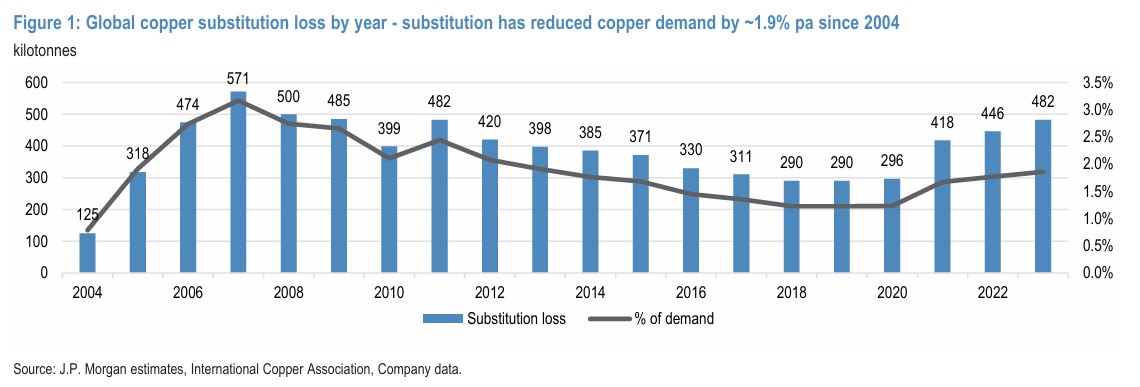
- Over the past 20 years, copper has lost an average of 2% of global demand annually due to substitution, which dropped to about 1% from 2015 to 2020, but has recently accelerated back to 2%.
- Historically, substitution seems to lag behind the sharp rise in copper prices or the copper-aluminum price ratio, and acceleration in substitution takes time.
- As technology matures, copper usage will decline, but it will not completely disrupt emerging demand.

- Substitution and conservation are unlikely to offset the long-term market deficit.
- Even if substitution accelerates to 6% of copper demand, it is estimated that by 2030, this would only correspond to an additional annual reduction of about 1.3 million tons in demand, and the market will still face a deficit.
- Regarding how to fill the long-term supply gap, two areas can be focused on:
- New leaching technologies.
- Increased recycling and waste supply.
- It is expected that by 2030, the total increased capacity could be about 590,000 tons per year; the annual growth rate of waste supply is 5-6%.
- However, the maturity of technology and the scope of application still face significant uncertainty. At the same time, the uncertainty of tax policies on waste supply in China is a potential resistance factor.
- The current market deficit could expand to about 2 million tons by 2030, maintaining a bullish outlook on copper stock exposure and pure copper miners.
Risk warning and disclaimer
The market has risks, and investment should be cautious. This article does not constitute personal investment advice and does not take into account the specific investment goals, financial situation, or needs of individual users. Users should consider whether any opinions, views, or conclusions in this article align with their specific circumstances. Investment based on this is at their own risk