Robotaxi enters a critical validation period, Tesla rises for three consecutive days to reach a new high

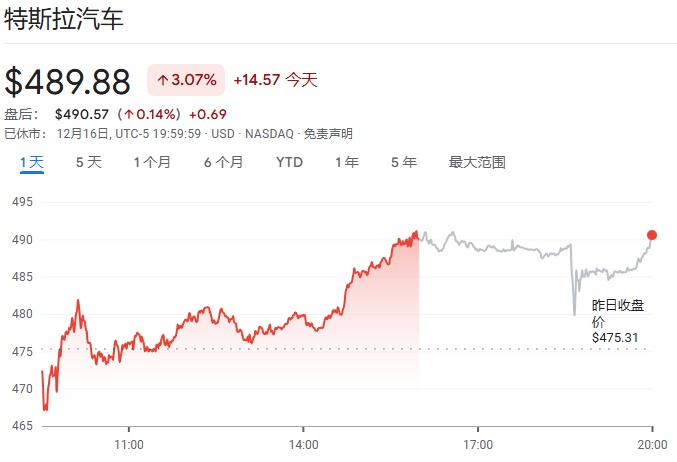
Tesla's stock price reached a historic high of $489.88 overnight, with the latest driving factor being a key step in autonomous driving testing. The company has been testing fully autonomous vehicles in Austin, with no occupants inside. This comes just about 6 months after the company launched its Robotaxi pilot program with safety drivers in June. Morgan Stanley expects Tesla's Robotaxi fleet to rapidly expand from 200 vehicles in 2025 to 1 million vehicles by 2035
Tesla's stock price reached a historic high of $489.88 overnight, rising for the third consecutive trading day, with a market capitalization climbing to $1.63 trillion. This surge is primarily attributed to investor optimism regarding the company's Robotaxi business prospects, despite ongoing challenges in electric vehicle sales.

The latest driving factor is Tesla's launch of fully autonomous Robotaxi testing in Austin, with no safety supervisors or passengers in the vehicle. This marks a critical validation period for the company's autonomous driving commercialization, just six months after the launch of its supervised service in June.
Morgan Stanley believes this breakthrough will be the most important catalyst for validating Tesla's Robotaxi strategy. Wall Street analysts expect that successful autonomous operations will accumulate key data and regulatory basis for the launch of unsupervised Full Self-Driving (FSD) for personal vehicles.
While the stock price hits new highs, Tesla's traditional electric vehicle business still faces pressure from declining sales. According to Cox Automotive data, the company's U.S. sales in November fell to a four-year low, primarily impacted by the cancellation of federal tax credit policies and brand image controversies.
Key Step in Autonomous Driving Testing
Tesla CEO Elon Musk revealed this week that the company has been testing fully autonomous vehicles in Austin, with no occupants in the vehicle. This comes just about six months after the company launched its supervised Robotaxi pilot project in June.
According to Morgan Stanley's analysis, this progress signifies that Tesla's autonomous driving commercialization has entered a critical validation phase. The investment bank expects Tesla's Robotaxi fleet size to rapidly expand from 200 vehicles in 2025 to 1 million by 2035.
Morgan Stanley pointed out that Tesla is leading the industry with a cost advantage of $0.59 per mile. Successful autonomous operations will accumulate important data and regulatory basis for the launch of unsupervised FSD for personal vehicles, with an expected FSD penetration rate of 70% by 2035.
Wall Street Raises Target Price
Mizuho raised Tesla's target price from $475 to $530, maintaining a buy rating. Analyst Vijay Rakesh stated that improvements in fully autonomous driving technology could support the accelerated expansion of the Robotaxi fleet in Austin and San Francisco, potentially eliminating safety supervisors sooner.
Rakesh referenced operational data from Waymo, a subsidiary of Alphabet, for comparative analysis. Waymo currently completes about 450,000 fully autonomous taxi services per week, a significant increase from 250,000 in April, with a goal of reaching 1 million per week by the end of 2026.
However, Barclays analyst Dan Levy remains cautious, maintaining a hold rating and a target price of $350. He believes that differences in regulatory policies across states may affect the speed of Tesla's service expansion, with key issues still revolving around promotion timing and scale
Electric Vehicle Sales Under Continued Pressure
Despite the promising outlook for Robotaxi, Tesla's traditional electric vehicle business still faces challenges. In the first two quarters of this year, the company's automotive business revenue declined by 20% and 16%, respectively, with a 13% drop in delivery volume.
According to data from Cox Automotive, Tesla's U.S. sales in November fell to a four-year low. This was mainly influenced by the expiration of the federal electric vehicle tax credit policy at the end of September, as well as ongoing consumer backlash against Musk's political activities.
The situation improved in the third quarter, with Tesla's revenue growing by 12%, primarily due to a rush of purchases by U.S. buyers before the tax credit expiration. However, the launch of the Model Y and Model 3 entry-level models in October did not significantly boost sales and may have diverted demand from higher-end models.
Faced with competition from low-cost or more attractive products from rivals such as BYD, Xiaomi in China, and Volkswagen in Europe, Tesla continues to experience increasing competitive pressure in the global market. FactSet data shows that currently, 40% of analysts give Tesla a buy rating, with an average target price of around $400