


美银基金经理调查:从股票到大宗商品,投资者为四年半来最乐观,做多 “MAG 7” 为最拥挤交易

The Bank of America’s December survey shows that global fund managers' optimism has reached a four-and-a-half-year high, with cash levels dropping to historic lows. There is a large-scale flow of funds into U.S. stocks, technology, and commodities, firmly expecting an economic "soft landing." However, the extreme bullishness has triggered Bank of America's contrarian "sell signal," with the AI bubble and crowded trades remaining major risks
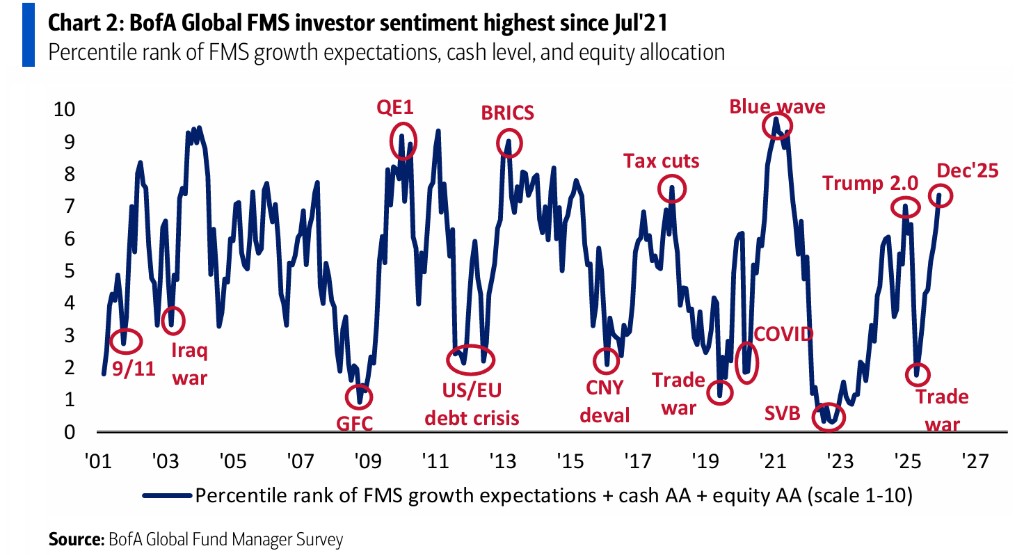
As investors prepare to welcome the new year, market sentiment is closing out with an unusually strong confidence. A monthly fund manager survey released by Bank of America on the 16th shows that global fund managers exhibit a firm optimistic attitude towards all asset classes, from economic growth to stocks and commodities, with overall optimism rising to its highest level in four and a half years.
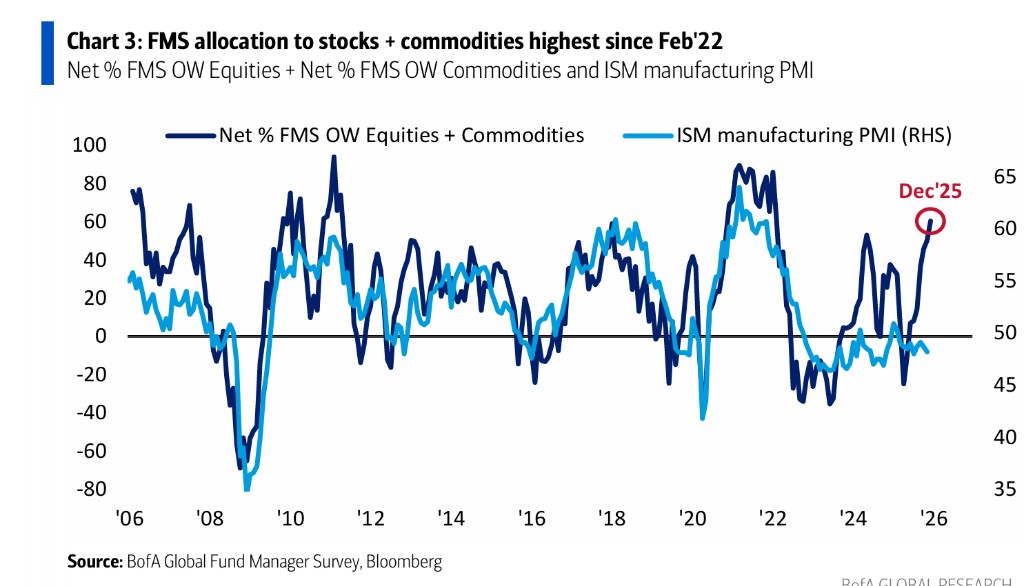
According to the Wind Trading Desk, this survey of 203 fund managers managing $569 billion in assets shows that a broad sentiment indicator based on cash levels, stock allocations, and economic growth expectations rose to 7.4 in December (out of a maximum of 10), marking the highest bullish reading since July 2021. Investors' overall exposure to stocks and commodities, which typically perform well during economic expansions, has reached its highest level since February 2022.
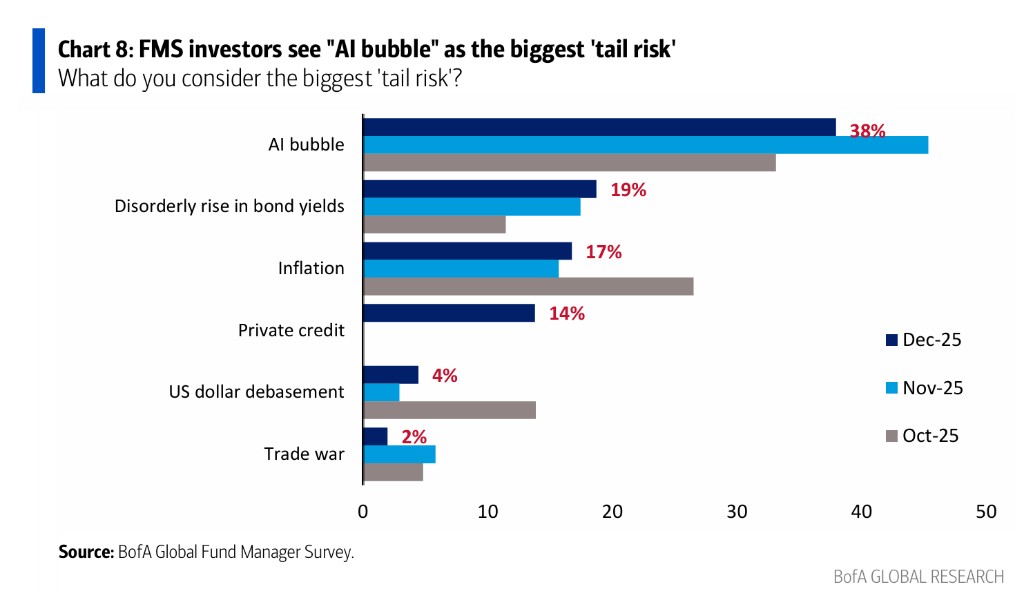
In terms of macro outlook, the market's expectation of an economic "soft landing" dominates, with the vast majority of investors ruling out the possibility of a recession. The survey shows that going long on the "Magnificent 7" (the seven tech giants in the U.S. stock market) has become the most crowded trade for the second consecutive month, while concerns about an artificial intelligence (AI) bubble remain the primary tail risk of market attention.
Bank of America strategist Michael Hartnett points out that such high levels of optimism have only occurred eight times this century. However, the extreme bullish sentiment has also triggered the bank's contrarian "sell signal." Hartnett warns that the current cash level has fallen below the 4% threshold, which, according to Bank of America's trading rules, is typically seen as a contrarian sell signal for the stock market, indicating that bullish positions may have become the biggest resistance facing risk assets.
Macro Consensus: Soft Landing and Soaring Growth Expectations
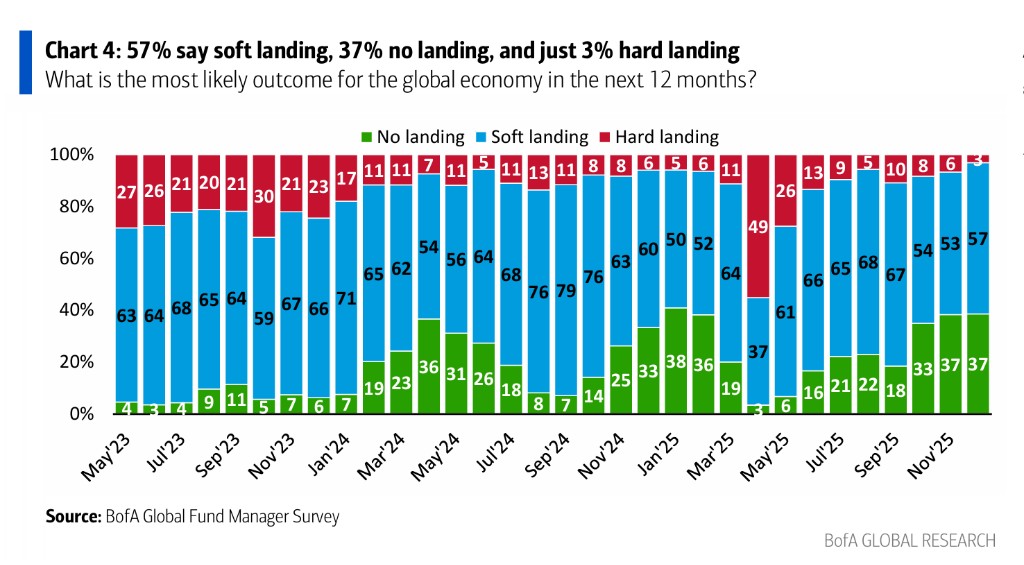
Investors' views on the global economic outlook have undergone a fundamental shift. 57% of respondents expect a "soft landing" for the global economy in the next 12 months, 37% expect "no landing" (i.e., continued growth), while only 3% anticipate a "hard landing," the lowest level in the past two and a half years.
This optimistic sentiment has directly boosted growth expectations. A net 18% of investors expect the global economy to strengthen in the future, the highest level since August 2021. Meanwhile, corporate earnings expectations have also significantly improved, with a net 29% of respondents believing that global corporate profits will increase. Although soft data such as the ISM Manufacturing PMI remains weak (at 48.2 in November), investors are betting that cyclical industries are about to accelerate significantly in this cycle The liquidity situation is also considered to be at its best in years. A net 61% of investors rate the current market liquidity as positive, the highest level since September 2021, and the third-best period for liquidity assessment in the past 17 years.
Asset Allocation: A Comprehensive Shift Towards Cyclical Assets
Driven by optimism, funds are flowing massively into risk assets. The total allocation ratio for stocks and commodities has reached its peak since February 2022. Specifically, the net overweight ratio for stocks has risen to 42%, while the net overweight ratio for commodities has increased to 18%. In contrast, the net underweight ratio for bonds has expanded to 29%, the lowest since October 2022.
There is a clear sector rotation characteristic, with funds flowing out of bonds, healthcare, and consumer staples, and into U.S. stocks, technology, and materials sectors.
- Technology Sector: The net overweight ratio has risen to 21%, the highest since July 2024.
- Banking Sector: Remains one of the sectors with the highest overweight degree, with a net overweight of 32%.
- Defensive Sectors: Energy and consumer staples have seen significant reductions, with the allocation ratio for the energy sector nearly 2 standard deviations below the average level of the past 20 years.
From a regional perspective, investors have shifted to a net overweight of 6% in U.S. stocks, reaching a new high since February 2025; the net overweight ratio for emerging market stocks has also risen to 39%.
Crowded Trades and Tail Risks
Despite the bullish market sentiment, risk awareness remains. The survey shows that "Long the Magnificent 7" has been rated the most crowded trade for the second consecutive month, accounting for 54%; followed by "Long Gold," accounting for 29%.
Regarding potential market risks:
- AI Bubble: Still regarded as the biggest tail risk, with 38% of investors expressing concern, although this percentage has slightly decreased from last month.
- Credit Risk: 40% of investors believe that "private equity/private credit" is the area most likely to experience a systemic credit event, followed by "AI mega-cap capital expenditures" (29%). Notably, in this month's survey, 14% of investors listed "private credit" as the biggest tail risk for the coming year.
- Corporate Investment: Although it has declined, a net 14% of investors believe that corporate capital expenditures are currently too high (Overinvesting), reflecting concerns about the sustainability of the AI capital expenditure boom.
In terms of personnel expectations for monetary policy, the market has begun to bet on the future leadership of the Federal Reserve. Surveys show that 69% of investors expect Kevin Hassett to be nominated as the next Federal Reserve Chairman, while the expected proportions for Christopher Waller and Kevin Warsh are both 4%.
Cash Crash and Sell Signal Warning
Survey data indicates that fund managers' cash allocation level has further decreased from 3.7% last month to 3.3%, setting a historical low. Bank of America points out that when cash levels fall below 4.0%, it is typically seen as a contrarian "sell" signal. Historically, when cash levels are below 3.6%, the average return of global stock markets in the following month is -2%.
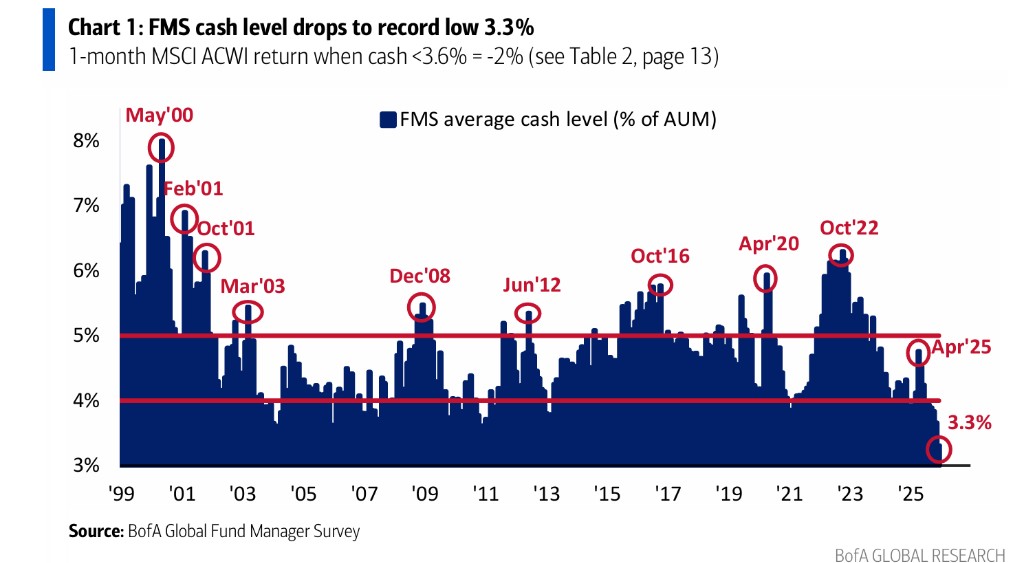
Accompanied by a sharp decline in cash holdings, Bank of America's "Bull-Bear Indicator" rose from 6.4 last month to 7.9. This indicator aims to measure extreme market sentiment, and the current reading suggests that market sentiment is extremely exuberant. Bank of America strategists recommend adopting a contrarian strategy: buy cash and bonds, sell stocks and commodities; regionally and sector-wise, they suggest buying UK stocks and the energy and consumer staples sectors, while selling technology stocks and bank stocks
