Excluding AI, on the brink of recession

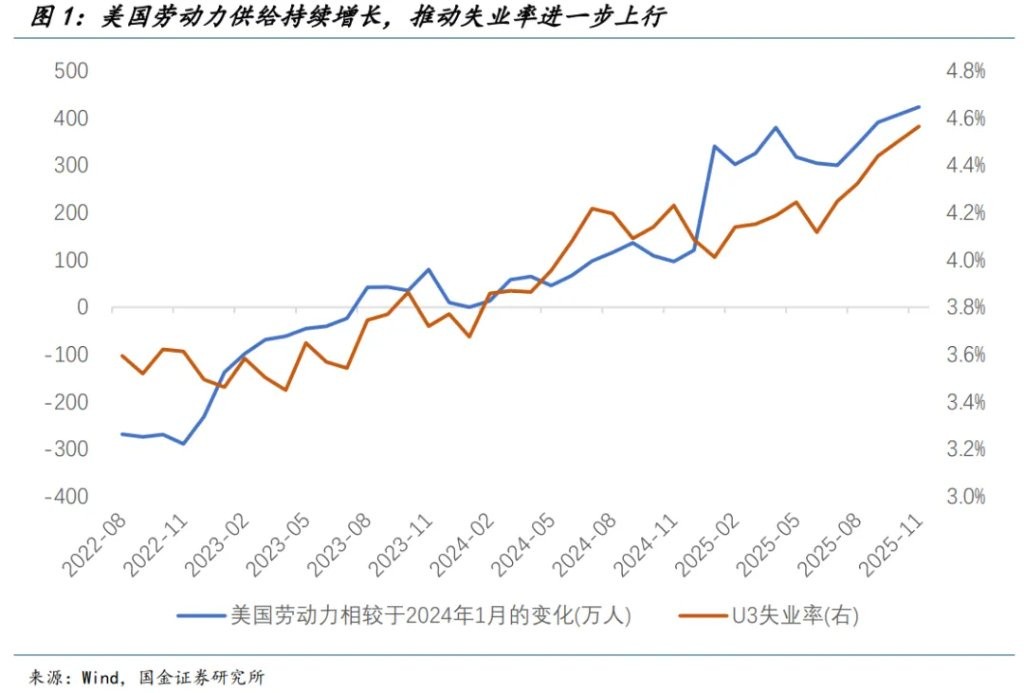
As 2025 comes to a close, the supply of labor in the United States continues to recover, while the unemployment rate rises further. The "service-employment-income-consumption" chain in the U.S. weakens, and the economy is on the brink of recession. The unemployment rate has become a golden indicator for observing the U.S. economy, and the Federal Reserve's tolerance for the rising unemployment rate stems from expectations of a weakening labor supply. However, the reality is that labor supply and demand are growing in deep red states, while employment levels are contracting in blue states, leading to a noticeable rise in the unemployment rate. The ongoing upward trend in the unemployment rate necessitates addressing how to limit its increase
At the Jackson Hole meeting in August, Powell described the U.S. labor market as a curious kind of balance that results from a marked slowing in both the supply of and demand for workers.
However, looking back at the end of 2025, the supply of labor in the U.S. continues to recover, driving the unemployment rate further up—expectations of "weak labor supply" are merely a false hope.
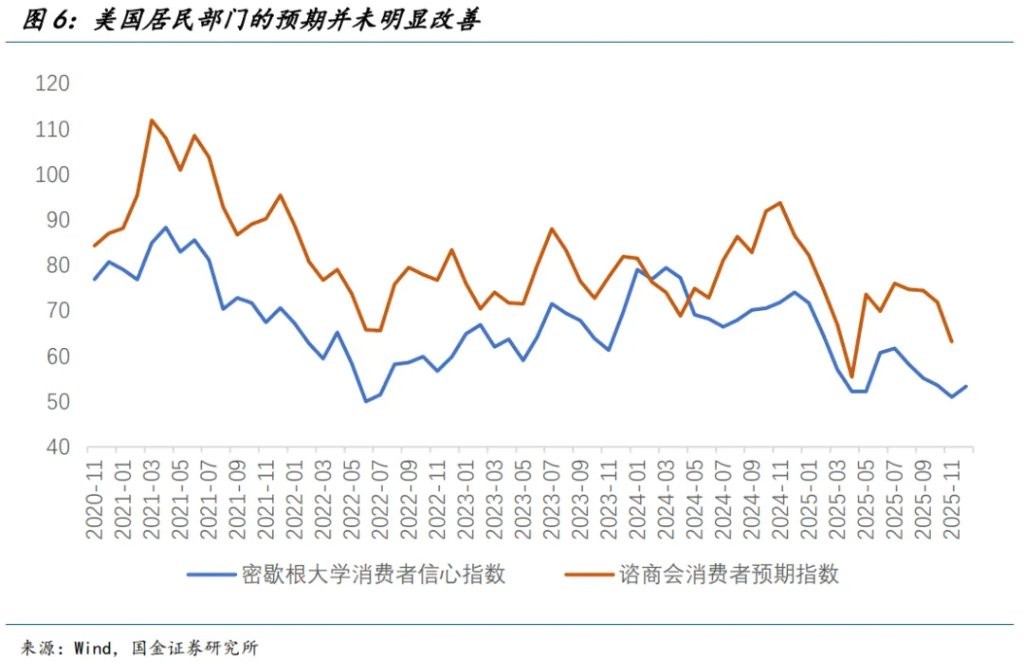
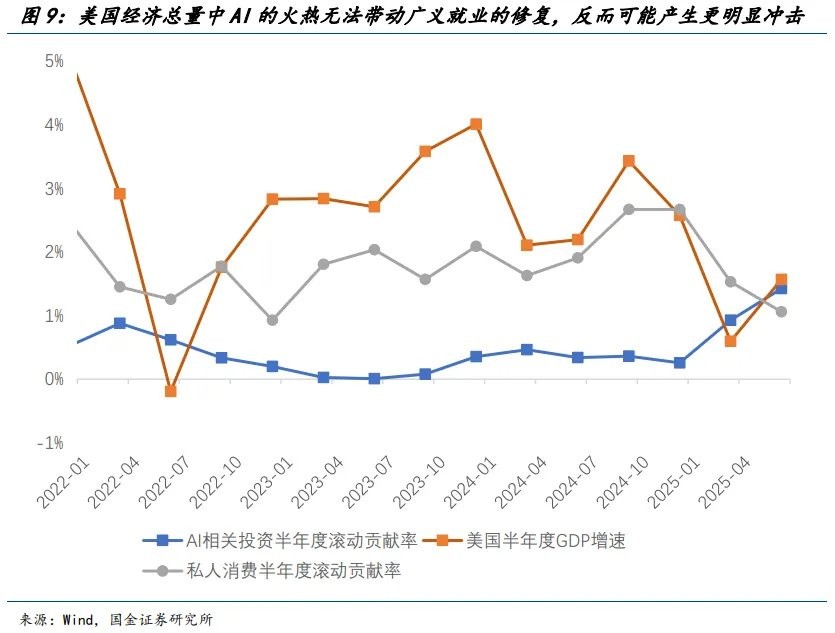
The continuously rising unemployment rate, the extremely narrowed distribution of new jobs (relying solely on the education and healthcare sectors), and the marginal recovery but still sluggish confidence—this "service-employment-income-consumption" chain in the U.S. is weakening; aside from the broad contributions of AI, the U.S. economy is essentially on the brink of recession.

Due to data distortions caused by the shutdown and the high volatility of new employment levels (frequent downward revisions), the unemployment rate is becoming the golden indicator for observing the U.S. economy and is also the most important reference factor in Powell's eyes.
The rising unemployment rate that began in the second half of 2025 has clearly attracted greater attention from the Federal Reserve, but its tolerance for the rising unemployment rate essentially stems from expectations of a weakening labor supply.
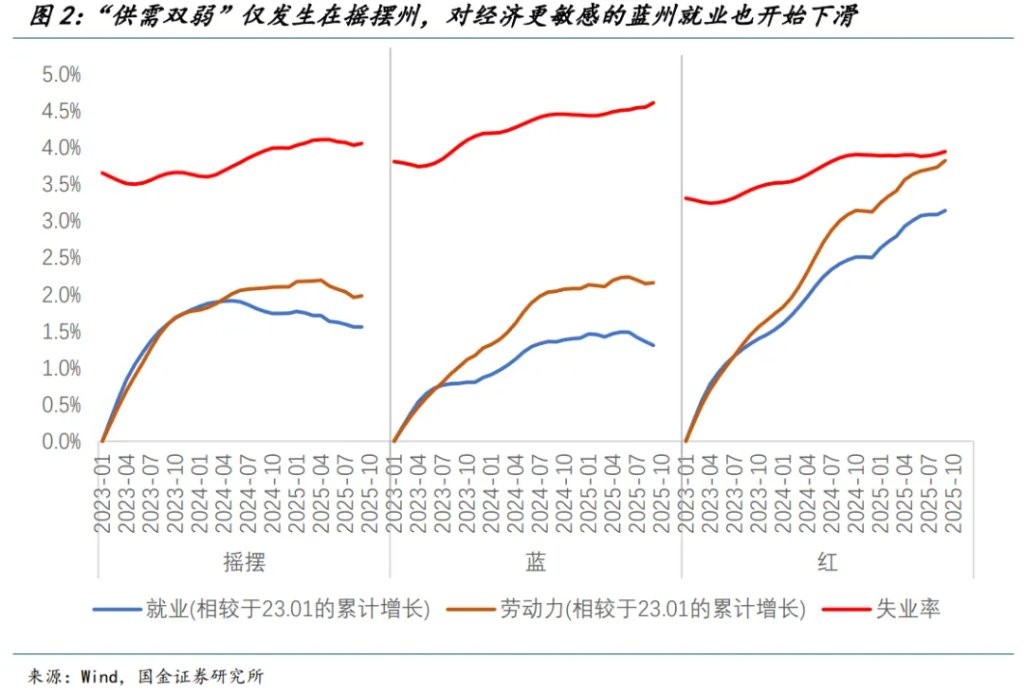
However, the reality is that the situation of weak supply and demand is only seen in the "swing states." Although the net inflow of immigration is nearly stagnant, the "chilling effect" of illegal immigrants as labor is not significant—what Trump has truly pushed to expel from the U.S. so far are more criminals, rather than ordinary people.
From a partisan perspective, this also presents a certain "K-shaped" distribution: the labor supply and demand in deep red states are still growing rapidly, while the employment levels in blue states, which are more sensitive to the economy and account for a larger share of GDP, began to contract after entering the second half of 2025, with the rising unemployment rate becoming more apparent—this is clearly a more disturbing signal.

From the results, the continuously rising trend of the unemployment rate (including U3 and U6 unemployment rates) needs to confront a question: what can limit the rise of the unemployment rate?
This echoes the most incisive question from the December FOMC press conference (from Nick Timiraos): after a 150bp rate cut, why has the interest rate-sensitive sector in the U.S. not recovered, and the unemployment rate continues to rise slowly, why does the Federal Reserve have confidence that the unemployment rate will not rise further in 2026?
We understand that Powell's response reflects a kind of good intention but does not fully answer the question: he explains that the current interest rate is at a neutral rate level, believing that this will likely stabilize the labor market, with the unemployment rate rising at most by 0.1%-0.2% (one or two more tenths) However, the unemployment rate of 4.564% in November has already exceeded the 4.5% unemployment rate forecast for the end of 2025 given in the Summary of Economic Projections (SEP), and it is also not far from triggering the "Sam Rule" corresponding unemployment rate of 4.732%. Based on the current SEP expectations from the Federal Reserve, there is not much upward tolerance left for the unemployment rate, but the unemployment rate itself has not shown any signs of slowing down.
Returning to Nick's question, Powell's response to the unemployment rate issue from the perspective of neutral interest rates lacks any forward-looking significance. If we look at the performance of interest rate-sensitive sectors, the rate cuts so far have been almost ineffective.
To suppress the unemployment rate, it mainly depends on four aspects: the relative position to the "neutral interest rate" (which can also be understood as the lagged feedback from past rate cuts), the dissipation of uncertainty regarding Trump’s policies (a clearer fiscal policy path), the correction of market and Federal Reserve rate cut expectations (a clearer monetary policy path), and the "timely decline" of labor supply—among which the impact of "interest rates" seems to be the weakest.
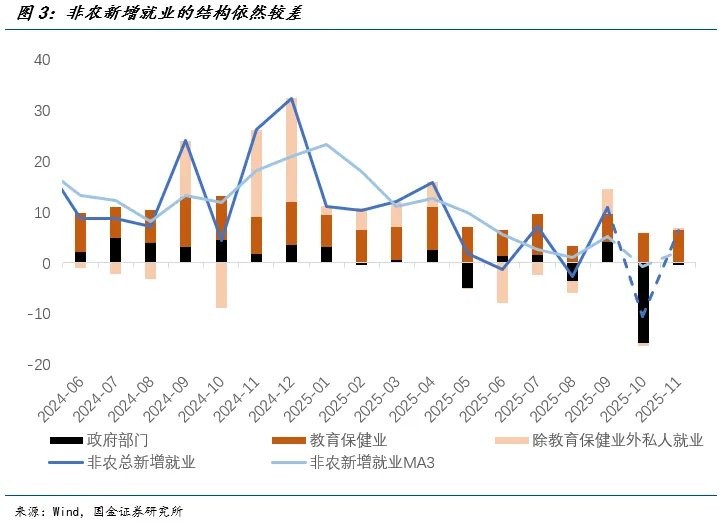
The structure of non-farm payroll job additions has not been repaired, with the education and healthcare sectors still standing out. Apart from that, the remaining private sector job additions have only recorded positive growth in September and November over the past seven months since May.

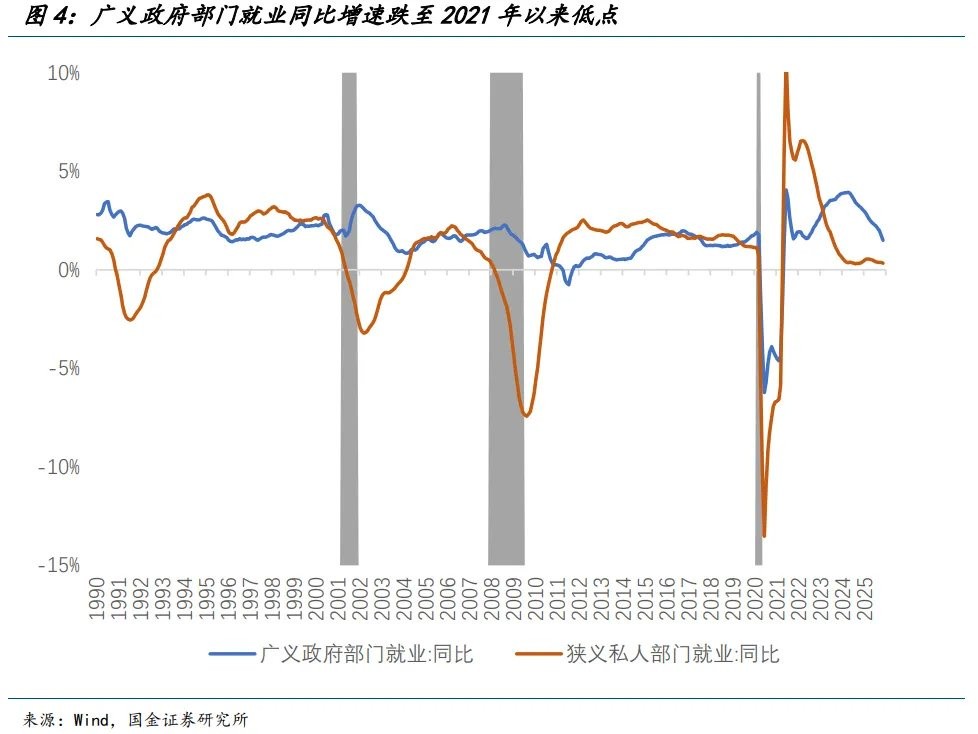
Due to the Deferred Resignation Program (DRP) for civil servants taking effect on September 30, the employment reduction from about 150,000 U.S. civil servants accepting a one-time buyout was accounted for in the October non-farm payrolls. The broad government sector employment was affected, with its year-on-year growth rate falling to the lowest level since May 2021, while the year-on-year growth rate of narrow private sector employment is once again approaching the low point of August 2024.
Although the market has fully accounted for this and is more focused on private sector employment, government employment can still provide stable incremental demand before 2025; from now on, the non-farm job additions in the U.S. may turn into a "one-man show" in the education and healthcare sectors.

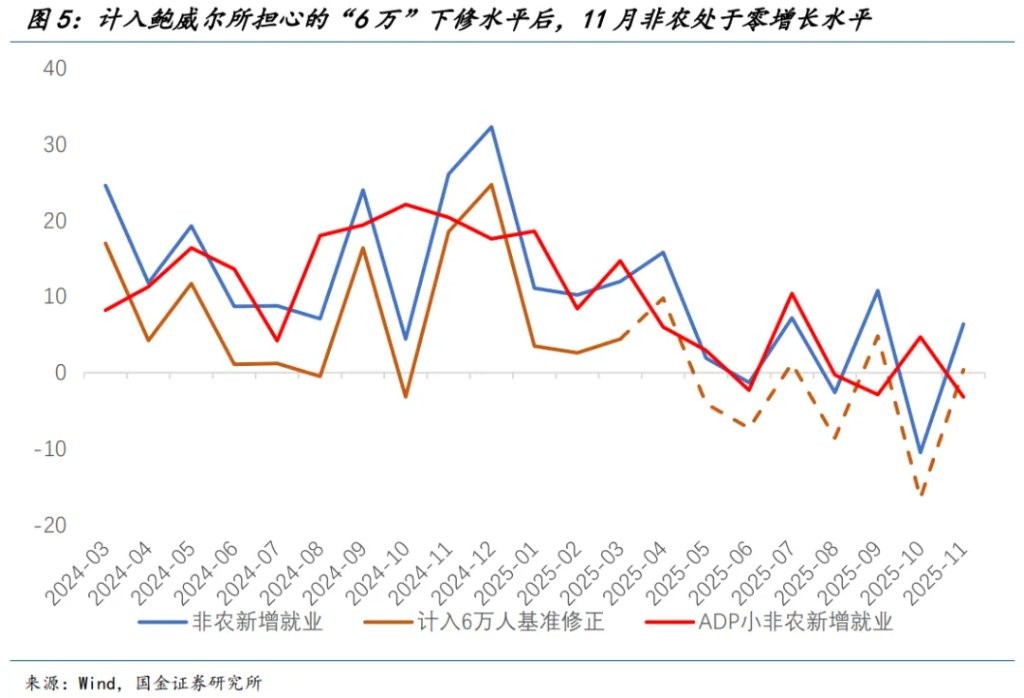
More importantly, Powell's mention of "60,000" non-farm payroll downward revision during the December FOMC press conference lingers in the ears, and the benchmark revision of the QCEW is becoming the "heart demon" of the Federal Reserve. If we exclude the 60,000 level, the November non-farm payrolls would only show "zero growth," which is consistent with the November ADP small non-farm figures.
The stabilization of the labor market is not just about the stabilization of numbers, but also about the convergence of fluctuations. The economic expectations perceived by the companies participating in the survey indicate not only a decline in new employment but also an unstable economic scenario, corresponding to high volatility in new employment (including initial values and revisions); this will also affect the performance of the "consumption - employment - income" chain in the U.S. household sector.

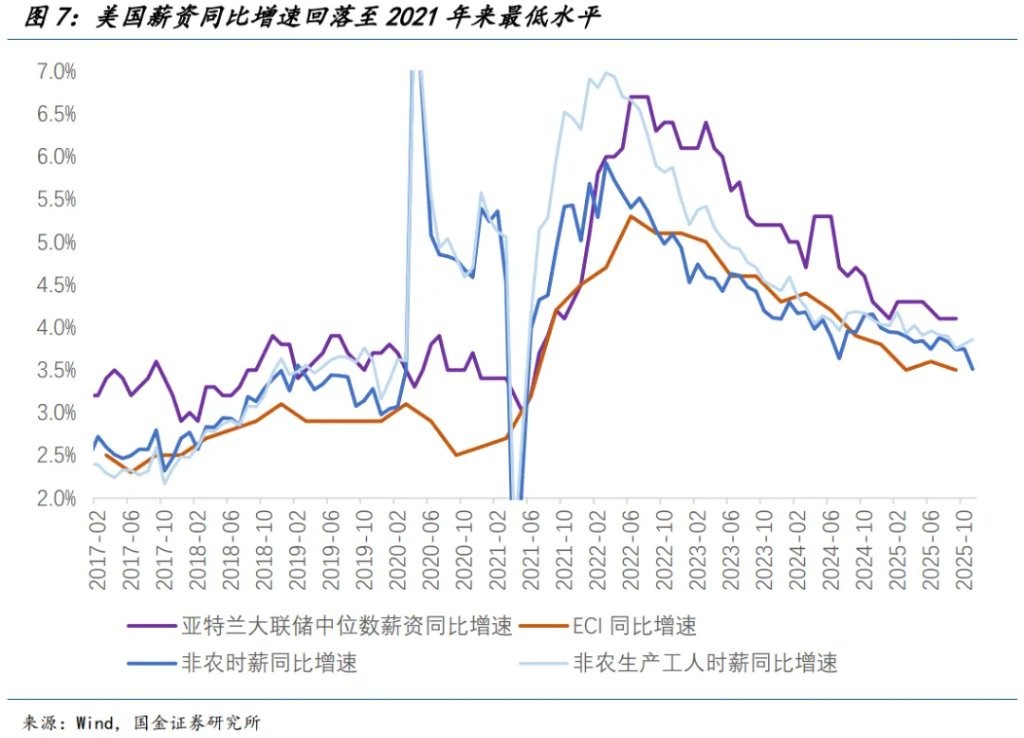
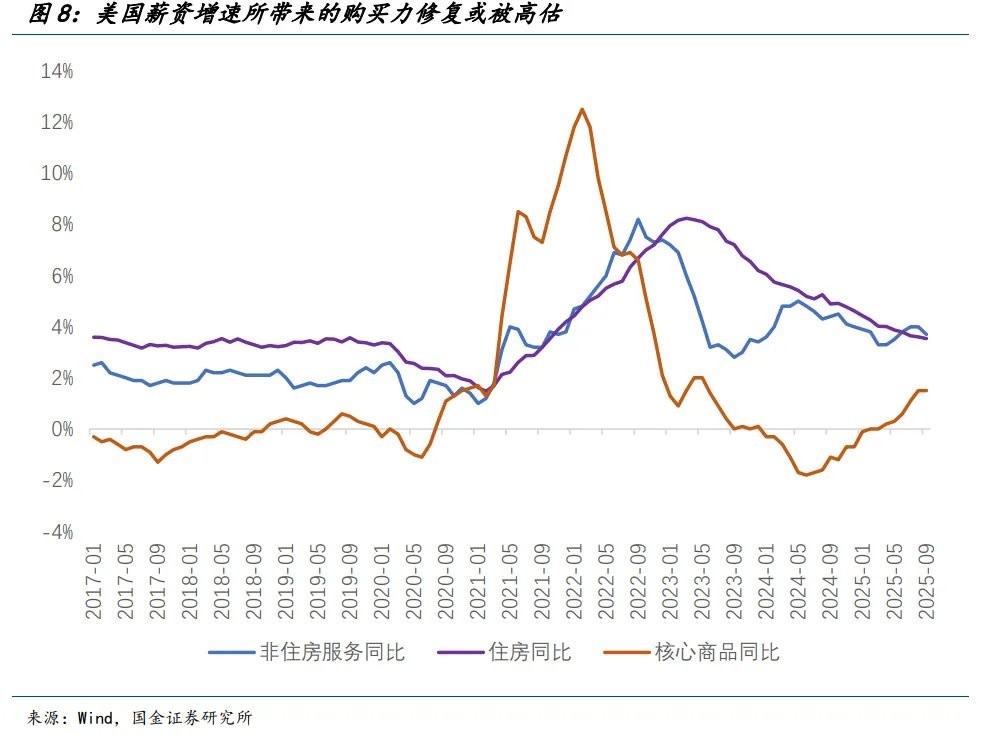
Another point of concern is that the year-on-year growth rate of wages has inadvertently further dropped to 3.5%. Although the actual wage growth rate remains in positive territory, inflation in non-residential services (which is 2 percentage points higher than the average level in 2019) and goods (1.2 percentage points higher) means that residents are facing greater purchasing power challenges.


Based on this non-farm report, we have become more optimistic about the possibility of interest rate cuts in the first half of 2026, especially in the first quarter. However, considering that a 100bp rate cut in 2024 will have extremely limited effects on the economy, the stimulating effect of rate cuts on employment seems to be at risk of being overestimated.
The continuously rising unemployment rate, the extremely narrowed distribution of new employment (relying solely on the education and healthcare sectors), and the marginal recovery but still sluggish confidence— the "services - employment - income - consumption" chain in the U.S. is weakening. Excluding the broad contributions of AI, the U.S. economy is essentially on the brink of recession.
Even AI can only make a positive contribution to economic growth, while the employment sector will continue to face pressure (and may even begin to impact employment demand)— the differentiation between AI and non-AI industries will continue.

Risk Warning and Disclaimer
The market has risks, and investment requires caution. This article does not constitute personal investment advice and does not take into account the specific investment goals, financial conditions, or needs of individual users. Users should consider whether any opinions, views, or conclusions in this article are suitable for their specific circumstances. Investment based on this is at one's own risk