


瑞银企业调查:六成企业选择 “自制” AI 而非购买现成,“AI 智能体” 仅有 5% 真正落地

Despite the continued rise of artificial intelligence technology, the large-scale deployment of enterprise-level AI applications is progressing slowly. UBS's latest survey shows that only 17% of the surveyed companies have achieved large-scale production of AI projects, a slight increase from 14% in March of this year. As many as 60% of companies choose to build AI applications in-house rather than purchasing third-party products, and the much-discussed "AI intelligent body" technology has only been scaled up by 5% of companies. The survey also found that AI applications have not led to large-scale layoffs, with 40% of surveyed companies stating that AI will drive employee growth
Despite the continuous rise of artificial intelligence technology, the large-scale deployment of enterprise-level AI applications is progressing slowly.
According to the Chasing Wind Trading Desk, the latest fifth enterprise AI survey released by UBS's Karl Keirstead team shows that only 17% of surveyed companies have achieved large-scale production of AI projects, a slight increase from 14% in March this year.
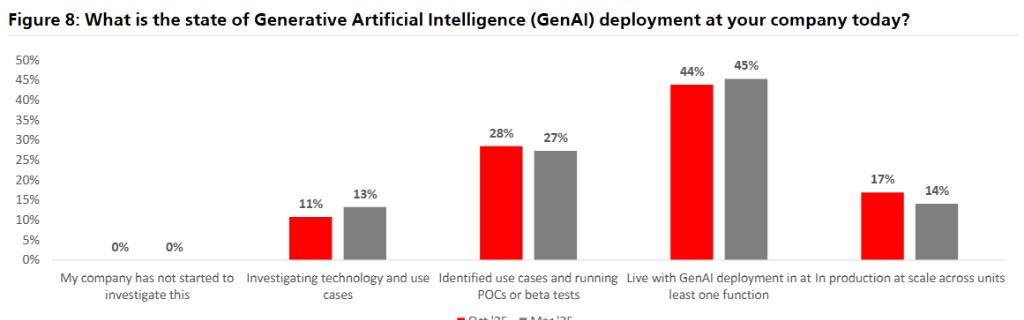
More notably, as many as 60% of companies choose to build AI applications in-house rather than purchasing third-party products, and the much-discussed "AI agents" technology has only been scaled up by 5% of companies.
The survey results indicate that Microsoft, OpenAI, and NVIDIA continue to dominate the enterprise AI market. In terms of cloud infrastructure, Microsoft Azure remains the leader; in the realm of large language models, OpenAI's GPT series models occupy three of the top five spots, although Google's Gemini and Anthropic's Claude are quickly catching up. Microsoft's M365 Copilot remains the preferred enterprise AI tool, but OpenAI's ChatGPT commercial version is rapidly closing the gap.
This survey was conducted in October 2025, covering IT executives from 130 companies with an average employee count of 8,200 and an IT budget of approximately $800 million. The survey reveals the core challenges facing enterprise AI deployment: 59% of respondents believe that unclear return on investment is the biggest obstacle, a significant increase from 50% in March this year. Concerns about regulatory compliance (45%) and a lack of internal expertise (43%) rank second and third, respectively.
The survey also found that AI applications have not led to large-scale layoffs. 40% of surveyed companies stated that AI will drive employee growth, while only 31% expect a reduction in personnel, and just 1% anticipate significant layoffs. This finding is positive for seat-based SaaS companies, alleviating market concerns about AI replacing human labor.
In-house AI Development Becomes a Mainstream Trend
The most noteworthy finding of the survey is the preference of companies for AI application procurement models. Only 34% of surveyed companies stated that they rely entirely on AI products from third-party software vendors, while as many as 60% of companies choose to fully build in-house or adopt a hybrid model combining in-house development and procurement.
This trend poses challenges for traditional software vendors. For a long time, SaaS companies believed that as the complexity of AI applications increased, companies would eventually turn to purchasing ready-made solutions. However, the survey shows that this shift has not yet occurred UBS analysts pointed out that the trend of "DIY AI" models has created new opportunities for AI model providers such as OpenAI and Anthropic. These companies can enter the enterprise AI application market by selling "model + tools" platforms to businesses that prefer to build their own paths.
In specific application scenarios, the demand for AI deployment in internal IT help desks (75%) is significantly higher than that for external customer support (52%). ServiceNow maintains a leading position in internal IT workflow automation AI solutions, even surpassing Salesforce in the ranking of CRM AI technology providers, which is unexpected.
AI Agent Deployment Still in Early Stages
Although AI agents are seen as the next important development direction, their enterprise-level deployment is still in the early stages. Surveys show that only 5% of enterprises have achieved large-scale production deployment of AI agents, 71% are in pilot or small-scale production stages, and another 22% have not even started piloting.
This result contrasts with the optimistic expectations of companies like OpenAI and Anthropic regarding the market prospects for AI agents. These companies view AI agents as a key breakthrough for deep penetration into the enterprise market and expect the technology to bring substantial revenue and GPU consumption.
UBS believes that the slow progress of agent deployment supports the view that "AI agents will not massively replace human labor" and reminds investors to maintain rational expectations for short-term revenues from related technology suppliers.
Analysts state that the vision of significant revenue growth driven by AI agents, as depicted by many AI technology suppliers, may not be realized until 2027 or later, as the pace of enterprise adoption of new technologies is often slower than expected.
Microsoft's Alliance with OpenAI Remains Strong
In the fierce competition for AI models, OpenAI continues to maintain its leading position in the enterprise market. Its GPT 5.0, 4.0, and 3.5 models occupy three of the top five spots among enterprise users, with ChatGPT 4.0 ranking first.
Notably, despite market rumors that "large language models are being commoditized" and that Google has surpassed OpenAI at the model level, survey results show that OpenAI's position in the enterprise market remains solid. However, competition is intensifying: the adoption rate of Google's Gemini has surged from 19% in May last year to 46%, and Anthropic's Claude has also jumped to third place.
In the general AI tools sector, Microsoft's M365 Copilot maintains a dominant position, but OpenAI's ChatGPT commercial version is rapidly rising to second place. If the various enterprise versions of ChatGPT are combined, its overall popularity may be comparable to that of M365 Copilot.
Surveys show that the average number of paid M365 Copilot seats among responding enterprises is 2,050, steadily increasing from 1,715 in March, representing a year-on-year growth of 67%. The average number of ChatGPT seats in enterprises is about 995, roughly half that of Copilot
Data Software Vendors Benefit Significantly
The demand pull effect of AI projects on data infrastructure is evident. Among various categories of data software, the proportion of respondents expecting spending increases (an average of 52%) far exceeds the proportion expecting spending cuts (an average of 10%).
The cloud data warehouse sector benefits the most, with 69% of respondents expecting related spending to increase, and 25% expecting significant growth. This is favorable for vendors such as Snowflake, AWS Redshift, and Google BigQuery. In terms of specific vendor selection, Snowflake is slightly ahead, but Databricks is closely following, with competition becoming increasingly fierce.
The cloud data lake and ML/AIOps sectors also perform strongly, with 56% and 60% of respondents respectively expecting spending increases. In contrast, the AI pull effect on operational databases (such as MongoDB and Oracle) is relatively mild, with only 10% of respondents expecting significant increases in related spending.
UBS believes that this difference reflects the current focus of AI applications primarily on analytics and machine learning workloads, rather than more complex transaction processing applications. As enterprises build more complex "second-generation" AI applications, the demand for operational databases may significantly increase
