


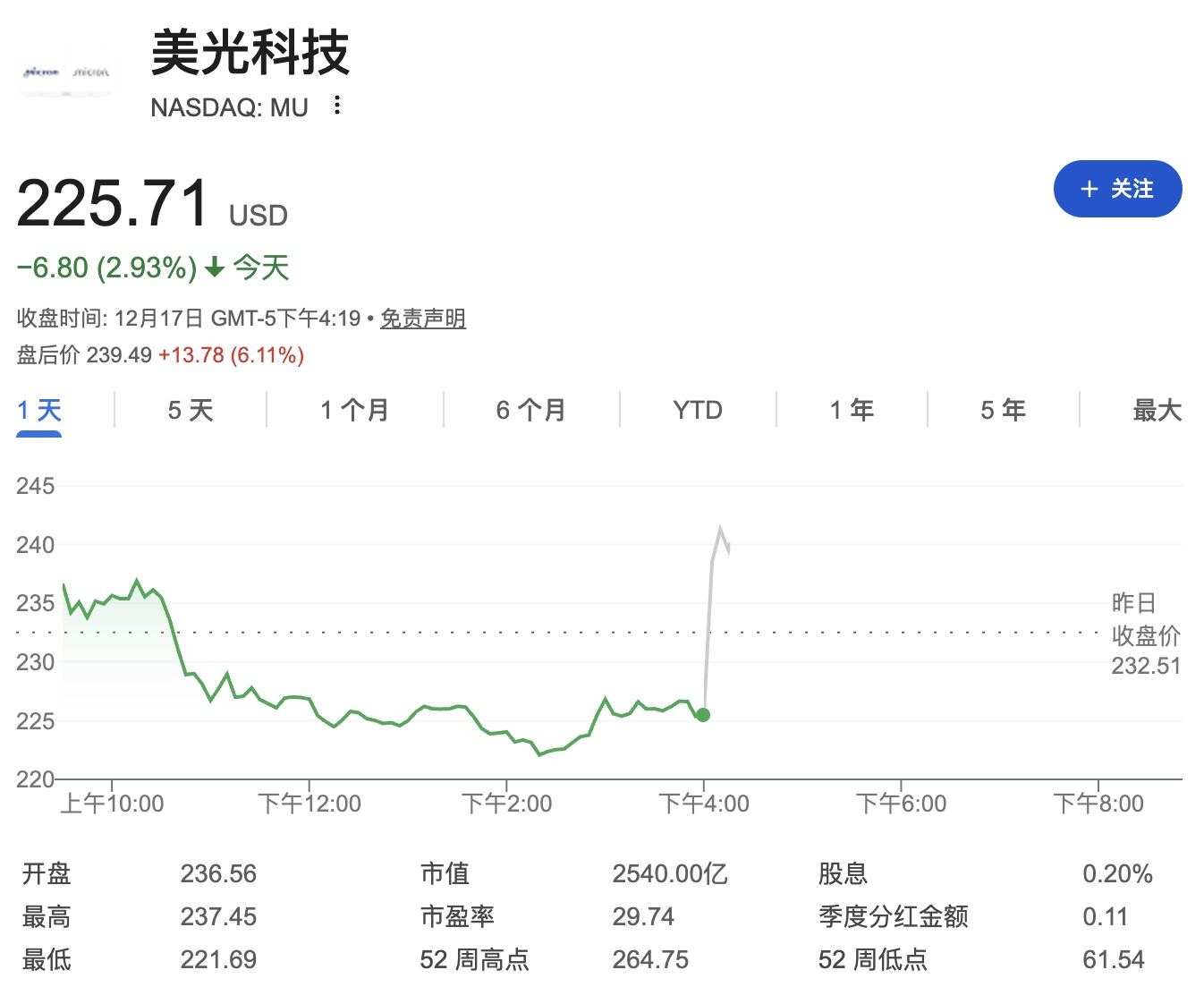
Strong demand for chips, Micron's performance and guidance both "explode," increasing capital expenditure, stock price surges over 6.7% after hours

Against the backdrop of an explosion in demand for AI data centers and a continued tightening of storage chip supply, Micron delivered a first-quarter report on Wednesday that was significantly better than expected, providing guidance for second-quarter revenue, gross margin, and earnings per share that far exceeded market expectations. It indicated that the shortage of memory/storage chips will persist until 2026 and last even longer, raising its capital expenditure expectation for fiscal year 2026 from $18 billion to $20 billion
Benefiting from the tightening supply of storage chips, significant price increases, and the rapid growth in demand for artificial intelligence data centers, Micron announced its first fiscal quarter results after the market closed on Wednesday. The company not only exceeded analysts' expectations for the last quarter but also provided guidance for second fiscal quarter revenue, gross margin, and earnings per share that far surpassed expectations. Additionally, it raised its capital expenditure forecast for fiscal year 2026 from $18 billion to $20 billion, stimulating the company's stock price to rise over 6.7% in after-hours trading.
Here are the key points from Micron's first fiscal quarter financial report:
Key Financial Data:
Revenue: Micron's adjusted revenue for the first fiscal quarter was $13.64 billion, a year-on-year increase of 57%, exceeding analysts' expectations of $12.95 billion.
Capital Expenditure: Micron's net capital expenditure for the first fiscal quarter was $4.5 billion.
Operating Expenses: GAAP operating expenses were $1.51 billion, compared to $1.40 billion in the previous quarter and $1.17 billion in the same period last year; non-GAAP operating expenses were $1.33 billion, compared to $1.21 billion in the previous quarter and $1.05 billion in the same period last year.
Operating Profit: Under GAAP, operating profit was $6.136 billion, accounting for 45.0% of revenue; under non-GAAP, operating profit was $6.419 billion, accounting for 47.0%, exceeding analysts' expectations of $5.37 billion.
Gross Profit: According to GAAP, gross profit was $7.646 billion, with a gross margin of 56.0%; according to non-GAAP, gross profit was $7.753 billion, with a gross margin of 56.8%.
Net Profit: Under GAAP, net profit was $5.24 billion, with diluted earnings per share of $4.60; under non-GAAP, net profit was $5.48 billion, with diluted earnings per share of $4.78, exceeding analysts' expectations of $3.95.
Cash Flow: Operating cash flow was $8.41 billion, exceeding analysts' expectations of $5.94 billion, also higher than the previous quarter's $5.73 billion, and significantly higher than $3.24 billion in the same period last year.
Segment Data:
Cloud Storage: Revenue for the first fiscal quarter was $5.284 billion, compared to $4.543 billion in the previous quarter and $2.648 billion in the same period last year, doubling year-on-year. The segment's gross margin was 66%, up from 59% in the previous quarter and 51% in the same period last year; the operating profit margin was 55%, up from 48% in the previous quarter and 40% in the same period last year.
Data Center Business: Revenue for the first fiscal quarter was $2.379 billion, compared to $1.577 billion in the previous quarter and $2.292 billion in the same period last year. The gross margin was 51%, up from 41% in the previous quarter and 50% in the same period last year; the operating profit margin was 37%, up from 25% in the previous quarter and 38% in the same period last year.
Mobile and Client Business: Revenue for the first fiscal quarter was $4.255 billion, compared to $3.760 billion in the previous quarter and $2.608 billion in the same period last year. The gross margin was 54%, up from 36% in the previous quarter and 27% in the same period last year; The operating profit margin is 47%, up from 29% in the previous quarter and 15% in the same period last year.
Automotive and Embedded Business: Revenue for the first fiscal quarter was $1.72 billion, compared to $1.43 billion in the previous quarter and $1.16 billion in the same period last year. The gross margin was 45%, up from 31% in the previous quarter and 20% in the same period last year; the operating profit margin was 36%, up from 20% in the previous quarter and 7% in the same period last year.
Second Fiscal Quarter Performance Guidance:
Revenue: The revenue for the second fiscal quarter is expected to be $18.7 billion, with a fluctuation of $400 million, significantly exceeding analysts' expectations of $14.38 billion.**
Gross Margin: Under GAAP, the gross margin is expected to be 67.0%, with a fluctuation of 1 percentage point; under non-GAAP, the gross margin is expected to be 68.0%, with a fluctuation of 1 percentage point, higher than analysts' expectations of 55.7%.
Operating Expenses: Under GAAP, operating expenses are expected to be $1.56 billion, with a fluctuation of $20 million; under non-GAAP, operating expenses are expected to be $1.38 billion, with a fluctuation of $20 million.
Earnings Per Share: Under GAAP, diluted earnings per share are expected to be $8.19, with a fluctuation of $0.20; under non-GAAP, diluted earnings per share are expected to be $8.42, with a fluctuation of $0.20, significantly exceeding analysts' expectations of $4.71.
Strong performance combined with guidance that far exceeded expectations led Micron's stock price to surge over 6.7% in after-hours trading on Wednesday. Prior to this, the stock had already risen 168% this year, closing at $225.71 on Wednesday.
Micron Technology's Chairman, President, and CEO Sanjay Mehrotra stated:
“In the first quarter of fiscal 2026, Micron achieved record revenue and significant margin expansion across the company and all business segments. Our outlook for the second fiscal quarter indicates that revenue, gross margin, earnings per share, and free cash flow will all reach important new highs, and we expect the company's performance to continue to strengthen throughout fiscal 2026. With leading technological capabilities, a differentiated product portfolio, and strong operational execution, Micron has become an indispensable key supporter in the AI ecosystem, and we are continuously investing to meet the growing demand for storage and memory from our customers.”
AI Components in Short Supply, Storage Chip Shortage
Micron's chips are key components in various devices, including data center servers, personal computers, smartphones, and automobiles. Additionally, Micron is one of the three major suppliers of high-bandwidth memory (HBM), alongside South Korea's SK Hynix and Samsung Electronics. HBM is a core component necessary for training and deploying generative AI models. For example, Micron's storage products are extensively used in AMD's latest generation of AI chips Media analysis indicates that the demand for components related to artificial intelligence computing is extremely strong, surpassing supply capabilities, which is benefiting companies like Micron.
At the same time, there is also a supply shortage of more basic storage chips used for personal computers. This is partly because the storage chip industry is shifting production capacity towards more advanced technologies to serve artificial intelligence data centers.
PC manufacturers, including Dell Technologies and HP, have already warned investors that a shortage of storage chips is expected in the coming year, which will drive up component prices. Micron also stated on Wednesday that memory/storage (chips) supply will remain in a "significant shortage state." The supply shortage is expected to persist until 2026 and last even longer. The company also expressed disappointment at being unable to meet customer demand, estimating that it can only satisfy 1/2 to 2/3 of the needs of key customers.
Wedbush analysts expect that by the end of this year, DRAM (Dynamic Random Access Memory) prices will rise by at least 30%, while NAND flash ("non-volatile" flash) prices will increase by at least 20%.
Micron reported that its cloud storage business achieved sales of $5.28 billion in the first fiscal quarter, doubling year-on-year; core data center business sales were $2.38 billion, a year-on-year increase of only 4%. The company stated that the growth of these two business segments was mainly benefited from higher product pricing.
Analysts believe this also puts Micron in a more favorable position when negotiating with customers in this traditionally volatile industry. With supply constraints, Micron's profit margins are expected to benefit further.
Bloomberg Intelligence analyst Jake Silverman stated in a report:
"Storage chip prices are unlikely to stop rising in the short term."
Responding to Demand Growth, Increasing Capital Expenditure
Micron had previously warned investors that spending would continue to rise as the company strives to meet demand growth. The company plans to spend $13.8 billion on new facilities and equipment in fiscal year 2025 and indicated that related investments will exceed this level in the current fiscal year. The company stated on Wednesday that it has raised its capital expenditure expectation for fiscal year 2026 to $20 billion, up from the original estimate of $18 billion.
Micron noted that it is seeing strong demand from data centers, primarily due to large cloud service providers continuously increasing their spending. These cloud service providers offer customers hardware and cloud computing capabilities while continuously expanding related infrastructure.
Sanjay Mehrotra stated during the earnings call with analysts:
"The expansion of AI data center capacity is driving a significant increase in demand for high-performance, high-capacity storage and memory. Server shipment demand has clearly strengthened."
He also added that the company observes that the growth rate of server shipments will be at a high level between 10% and 20% in 2025.
To more effectively respond to the surge in demand brought about by AI, Micron is undergoing significant strategic adjustments. The company announced on December 3 that it plans to exit its Crucial consumer business. Micron will continue to ship Crucial consumer products through sales channels until the end of the second fiscal quarter in February, after which it will fully focus on enterprise and commercial business to retain more supply capacity for AI chips and data center-related demand Rosenblatt analyst Kevin Cassidy believes that this move highlights management's emphasis on the "high-value terminal market." Investors will closely monitor management's comments on the progress of capacity ramp-up, particularly how to convert existing capacity into "sellable output" aimed at high-margin cloud and data center products.
More news, ongoing updates
