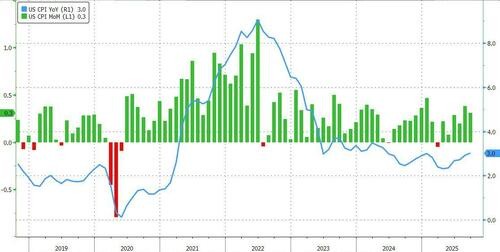
Tonight, the last CPI for the U.S. in 2025 will be released: a tug-of-war around the 3% mark, with the "20s" still being the market's biggest expectation

Wallstreetcn
2025.12.18 07:19
portai
I'm PortAI, I can summarize articles.

It is widely expected that the year-on-year increase in November's CPI will expand to 3.1% (slightly higher than September's 3.0%), while the core CPI is expected to remain at an annualized level of 3.0%. "Whether the reading falls within the 2% range or the 3% range will be crucial," analysts predict that if inflation returns to the 2% range, it will significantly boost risk appetite and may open up space for a "Christmas rally" in U.S. stocks at the end of the year; conversely, if it stabilizes above 3%, it will reinforce the narrative of "higher interest rates for longer."

As expectations for interest rate cuts fluctuate and inflation paths diverge again, the U.S. market is set to receive the last major macroeconomic data for 2025.

On Thursday local time (9:30 PM Beijing time), the U.S. Bureau of Labor Statistics (BLS) will release the November CPI data. Since the October CPI has been canceled, the BLS has made it clear that this report will not provide month-on-month data for November.

Analysts generally expect the year-on-year increase in the November CPI to expand to 3.1% (slightly higher than September's 3.0%), while the core CPI is expected to remain unchanged at an annualized level of 3.0%. José Torres, a senior economist at Interactive Brokers, stated that "whether inflation falls within the 2% range or the 3% range will be crucial," and this psychological dividing line may affect market expectations for the Federal Reserve's policy path.

In short, if inflation returns to the 2% range, it will significantly boost risk appetite and may open up space for a "Christmas rally" in U.S. stocks at the end of the year; conversely, if it stabilizes above 3%, it will reinforce the narrative of "higher rates for longer."

Government Shutdown Leads to Data Anomalies, Increasing Interpretation Difficulty

Due to the lack of October benchmark data and limited data collection time, analysts warn that this will not be a "clean" report, which may increase interpretation difficulty and market volatility.

The U.S. Bureau of Labor Statistics has made it clear that due to partial missing October data, the report will not include month-on-month changes for November. This anomaly stems from the longest government shutdown in U.S. history, lasting 43 days, which only officially ended when President Trump signed the funding bill on November 12.

Victoria Fernandez, Chief Market Strategist at Crossmark Global Investments, pointed out that "by the time the government actually reopened and began collecting data, nearly half of November had already passed, so only data from the latter half of the month could be obtained." This limitation in data collection time may create discrepancies in price performance between the latter and earlier halves of the month.

The BLS originally planned to release the November CPI report on December 10, but this was postponed to this Thursday due to the impact of the government shutdown.

Market Expectations Diverge, Key at the 3% Psychological Threshold

Wall Street analysts have differing expectations for the November inflation data. Economists surveyed by Dow Jones expect the annualized inflation rate to rise to 3.1%, with the core CPI expected to remain steady at 3.0%. However, Torres from Interactive Brokers expects the actual data may come in below expectations, with both overall and core readings at 2.9%, although he believes the overall inflation rate could range between 2.9% and 3.1%.

In the absence of month-on-month data, Goldman Sachs has used the "two-month average" data from October and November to depict trends: the average month-on-month core CPI for the two months is about 0.21%, which means the year-on-year core CPI for November may drop to 2.88%, lower than September's 3.02% and the market's general expectation of 3.0% This means that although the headline annual rate may be "rising," the underlying inflation momentum is still gently slowing. The structural clues that Goldman Sachs is focusing on include:

  • Car prices: Used car prices have risen by about 0.5% on average over the past two months, while new car prices have slightly rebounded.

  • Car insurance: Online data indicates a slight decline.

  • Airfare prices: Despite seasonal disturbances, the base prices remain relatively strong.

  • Tariff impacts: This has led to a temporary increase in core inflation (averaging about +0.08 percentage points over two months).

  • Data collection delays: This may underestimate the downward pressure on November inflation from holiday discount categories like clothing and home goods.

In terms of housing-related components, Goldman Sachs expects a technical rebound after a prior abnormal weakness, but this does not change the mid-term easing judgment; hotel prices may remain relatively strong.

Torres emphasized that if the inflation rate can drop to the 2% range rather than rise to the 3% range, "it will strengthen expectations for monetary policy easing in the last CPI report of 2025, as this would allow for more rate cuts next year." He believes that a reading of 2.9% could clear the way for what is known as the Santa Claus rally.

Due to the lack of month-on-month data, analysts believe that the market's sensitivity to this data may have decreased, but Fernandez believes the overall theme will still be that inflation "remains high" and has not returned to the 2% target as expected.

Key "Verification" for Federal Reserve Policy Considerations, Hawk-Dove Divergence May Intensify

For the Federal Reserve, the importance of this CPI report lies in whether it validates existing judgments.

Recently, Powell has emphasized risks in the labor market, believing that the impact of tariffs on inflation is more likely to be one-time. If the data is hot, it will provide a basis for hawks advocating for inaction; if the annual rate falls back to the 2% range, it will help solidify expectations for further easing in 2026.

In the recent policy meeting, two members, Schmid and Goolsbee, voted against rate cuts. Goolsbee expressed a desire to wait for more information, especially inflation data; Schmid believed there has been little change since October, the data remains incomplete, and he continues to hear concerns about inflation in his district.

The Federal Reserve's November Beige Book shows that prices rose moderately during the reporting period ending November 17. The manufacturing and retail sectors are generally facing input cost pressures, primarily reflecting price increases driven by tariffs. Multiple regions reported rising costs in insurance, utilities, technology, and healthcare.

Pantheon Macroeconomics believes that as the inflationary pull from housing and labor weakens, the Federal Reserve is forming conditions to shift back to rate cuts in the first half of 2026, possibly as early as March