Lagarde hints that the ECB is not in a hurry to act: policy is in a favorable position, no preset interest rate path, all options should be considered

Wallstreetcn
2025.12.18 17:21
portai
I'm PortAI, I can summarize articles.

Lagarde said that the central bank's interest rate policy is in a "favorable position," which "does not mean we are static." The bank will continue to make decisions based on data at successive meetings; on Thursday, the central bank did not discuss interest rate hikes or cuts, and due to current uncertainties, it cannot provide forward guidance; the eurozone economy is resilient, wages have unexpectedly risen but are expected to slow down; there is "no preference" for the next president candidate, and central bank executive Schnabel is one of the excellent candidates, urging experts to reassess whether the current executive is qualified to run for president; AI may influence the neutral interest rate by improving productivity, but it is currently uncertain, and it is too early to judge the economic impact of AI

After the European Central Bank (ECB) maintained interest rates for the fourth consecutive meeting and raised economic growth forecasts for this year and the next two years, ECB President Christine Lagarde reiterated that the central bank is in a "favorable position" regarding interest rate policy. This statement aims to balance market expectations regarding the direction of monetary policy. The ECB expects inflation to be slightly below the 2% target in 2026 and 2027, and to fully return to target levels only in 2028.

At the press conference following the ECB meeting on Thursday, the 18th, Lagarde emphasized that while the central bank's policy is in a "favorable position," this "does not mean we are static." Members of the ECB's Governing Council unanimously agreed that "all policy options should remain on the table" and will continue to adhere to a data-driven decision-making approach at each meeting, with no pre-set interest rate path. The interest rate decision on Thursday was unanimously approved.

The Eurozone economy has shown resilience, with a growth of 0.3% in the third quarter. The ECB has raised several growth and inflation forecasts, with the increase in the 2026 inflation forecast primarily due to the expected slower decline in service sector inflation. The uncertainty surrounding the inflation outlook remains higher than usual, preventing the central bank from providing forward guidance.

Lagarde also commented on her successor, stating that the ECB has "no preference" for the next president. She noted that ECB Executive Board member Isabel Schnabel is one of many excellent candidates and urged legal experts to re-examine whether the current executive board member is eligible to run for president. The final decision will be made by the European Council.

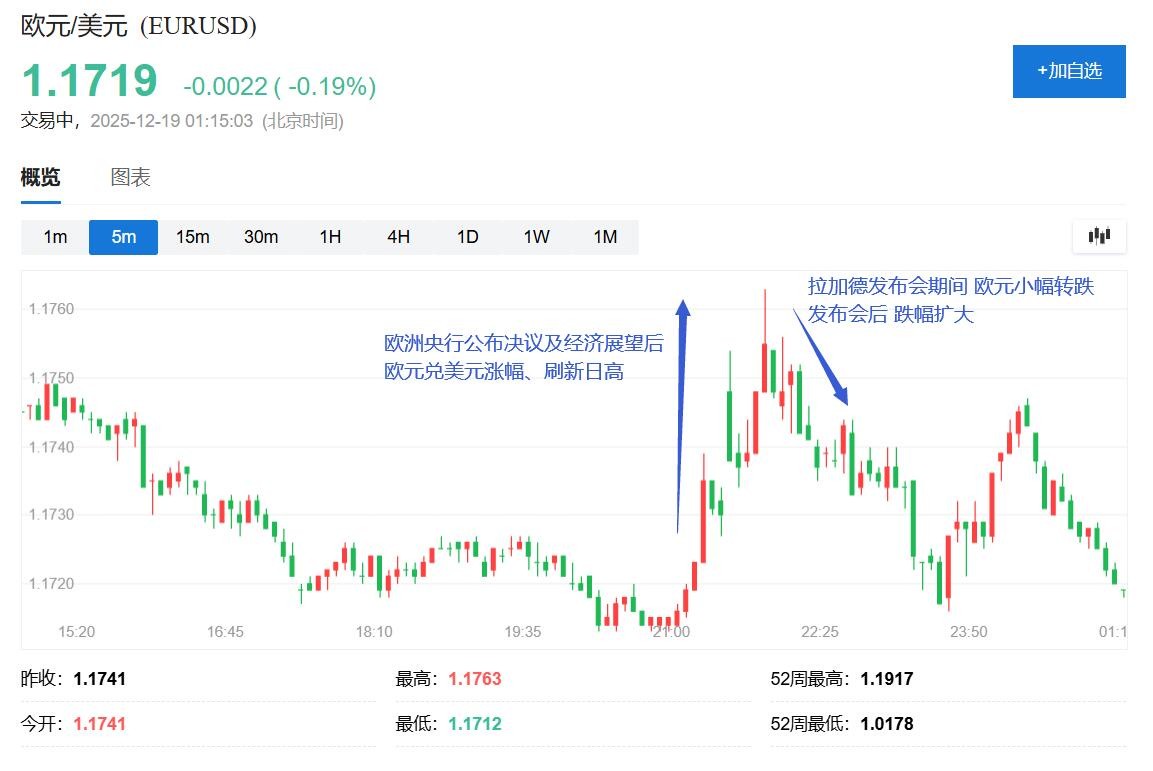
Before the ECB announced its decision, the euro fell to a daily low of 1.1713 against the dollar during European stock trading. After the announcement, the gains expanded, briefly surpassing 1.1760 to reach a daily high before retreating slightly during the press conference and falling back below 1.1720 in early trading on Wall Street. After Lagarde's press conference, the pricing in the currency market indicated that investors currently expect only about a 16% probability of the ECB raising interest rates next year.

Economic Resilience, Investment Surprises on the Upside

During Lagarde's press conference, she reiterated that the Eurozone economy is resilient, stating that service-led economic growth will continue in the short term. She said, "We believe the economy is undergoing some changes, with unexpected upside factors, particularly in investment."

This investment growth is not solely driven by public sector spending. The ECB's survey shows that investment is largely attributed to the development of artificial intelligence (AI). AI investment encompasses various aspects, including computing power, telecommunications infrastructure, and intangible asset investment.

Another unexpected upside comes from exports. Although exporters have performed better than expected in dealing with U.S. tariffs, Lagarde emphasized that the challenging global trade environment may continue to weigh on Eurozone growth in the next two years. In the coming years, domestic demand will become the main growth engine, and government spending in infrastructure and defense in European countries should support investment The European Central Bank raised its economic growth forecast on Thursday, expecting a growth of 1.4% in 2025 and 1.2% in 2026. This more optimistic outlook is partly due to Germany's infrastructure and military spending, as well as the continued strength of pharmaceutical exports from Ireland.

The Path of Inflation Decline is Bumpy, Wages are a Key Variable

Lagarde pointed out that inflation has been fluctuating "narrowly" since spring. Core inflation indicators have remained relatively stable in recent months, still aligned with the mid-term target of 2%. Inflation is expected to decline in the near term, mainly due to the past rise in energy prices dropping out of annual statistics.

ECB staff expect average inflation to remain below 2% in 2026 and 2027, with energy inflation being negative for most of that period, while non-energy inflation will gradually decline. Inflation should return to the target of 2% by 2028, partly due to a significant rise in energy inflation at that time and the introduction of the ETS2 emissions trading system.

Lagarde acknowledged, "We were unexpectedly surprised by the upward wage growth," which is the main reason for service sector inflation being higher than expected. However, surveys on wage expectations indicate that wage growth will slow in the coming quarters and stabilize below 3% by the end of 2026. Most long-term inflation expectation indicators remain around 2%.

A stronger euro may further reduce inflation. Lagarde stated that the ECB does not target exchange rates but will clearly monitor this factor.

Uncertainty Hinders Policy Guidance, All Options Remain Open

In the face of market expectations for forward guidance, Lagarde made it clear:

"I know everyone wants some forward guidance, but in the current situation, given the level of uncertainty we are experiencing, we simply cannot provide forward guidance."

She emphasized that uncertainty "has not changed much and may have worsened." Given the level of uncertainty, the ECB did not discuss whether to raise or lower interest rates on Thursday. All officials are focused on uncertainty, whether related to geopolitical issues or trade flows with overcapacity countries and situations occurring at European borders.

The uncertainty surrounding the inflation outlook remains higher than usual. Lagarde cited two-way risks: if the U.S. raises tariffs, weakening demand for eurozone exports, or if overcapacity countries increase exports to the eurozone, inflation could be lower. Increased volatility in financial markets and rising risk aversion could dampen demand, thereby lowering inflation.

Conversely, if a more fragmented global supply chain pushes up import prices, restricts the supply of key raw materials, and exacerbates capacity constraints in the eurozone economy, inflation could be higher. A slower decline in wage pressures could delay the decrease in service sector inflation, and increased defense and infrastructure spending could also push inflation higher in the medium term.

Lagarde stated that market repricing could pose risks to financial stability.

Succession Issues Emerge, Legal Obstacles to be Resolved

When asked about succession issues, Lagarde stated:

"I have no preferred candidates. There are many good candidates, and Isabel Schnabel is one of them." She added, "I find it very satisfying to some extent that so many people want my job. It's a great job where you feel you can really make a difference, impact people's lives, and work to contribute to the EU and our currency, the euro."

Regarding the legal question of whether current executive board members are eligible to run for president, Lagarde revealed that legal experts had previously reviewed this twice and deemed it impossible due to the non-renewable eight-year term. Both instances involved French citizens, once with then Vice President Christian Noyer and the other with potential candidate Benoit Coeure.

Lagarde called for a re-examination of the issue to determine "what is possible, what is not, and what the conditions are." She emphasized that "it is not clear," and further research is needed.

Lagarde insisted that she would not be involved in the selection of her successor. "As for who and what nationality, I will not comment on that. It will be decided by the European Council, and the decision will be made outside this beautiful institution." She also stated that resolving this issue would take quite a long time.

It is too early to judge the impact of AI on the economy; digital euro awaits political decision

Speaking about the impact of AI, Lagarde stated that AI is affecting economic growth in the eurozone, but it is still too early to determine whether the impact of AI will be long-lasting. She pointed out that AI could influence the neutral interest rate by increasing productivity, but there is currently too much uncertainty to ascertain this. In any case, today's meeting did not discuss this issue.

Regarding the digital euro project, Lagarde said, "This is an important moment for the digital euro because we have completed our work, but now it is up to the European Council, and of course subsequently the European Parliament, to determine whether the European Commission's proposal is satisfactory and how to translate it into legislation or make amendments."

She emphasized that the ECB's goal is to ensure that in the digital age, there is a currency that serves as an anchor for financial system stability. Currently, this anchor is central bank money, essentially physical cash. However, in the digital age, there must be a sovereign digital representation and a digital anchor for the financial system.

Issues regarding Russian assets must respect the rule of law

When asked about the EU's attempt to use frozen Russian assets to support Ukraine, Lagarde responded cautiously, emphasizing that this falls within the purview of European leaders and is an expression of foreign policy. "Central banks should neither hold political views nor make choices about what is appropriate or inappropriate."

She stated that the ECB's responsibility is to ensure that any choices made by leaders respect EU treaties, uphold international rule of law, and do not undermine financial stability. "This is within our scope of duties. Beyond that, it exceeds our authority."

However, Lagarde also expressed optimism: "Given the importance of this matter, I fully believe they will find a solution. It may proceed in the usual European way, you know, with repeated discussions, time-consuming processes, and a lot of speculation. But I believe we will find a solution because it is too important."

She reiterated that the ECB will not violate EU law but believes that EU leaders meeting in Brussels will find a solution