華爾街點評 11 月 CPI:數據偏差明顯,美聯儲不大可能因此政策轉向

Wallstreetcn
2025.12.19 07:31
portai
我是 PortAI,我可以總結文章信息。

The U.S. November CPI shows signs of cooling, but Barclays and Morgan Stanley warn that the data is distorted by technical factors such as Black Friday promotions, missing rent, and "deferred recognition," which may lead to an underestimation of the actual figures. Wall Street believes the data is insufficient to trigger a short-term shift by the Federal Reserve, with a very low probability of a rate cut in January, while still focusing on December's employment and inflation, maintaining the judgment of one rate cut each in March and June 2026

Although the U.S. November CPI data shows that inflation has further cooled, major Wall Street investment banks warn that the data is severely affected by technical distortions and statistical biases, making it difficult to accurately reflect price trends. Institutions, including Barclays and Morgan Stanley, believe that this "noisy" report is insufficient to prompt the Federal Reserve to change its policy stance in the short term.

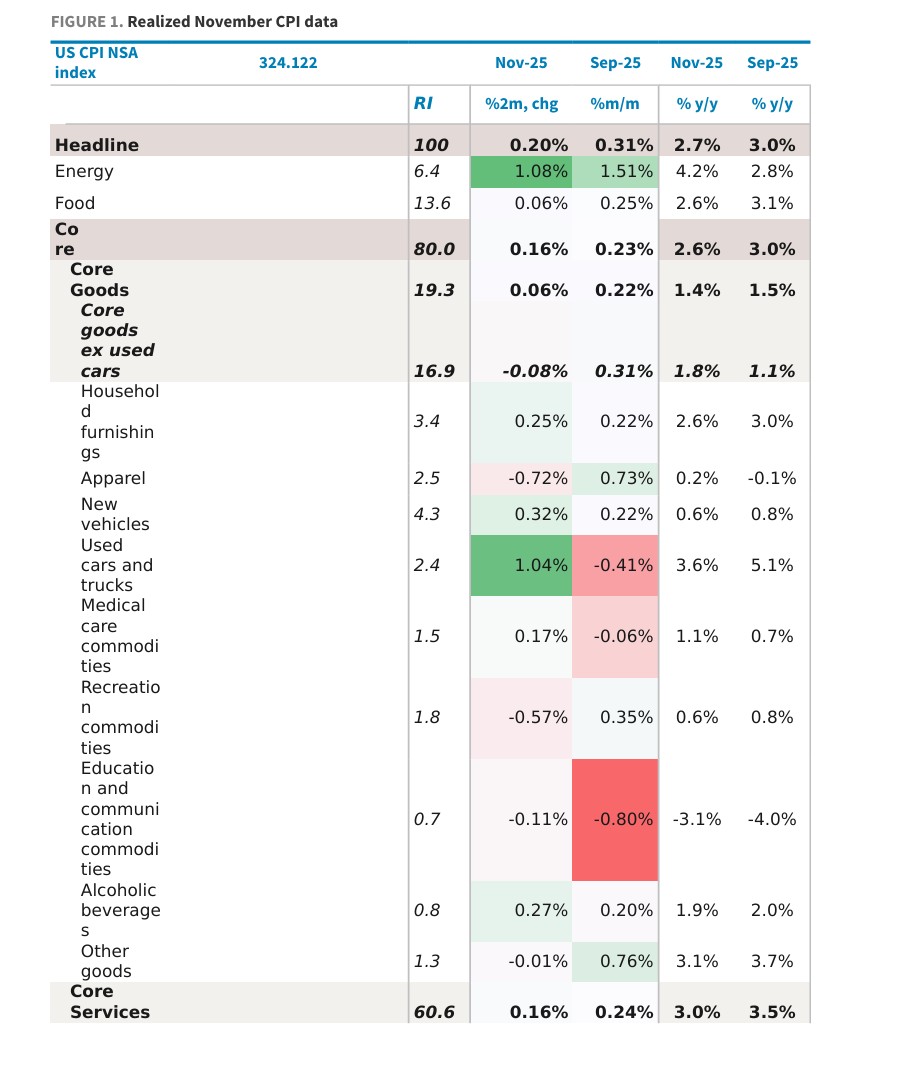
According to Wind Information, the U.S. November core CPI recorded only a 0.16% increase (based on the bi-monthly change from September to November), with the year-on-year growth rate dropping to 2.6%, significantly lower than the market expectation of 3.0%. The data from Morgan Stanley's Michael T. Gapen team also shows that the average monthly increase in core CPI for October and November was only 0.08%, well below the previously expected 0.28%.

Despite the weak surface readings, analysts believe that the timing of data collection and the handling of missing data artificially depressed the inflation figures. Barclays economists, led by Pooja Sriram, estimate that due to the concentration of price collection during the "Black Friday" promotional period, combined with issues in the calculation method for housing rent data, the actual reading of the November core CPI may have a downward bias of about 20-25 basis points.

Given the various measurement issues with the data, Wall Street generally believes that the Federal Reserve will not overreact. Barclays believes that the threshold for the Federal Open Market Committee (FOMC) to change its policy consensus remains high, and decision-makers will focus more on the upcoming December employment and inflation data rather than this distorted report. The bank maintains its forecast that the Federal Reserve will cut interest rates in March and June 2026, believing that the likelihood of a rate cut in January is extremely low.

Data Distortion and Downward Bias

The biggest controversy in this CPI report lies in the technical interference during the data collection and processing. Morgan Stanley bluntly stated in its report that this is a "noisy" data set, pointing out that the U.S. Bureau of Labor Statistics (BLS) may have used a "carry forward" method for some missing data categories, effectively assuming a 0% inflation rate, which led to an unexpected downward reading.

Barclays further dissected the two core factors leading to the bias. First is the timing issue of price collection. The report indicates that due to specific factors, price collection was limited to the second half of November, coinciding with the "Black Friday" promotional period. Historical data shows that the prices of imported goods during promotional periods are usually about 1% lower than in the first half of the month. Barclays estimates that this alone could lead to an underestimation of the core CPI by 10-15 basis points.

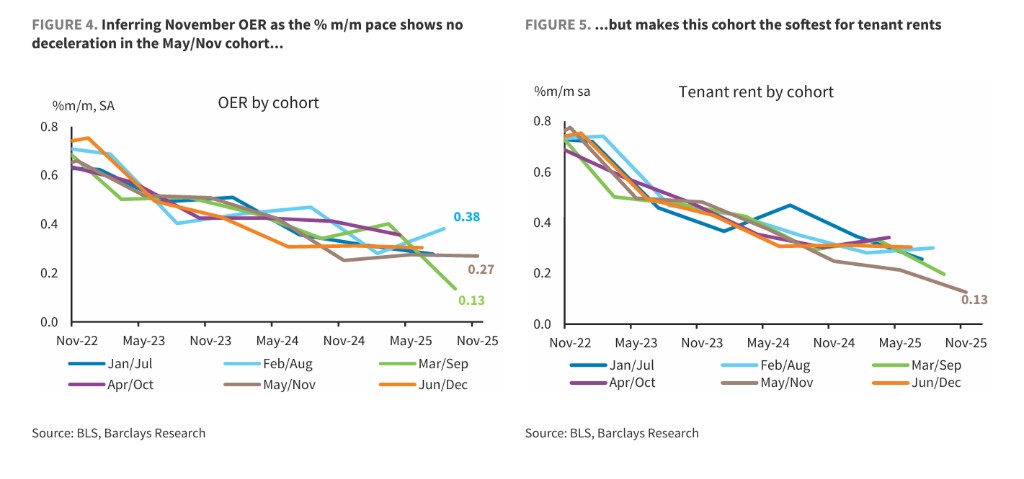
Second is the missing rent data. Due to the lack of rental and Owners' Equivalent Rent (OER) data for October, the statistical bureau may have assumed zero growth in rent when calculating. This statistical "gap filling" distorts the bi-monthly data comparison and may have a lasting interference effect on subsequent data calculations up to April 2026

Doubts About Weakness in Housing and Services Sector

Sub-item data shows that the sharp decline in housing and service sector inflation is key to lowering the overall data, but the authenticity of this trend is questioned. According to JP Morgan statistics, core service sector inflation is significantly below expectations, mainly dragged down by extremely weak readings of primary residential rents and OER.

Data from Barclays shows that reported rents only increased by 0.13%, and OER increased by 0.27% (bi-monthly increase). This means that the average monthly rent increase for October and November was only 6 basis points. Analysts express high skepticism about this, believing that even considering the trend of cooling market rents, this figure is significantly below reasonable levels, further confirming the view that there is a downward bias in the statistical methods.

In addition, core services outside of housing also showed weakness. Airline ticket prices fell sharply by 6.6% over two months, and health insurance services dropped by 2.9%. JP Morgan points out that if this slowdown in health insurance CPI continues, it may imply that this sub-item will face downward pressure of more than 1 basis point each month until April next year.

Policy Threshold Not Triggered

Although the inflation data seems to provide a reason for interest rate cuts, Wall Street analysts warn investors not to overinterpret it. Barclays takes a cautious stance, believing that due to numerous measurement issues, this report cannot provide a clear inflation path signal for the FOMC.

Barclays emphasizes in its research report that the threshold for an interest rate cut at the Federal Reserve's meeting on January 28 is very high. The indecisive voting members will focus on the December employment and inflation data scheduled for release in January to obtain more reliable economic signals.

Based on the judgment of "data noise," Barclays maintains its baseline forecast unchanged, predicting that the Federal Reserve will implement two interest rate cuts in 2026, in March and June, after which rates will remain stable until the end of 2027. Although JP Morgan has lowered its short-term inflation forecast, it also warns that if technical factors are the main cause of the current weakness, December inflation data may see a re-acceleration