"Smart money" has also been "cutting leeks" in the cryptocurrency circle this year

2025 became the most difficult year for cryptocurrency hedge funds since the crash in 2022, with directional funds down 2.5%, while fundamental strategies and altcoin-focused strategies fell by about 23% as of November. The flash crash triggered by Trump's remarks in October not only led to nearly $20 billion in leveraged liquidations but also exposed deep flaws such as weak market liquidity and lagging infrastructure
2025 will be the most challenging year for cryptocurrency hedge funds since the market crash in 2022. Policies and institutional funds have not brought an overall breakthrough to the industry, but rather highlighted the existing fragility of the market structure.
Data shows that as of November, directional funds have fallen 2.5% this year, recording the worst performance since 2022. According to Crypto Insights Group, strategy funds focusing on fundamentals and altcoins have seen deeper declines, with a drawdown of about 23%. Only market-neutral funds have achieved approximately 14.4% positive returns through hedging strategies.
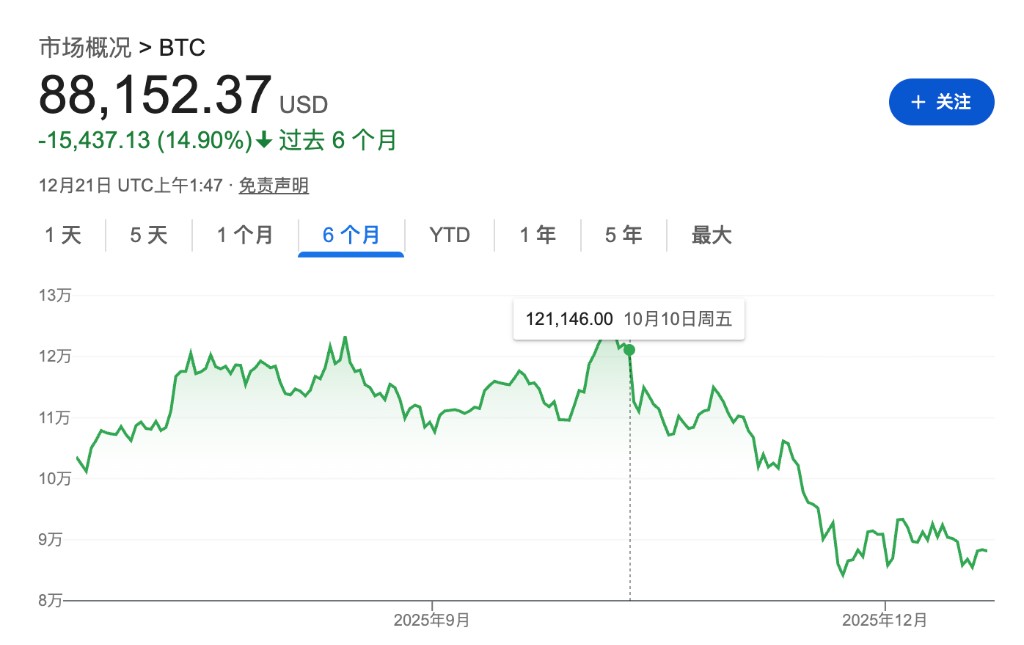
The extreme market conditions on October 10 became a key turning point for the year. The sharp drop in Bitcoin led to nearly $20 billion in leveraged positions being liquidated within hours. This market panic triggered by Trump's tariff remarks not only caused many quantitative strategies to "completely blow up," but also exposed deep flaws in the cryptocurrency trading infrastructure regarding liquidity pressure, risk control, and clearing mechanisms.
For investors, this year has highlighted that even with an improved regulatory environment and the entry of Wall Street, the cryptocurrency market still faces systemic risks such as liquidity exhaustion and lagging infrastructure. The industry is readjusting strategies internally, reducing exposure to altcoins, and turning to decentralized finance and other niche areas to seek opportunities.
Wall Street's Entry Changes the Game
Institutional funds are accelerating their inflow into the cryptocurrency market through ETFs and structured products, profoundly changing the industry ecology and competitive landscape. The once stable double-digit monthly returns are tending to disappear, and traditional arbitrage opportunities have significantly narrowed.
Taking Bitcoin spot-futures basis trading as an example, the strategy's returns have sharply declined from considerable double digits to fleeting or even zero. Paul Howard, director of market maker Wincent, pointed out that investors are using structured products with downside protection, which can reduce volatility and increase the decay of excess returns.
Although Bitcoin still shows significant volatility during periods of thinner liquidity, bringing considerable returns to early positions, the rapid switching of market conditions has made it difficult for many funds to efficiently build or exit positions. Meanwhile, Wall Street institutions are deeply involved in the crypto market, continuously narrowing spreads and further squeezing the profit margins of traditional arbitrage strategies.
Currently, the cryptocurrency hedge fund industry still exhibits fragmentation and small-scale characteristics. According to Crypto Insights Group data, the overall asset management scale of active liquidity strategies is about $12 billion to $15 billion, with typical fund management sizes of only about $30 million. Although a few large institutions manage considerable funds, most participants are still in the small to medium-sized development stage.
October Flash Crash Exposes Systemic Vulnerabilities
October 10 became one of the fastest liquidation events in cryptocurrency history. The tariff remarks from Trump's campaign team triggered a sharp market sell-off, with prices plummeting about 14% in a short period.
Thomas Chladek, Managing Director of Forteus, an asset management company under Numeus, recalled, "At that time, I was on a flight from Asia to Europe. During the flight, I checked several managed accounts and found that all positions were rapidly collapsing." Yuval Reisman, founder of Atitlan Asset Management, pointed out that this year the market has shown significant characteristics of "Trump volatility," which refers to irregular and severe fluctuations triggered by political and regulatory news.
Directional funds using subjective judgment or quantitative models saw their cumulative returns for the year nearly wiped out within a few hours that afternoon. Quantitative strategies focusing on altcoins, which had already been under pressure due to thin liquidity, reported that several fund managers encountered "complete liquidation."
The impact of this shock goes far beyond price levels. The weak links in cryptocurrency infrastructure were fully exposed: liquidity evaporated sharply, cross-exchange collateral was trapped, and risk control systems lagged severely. Several industry insiders who experienced the FTX and Terra Luna events stated that the scene of this collapse felt familiar, but its destructiveness was more shocking in a market that should have been more robust and mature.
Chladek summarized:
"Trump's tweets may have triggered risk aversion, but they should not be held responsible for an 80% collapse in certain cryptocurrencies in a single day. The fundamental issue lies in poor collateral management, which led to a chain liquidation after liquidity was withdrawn by market makers."
Altcoin Strategies Hit Hard
The mean reversion strategy for altcoins was the most significantly damaged in this round of market turmoil. During the October collapse, dozens of tokens fell more than 40% within hours, directly causing related strategy models that relied on prices to fail. Kacper Szafran, founder of the multi-manager fund M-Squared in Malta, stated, "Our exposure to such strategies was relatively limited, and we have completely exited those strategies that overly relied on the depth of altcoin order books after the event."
As a result, M-Squared fell 3.5% in October, marking its worst monthly performance since November 2022 and the largest drawdown since the fund opened to external capital earlier this year. However, the fund later achieved a 1.6% increase in November, partially recovering its losses.
In contrast, market-neutral cryptocurrency strategies performed more steadily, rising about 2% overall in October. However, these strategies require high execution precision, complex infrastructure, and continuous monitoring capabilities. Bohumil Vosalik, CEO of 319 Capital registered in the BVI, pointed out, "Well-prepared institutions can achieve total returns of 1% to 3% in less than an hour by reasonably allocating collateral across exchanges and establishing corresponding systems."
Industry Readjusts Strategies
This market collapse further exposed the reality of the lagging development of cryptocurrency infrastructure. Issues such as trading connection interruptions, market maker withdrawals, and order routing system failures erupted simultaneously. Due to the lack of circuit breaker mechanisms and central clearing systems, losses continued to accumulate and amplify According to data from Kaiko and Bloomberg, since October 10th, the trading volume of Bitcoin within a 1% range of the midpoint has significantly shrunk, while volatility continues to rise, indicating that market liquidity has not yet returned to pre-event levels. Peter Kosa, growth director at Sigil Fund, pointed out: "Overall, we have clearly observed a decline in market liquidity and an increase in volatility since October 10th."
In the face of this environment, many funds have reduced their exposure to altcoins before the end of the year, turning to the decentralized finance sector in hopes of finding space in the DeFi market, which still exhibits fragmentation and profit opportunities. However, as industry observer Szafran warned: "Some market participants may not return with the same intensity as before. This will inevitably trigger a reshaping of the overall strategic landscape."