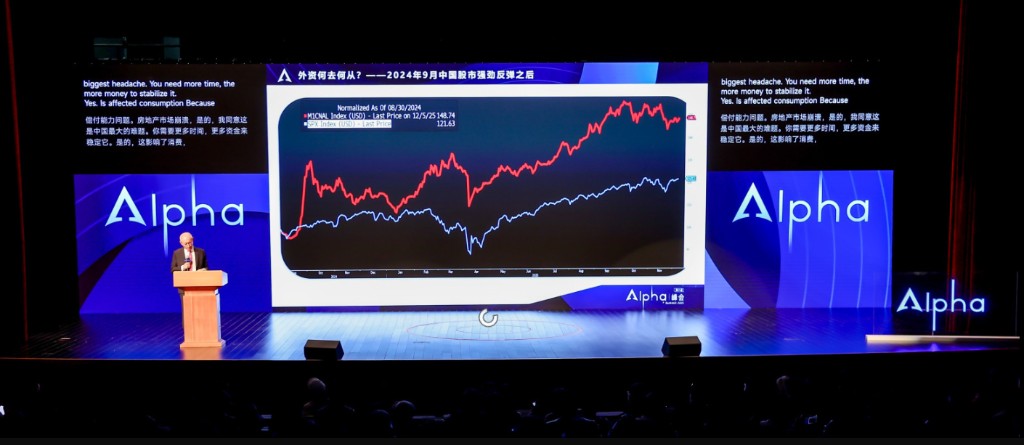
Bisheng Asset founder Wang Guohui: The long bull market has arrived, and those who label China as "non-investable" may not understand investment | Alpha Summit
Wang Guohui pointed out that those who label China as "uninvestable" either have ulterior motives or do not understand investment. He proposed a unique theory of "China MIT" — the combination of Manufacturing, Innovation, and Talent, believing that this is the core of China's economic moat. He predicts that with the repair of fundamentals and the return of foreign capital, the Chinese stock market may have entered a bull market cycle lasting several years, and by 2030, China's GDP is expected to surpass that of the United States
Exciting Insights:
- Refuting the "China is Uninvestable" Argument: Warren Buffett said it best: "If socks are cheap, I will buy a lot of socks; if stocks are cheap, I will buy a lot of stocks." Labeling China as "uninvestable" is a flawed concept. Any business can be invested in as long as the price is right. In my 44-year career in investment, I have never heard any stock market described in such a way.
- China's Stock Market May Have Entered a "Multi-Year Bull Market": By 2030, thanks to its large population, currency appreciation, and massive technological output, China's GDP is very likely to surpass that of the United States. Therefore, even if half of my predictions are correct, China's stock market may have already entered a multi-year bull market.
- Refuting "Japanification": China will not repeat Japan's deflationary crisis. Compared to Japan back then, China has an annual trade surplus of $1 trillion, a stock market price-to-earnings ratio of only 15 times (compared to Japan's 75 times), and its major banking system remains healthy.
- China's "MIT" Advantage in Manufacturing (M): China produces 34% of the world's manufactured goods. This is not just about factories, but also includes ports, high-speed rail, power plants, and a complete infrastructure ecosystem. No country can replicate and replace China in 10, 20, or even 30 years. The world has never seen a country with such a strong industrial base fall into structural decline.
- China's "MIT" Advantage in Innovation and Talent (I&T): The "innovative power" of Chinese enterprises is severely underestimated. One-third of the engineers in the R&D centers of top U.S. tech companies are Chinese. China has about 30 million STEM graduates under the age of 35, and this talent pool is top-notch and unbeatable.
- The Return of Foreign Capital is Inevitable: It is only a matter of time before Western investors return to China. If China's stock market significantly outperforms the U.S. stock market next year, it will be "professionally foolish" for fund managers to stubbornly maintain a bearish stance. Performance pressure will force them to reallocate Chinese assets.

On December 19, Wong Kok Hoi, founder, executive chairman, and chief strategist of APS Asset Management, delivered an in-depth speech on the economic outlook for China after 2025 and global asset allocation logic at the "Alpha Summit" co-hosted by Wall Street Insights and China Europe International Business School.
Wong Kok Hoi is one of Asia's most renowned fund managers, with over 44 years of global investment experience. He founded APS Asset Management in 1995, making it one of the earliest and most successful hedge fund management companies in Asia. Wong is known for his contrarian thinking and fundamental research, having accurately captured bottom opportunities in Chinese assets during times of extreme market pessimism At this summit, Wang Guohui addressed various misunderstandings about China in the global market, using detailed data and personal experiences to reconstruct the logic of China's economic growth from three dimensions: "MIT" (Manufacturing, Innovation, Talent). He candidly stated that those who label China as "Uninvestable" either have ulterior motives or simply do not understand investment.
Here are the key points summarized by Wall Street Insights:
First, I would like to thank the organizers for inviting me to share my views on the future of the Chinese stock market.
As the ancients said, "The knowledgeable do not speak, and those who speak do not know." Although I belong to the latter group, as a fund manager who has been deeply involved in the Asian market for over forty years, I would like to share my observations on why I believe Chinese assets are at a critical historical turning point.
The Notion of "Uninvestable" is Pure Fallacy
In recent years, we have witnessed an "information war" against China in the international public opinion arena. From the Peterson Institute for International Economics to various investment bank reports, there has been an attempt to argue for the "end of the Chinese economic miracle." This large-scale negative narrative has led many international investors to conclude that the Chinese stock market is "Uninvestable."
In my 44-year career, I have never heard of any market being absolutely "Uninvestable." This is a flawed concept—any business can be invested in as long as the price is right.
As Buffett said, "If socks and stocks are cheap, I buy them." Therefore, those who label China as "Uninvestable" either have some hidden agenda or simply do not understand investment.
Unfortunately, this sentiment has at times affected confidence, leading Chinese households to keep up to $22 trillion in savings in low-yield bank deposits while ignoring the stock market, which offers highly attractive dividend yields. This phenomenon, where dividend yields are several times higher than deposit rates, is unsustainable and is merely a temporary "confidence deficit." Once confidence is restored, funds will flow massively into the stock market.
China Will Not Repeat "Japanification"
Many are concerned that China will fall into a Japanese-style balance sheet recession. I worked in Tokyo in the 1980s and experienced the bubble and collapse firsthand, and I can responsibly say that China's situation is fundamentally different from Japan's back then.
First, exchange rates and trade surpluses. After the "Plaza Accord" in 1985, the yen appreciated significantly in a short period, severely impacting exports. In contrast, the renminbi has remained resilient, and China's annual trade surplus currently exceeds $1 trillion, providing strong external support.
Second, valuation differences. When the Japanese stock market peaked in 1989, the price-to-earnings ratio was as high as 75 times; in contrast, the current price-to-earnings ratio of the Chinese stock market is only about 15 times.
Third, the banking system. After the Japanese bubble burst, major banks almost all fell into distress. In comparison, China's major banks remain financially sound and are not facing systemic repayment crises.
Therefore, the economic pressures China faces today are more cyclical than structural.

Core Competitiveness: China's "MIT" Theory
I am a firm bull on China, and my confidence stems from my summary of the "China MIT" theory.
M stands for Manufacturing:
China has established itself as a world-class manufacturing powerhouse. This is not just about factories and machines, but a complete ecosystem that includes seaports, airports, high-speed rail, telecommunications, and electricity. I believe no country—whether India or other emerging markets—can replicate and replace this ecosystem in the next 10, 20, or even 30 years. China produces 34% of the world's manufactured goods, and the world has never seen a country with such a strong industrial base experience structural decline; I do not believe China will break this record.
I stands for Innovation:
There is a common misconception that China lacks innovation, with the belief that Chinese companies only understand how to apply technology. These are two different matters. A reluctance to pay for basic research and development (in the past) does not mean a lack of innovative capability.
A simple fact is: in Silicon Valley, one-third of the engineers in the R&D centers of top American tech companies are Chinese. If Chinese people were not innovative, why have these global giants been hiring them for decades?
The situation is changing. China's advancements in semiconductors and large AI models (such as DeepSeek) are evident. Statistics show that a significant number of cutting-edge scientific papers are now published by Chinese institutions. This proves that China is fully capable of transitioning from applied innovation to hard technology innovation.
T stands for Talent:
China has a vast talent pool. Currently, there are about 30 million STEM (Science, Technology, Engineering, Mathematics) graduates under the age of 35 in China. Chinese talent is hardworking, intelligent, and highly productive. I believe the talent in China (within the MIT framework) is top-notch, unbeatable, and extraordinary.
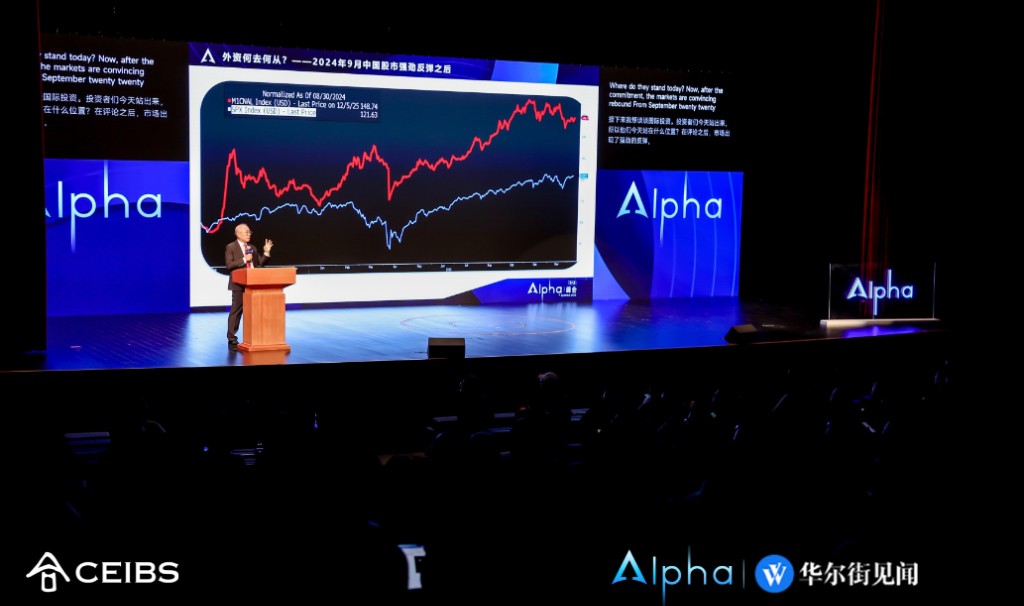
Foreign Capital Reflow and Performance Driven
We need to view the flow of foreign capital rationally. While some Western pension funds have temporarily withdrawn due to geopolitical pressures, we see that sovereign funds in Asia (such as GIC and Temasek) and Middle Eastern capital are continuing to invest.
More importantly, recently even Western private banks and some pension teams have begun to actively contact us to discuss the timing of returning to China. Why? Because for fund managers, performance is everything.
If the Chinese stock market significantly outperforms the U.S. stock market by 10%, 20%, or even 30% in the next year or two due to economic recovery, then for any global fund manager, stubbornly maintaining a bearish stance would be a "career foolishness" that is emotionally hard to bear. Because if they underperform the benchmark for three consecutive years, they face the risk of being fired. Therefore, the reflow of foreign capital is an inevitable result of market dynamics
Outlook for 2030: A Long Bull Market May Have Arrived
I am optimistic about the future. By 2030, China is highly likely to successfully transform into an innovative technology powerhouse.
With the maturation of pillar industries such as semiconductors, artificial intelligence, and biotechnology, the Chinese economy will become healthier. Based on a large population base, potential currency appreciation, and an explosion in technological output, there is a high probability that China's GDP will surpass that of the United States by 2030.
For the reasons mentioned above, I believe that the Chinese stock market may have entered a multi-year bull market cycle. For these reasons, China is very worthy of investment.
Thank you all.