a16z Annual Heavyweight Report: OpenAI Struggles to Defend, Google Goes All Out, Users Only Choose One

Silicon Valley venture capital firm a16z's latest report reveals that the consumer AI assistant market is rapidly moving towards a "winner-takes-all" landscape. The vast majority of users rely on a single product, with less than 10% of ChatGPT users utilizing other services. OpenAI leads with 800-900 million weekly active users, but its "super app" strategy faces experience challenges; Google, on the other hand, drives rapid growth for Gemini through an "experimental field" model, with the growth rate of paid users reaching nearly twice that of ChatGPT. Competition has shifted from scale expansion to a deep contest of ecosystems and commercialization
Recently, the top venture capital firm a16z in Silicon Valley released a significant annual report on the consumer AI market, pointing out that the current competitive core lies in the general AI assistant track, where users often choose only one main product, and a "winner takes all" pattern is accelerating.
The report shows that although the usage rate of AI is rising across the board, users' willingness to use multiple platforms is extremely low. Even among weekly active users of ChatGPT, less than 10% use other AI services simultaneously. Consumer data also confirms this: among mainstream products, only about 9% of users pay for multiple assistants.
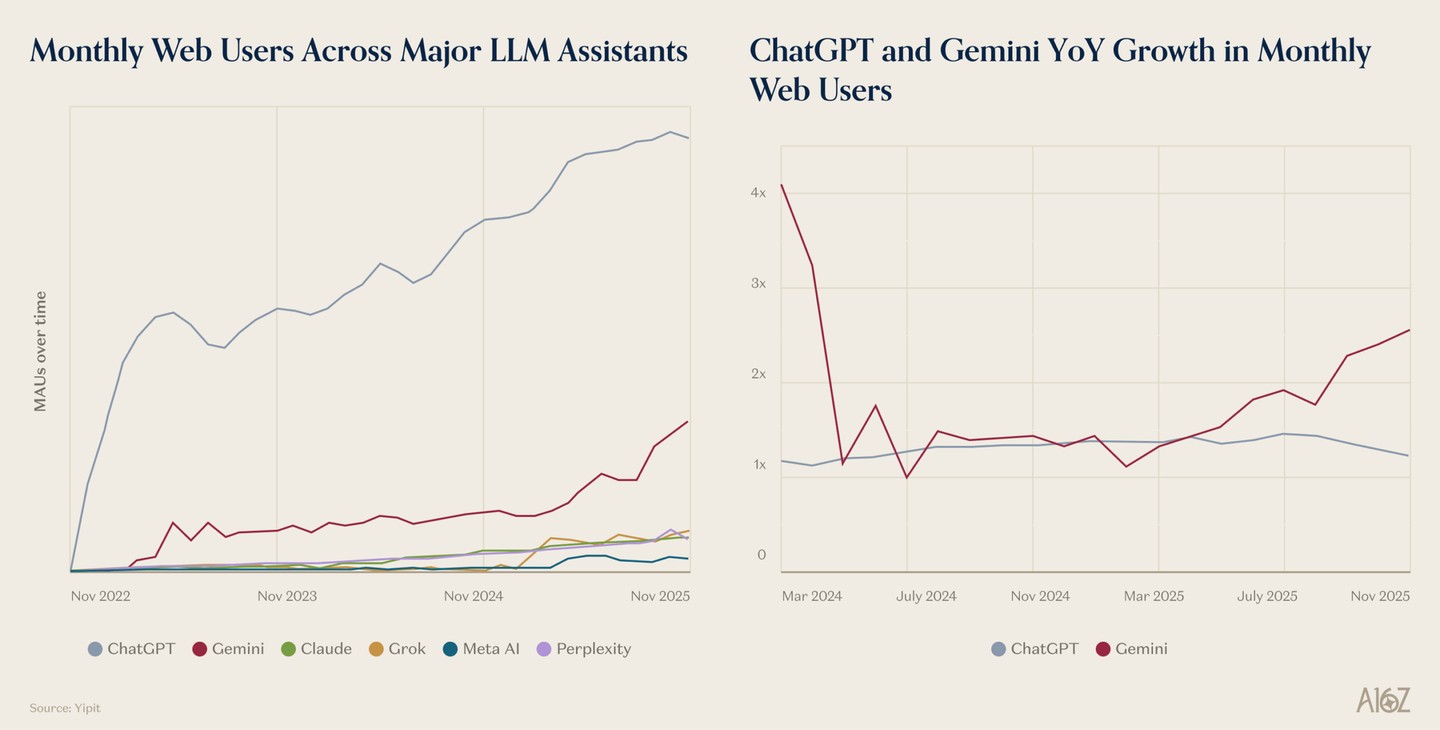
Although OpenAI still leads with 800-900 million weekly active users, its "super app" strategy is facing challenges; meanwhile, Google is rapidly catching up with its Gemini through an "experimental field" model, with desktop users growing by 155% year-on-year, and the growth rate of paid subscriptions approaching twice that of ChatGPT.
Giant Rivalry: A "Winner Takes All" Game?
The current AI assistant field faces a core question: will users really use multiple chatbots simultaneously given the many choices? The report data reveals a thought-provoking phenomenon: the vast majority of users actually rely heavily on a single AI assistant.
In the past year, even among active ChatGPT users, less than 10% have used other large model services simultaneously. Paid behavior further confirms this trend: among mainstream products, only about 9% of users have subscribed to more than one service. This supports the report's judgment: "While the competition among large language models may not be 'winner takes all', it is highly likely to form a situation where 'the winner takes most'."
Specifically, ChatGPT maintains a scale of 800 to 900 million weekly active users across all platforms, continuing to hold a historic leading position; Gemini's user numbers on the web and mobile are approximately 34% and 40% of ChatGPT, respectively. In terms of user stickiness, ChatGPT's daily active/monthly active ratio reaches 36%, nearly double that of Gemini (21%), reflecting deeper user usage habits.
However, the competitive landscape is undergoing profound changes. Gemini's desktop users have increased by as much as 155% year-on-year, significantly surpassing ChatGPT's 23%; its growth in paid users is even more remarkable, with Gemini Pro subscriptions increasing by nearly 300% year-on-year, far ahead of ChatGPT's 155% growth rate. This competition has shifted from early user scale expansion to a new stage of deep exploration of user quality and commercial value. While ChatGPT holds a first-mover advantage, Google is making every effort to catch up through continuous technological iteration and ecological synergy. The key to future competition lies in which side can more accurately grasp users' real needs and transform them into sustainable business models.
OpenAI's "Walled Garden" and Google's "Experimental Field"
In terms of product strategy, OpenAI and Google have chosen different development paths.
OpenAI tends to build a centralized ecosystem, aiming to integrate various AI needs of users into the core application of ChatGPT. This year, a series of new experiences, from daily updates of Pulse, group chat features to shopping research, have been incorporated into the existing product framework This model, while helping to consolidate user habits, also brings an increase in interface complexity. The report points out that providing an excellent experience under the existing framework faces challenges. The only exception is the independently released Sora, which has surpassed 12 million downloads, but its user retention performance still lags behind mainstream consumer applications.
In contrast, Google has adopted a more decentralized exploration strategy. The company prefers to provide independent development space for innovative products rather than integrating all features into Gemini. NotebookLM is a representative case of this model, which has continued to grow since its launch last fall, with mobile monthly active users reaching 8 million. Google has also launched a series of independent applications such as Portraits and Doppl. This "experimental field" model not only preserves a clear experience boundary for the main product but also provides room for trial and error in innovation. However, this has also brought new challenges of a dispersed product matrix and unclear user experience paths.
Differentiated Breakthroughs by Other Players
In addition to the two giants OpenAI and Google, other participants are carving out survival space through differentiated strategies.
Claude under Anthropic insists on the "professional consumer" route, deeply focusing on the technical user group. Its features such as Skills and Artifacts are clearly aimed at high-level usage scenarios, especially excelling in document and slide generation, with testing feedback indicating that it is "faster and more reliable than ChatGPT's Agent." Notably, its programming assistant Claude Code has achieved an annualized revenue of $1 billion within six months and is expected to continue receiving significant investment next year.
Perplexity also targets professional users but focuses more on serving non-technical groups that emphasize efficiency. Its core product, the AI browser Comet, and the email assistant, while not achieving viral spread, have accumulated over a million users and have been rated as "the most beloved AI browser."
The most promising dark horse this year may come from Musk's xAI. Its product Grok started from scratch and reached 38 million monthly active users by mid-December. The growth of this product benefits from its deep integration with the X platform and establishes an advantage through distinct personality settings and rapid iteration: it was the first to launch an AI companion with animation effects and quickly integrated cutting-edge features such as text-to-video, image-to-video, and voice synthesis. Industry observers note, "This may be the fastest-evolving AI product in terms of current capabilities."