What other thematic investment opportunities can be focused on after commercial aerospace and nuclear fusion?

Wallstreetcn
2025.12.22 04:00
portai
I'm PortAI, I can summarize articles.

Last week's market adjustment was mainly due to global liquidity pressure, anxiety over the overseas "AI bubble," and the A-share Q4 "settlement season" game. This week, the slowdown in U.S. inflation in November, a decrease in October non-farm payrolls, Japan's interest rate hike of 25bp, and the potential investment from the UAE sovereign wealth fund into OpenAI have alleviated global investor anxiety. The market welcomes a repair opportunity, with expanding domestic demand as the primary task. It is recommended to focus on two main lines: 1) Low-end applications in the AI direction, such as AI healthcare and intelligent driving; 2) Key industries involved in the "14th Five-Year Plan," such as commercial aerospace, 6G, nuclear power, and hydrogen energy

Viewpoint: Last week, we discussed that the recent market adjustment mainly stemmed from three factors: global liquidity pressure, anxiety over the overseas "AI bubble," and the A-share Q4 "settlement season" game. This week, the unexpected slowdown in U.S. inflation in November and the better-than-expected decrease in October non-farm payrolls, along with Japan's scheduled interest rate hike of 25 basis points, have somewhat alleviated global investors' anxiety over the "AI bubble." Since December, several major uncertainties that have suppressed liquidity and risk appetite in domestic and foreign markets have gradually materialized, providing a good opportunity for market recovery. Directionally, we previously suggested that the economic work conference in mid-2025 would lean towards "structural adjustment," and the market may exhibit structural trends. Expanding domestic demand is the primary task, but the wording is expressed as stable and positive rather than urgent. Meanwhile, economic and financial data for November indicate that the domestic economic fundamentals still need to be consolidated, making it difficult for related directions to achieve trend excess in the short term. Technology industry trend varieties are more likely to gather consensus among funds. Currently, investors have a relatively thorough understanding of the cyclical segments in AI computing power, chips and semiconductors, and energy storage. What other investment opportunities exist in the broader technology theme and track direction?

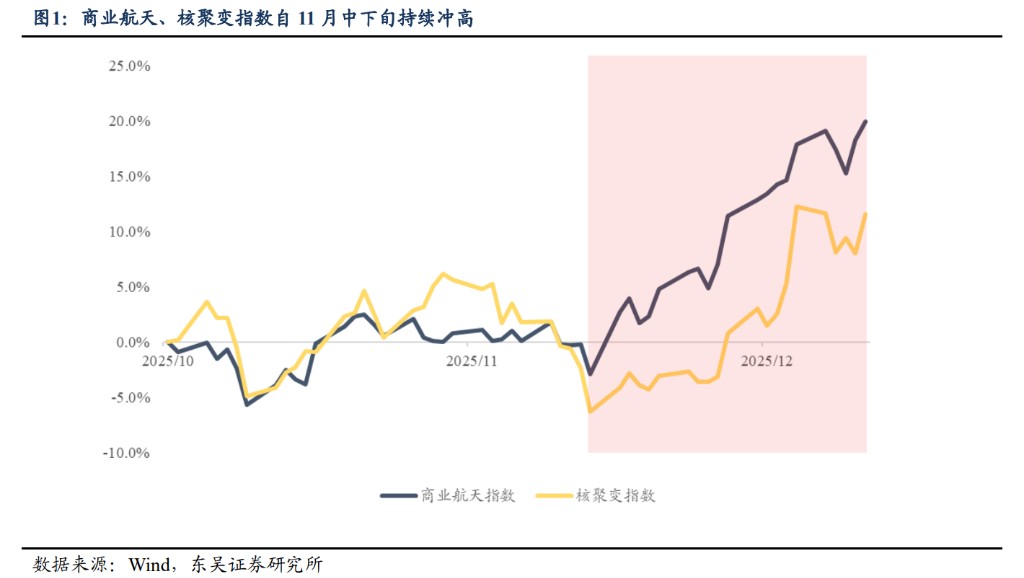
Next year marks the first year of the "14th Five-Year Plan." Historically, the market often has high expectations for industries involved in advance. As a future industry branch resonating with domestic and foreign industrial trends, the commercial aerospace sector has shown strong sustainability and profitability since mid to late November. However, the trading time for the sector has been nearly 20 trading days, and the excess relative to the growth style benchmark has significantly widened. From the perspectives of time and space, the difficulty of subsequent participation may increase, and there have been signs of switching to lower-positioned nuclear power and other branches recently. Considering factors such as chips, positions, and catalytic density, this article outlines some potential directions. It is recommended to focus on two main lines: 1) Low positions in the AI application sector, emphasizing the odds trading of diffusion branches, and paying attention to AI medical applications, AI edge computing, intelligent driving, and embodied intelligence; 2) Key industry branches related to the "14th Five-Year Plan," focusing on commercial aerospace and 6G, nuclear power, hydrogen energy, quantum communication, and brain-computer interfaces.

Low-position directions in the broader AI branch: AI medical, edge computing, intelligent driving, embodied intelligence

➢ AI Medical

AI large models have deep application potential in fields such as pathological detection and pharmaceuticals. AI + pathological detection helps improve diagnostic efficiency and reduce missed and misdiagnosed cases, with the core pain point being the establishment of high-quality medical data sets and the breaking down of data barriers. In November, the National Health Commission issued the "Implementation Opinions on Promoting and Regulating the Application Development of 'Artificial Intelligence + Medical and Health,'" proposing to establish a number of high-quality industry data sets and trustworthy data spaces by 2027, forming a number of excellent specialized large models and applications for specific diseases and specialties, and strengthening the application of AI models in intelligent diagnosis, intelligent rehabilitation, and infectious disease monitoring. Recently, Alibaba's medical model, Antifufu, surged to the top three in the iOS App Store rankings, reflecting the core demand of the C-end for achieving "inclusive healthcare" and instant health services through professional models. With the deepening of data sets and innovation in application models, more blockbuster medical large models are expected to emerge in the future In addition, the penetration of AI models in the pharmaceutical field is expected to significantly reduce the cost and time cycle of drug discovery, accelerate target development and verification processes, and lower the risk of failure through simulated clinical trials. This is also an important long-term industrial trend in AI healthcare.

➢ AI Edge

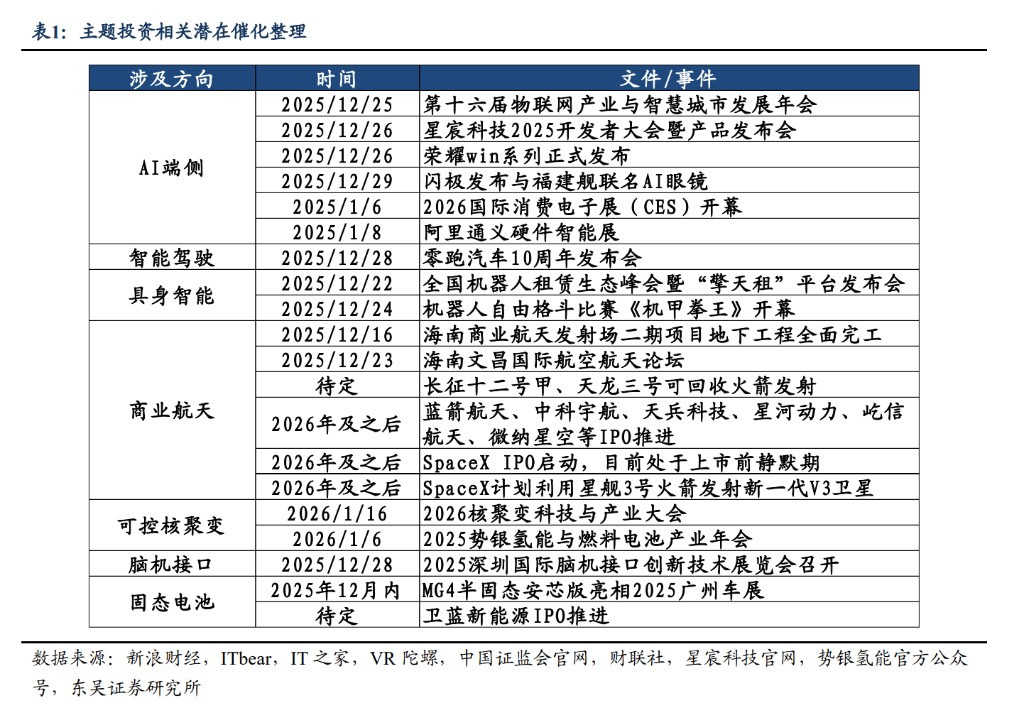
ByteDance explores the "traffic port + AI phone" model, which has the positive significance of being the "first to eat the crab." On December 1, ZTE Corporation and ByteDance launched the Doubao phone assistant. Although the business model still needs refinement, there are currently unresolved issues regarding data privacy protection, competition for traffic among giants, ecological conflicts, and profit distribution (applications like WeChat, Alipay, and banking apps prohibit executing data retrieval commands for Doubao phones). However, as a pioneer, the Doubao first-generation device is actually the starting point of the industrial trend rather than the endpoint: in addition to hardware technology upgrades, different participants such as operating systems, application developers, and regulators have gained a more concrete understanding of the opportunities and differences in industrial development, leading to their respective response strategies and efforts. The development of AI phones is expected to accelerate. The product capability of AI glasses is rapidly improving, awaiting cognitive penetration and order release. From the new models launched in November to December, whether it is Alibaba's Quark glasses or Li Auto's Livis glasses, they have basically balanced the four major issues of weight, performance, battery life, and cost. Quark glasses have seen explosive sales and were once out of stock. The market for AI glasses has a foundation for volume growth, and after entering the initial realization period of 1-10 order volume, further expansion of the market level requires consumer cognitive penetration and signals of confirmed order releases. In the short to medium term, the edge industry catalysis is relatively intensive, including the December launch of new Flash AI glasses, the CES conference overseas in early January next year, Alibaba's Tongyi hardware conference, and the expected release of Project Aura glasses jointly developed by Google and Xreal next year.

➢ Intelligent Driving

The domestic L3 road testing is expected to bring an increase in the value of intelligent driving hardware, and the Robotaxi business model continues to be validated. On December 15, the first batch of L3 autonomous driving models from Changan and Arcfox began pilot testing in designated areas of Beijing and Chongqing. XPeng and Xiaomi have recently obtained L3 road test licenses, and the commercialization of L3 intelligent driving applications is beginning to accelerate. Core component suppliers are expected to benefit from the value increment in L3 compared to L2 in areas such as lidar, high-performance chips, and intelligent chassis (steer-by-wire/braking). In addition, domestic Robotaxi leading companies, such as WeRide and Pony.ai, have reported high revenue growth in their latest financial reports and intelligent driving business. At a media exchange on December 16, the head of Pony.ai stated that the single-vehicle profitability of their Guangzhou fleet has achieved balance, and the Robotaxi business model has initially been validated. Besides the intelligence of the vehicles themselves, the "vehicle-road-cloud" intelligent transportation infrastructure direction is also included in the long-term goals of the "Transportation Power" outlined in the 14th Five-Year Plan. Overseas, Tesla has started road testing without safety drivers in Austin, and the visibility of L4's ultimate goal is becoming clearer, with plans to reach a fleet size of 500 vehicles by the end of the year. Recently, Tesla's stock price surged to a new high, which has positive implications for the A-share intelligent driving sector in terms of sentiment mapping ➢ Embodied Intelligence

The humanoid robot sector is set to see two significant industrial catalysts domestically and internationally, with the core of trading focused on scene implementation. The T-chain audit is nearing completion in December, and the subsequent market's core focus on catalysts includes the completion of the IPO counseling for Yushu Robotics and the rollout of Tesla's Optimus V3 product. The robotics sector has also entered the order verification stage; whether it is the T-chain or domestic chain, the subsequent market trend is unlikely to have the same sustained sector-level momentum as seen from January to March this year, especially given the vague industry ceiling guidance from figures like Musk. More importantly, whether humanoid robots can truly be implemented in industrial scenarios, such as CATL's recent large-scale introduction of robots into the new energy power battery PACK production line, and whether efficiency can be improved to create a mimetic effect within the industry, is a core focus for the entire sector in the "10-100" phase. If the aforementioned industrial signals are not observed for the time being, more attention should be paid to structural changes, such as the application of new materials, the increase of joint components, and whether listed companies can distinguish genuine suppliers from false ones.

"14th Five-Year Plan" Supporting Industries: Commercial Aerospace and 6G, Nuclear Power, Hydrogen Energy, Quantum Communication, Brain-Computer Interface

➢ Commercial Aerospace and 6G

Commercial aerospace has become a high ground for major powers' space competition and is an industrial trend resonating between China and foreign countries. China's 14th Five-Year Plan proposes the construction of a "strong aerospace nation," and the development of commercial aerospace falls within the core scope of a strong aerospace nation. Additionally, the establishment of the Commercial Aerospace Administration and the release of the "Action Plan for the High-Quality and Safe Development of Commercial Aerospace (2025-2027)" indicate a strategic emphasis at the policy level. Furthermore, the Trump administration signed the executive order "Promoting Competition in the Aerospace Industry" back in August this year, easing restrictions on commercial aerospace under the dual narrative of national security and economic revitalization. Musk's SpaceX $1.5 trillion IPO is also supported by U.S. aerospace policy. From the perspective of major power competition, the narrative of accelerated development in commercial aerospace, characterized by "seizing orbits and occupying frequencies," is fundamentally difficult to falsify in the medium term. Moreover, commercial aerospace and satellite internet are crucial components in building a new generation of communication systems—6G. The Fourth Plenary Session also included "sixth-generation mobile communication" in the forward-looking layout of future industries in the 14th Five-Year Plan. With the continuous improvement of space infrastructure in commercial aerospace, the 6G application end, centered on satellite communication, is expected to welcome development opportunities.

From an industrial logic perspective, the market for commercial aerospace may need to take "two steps." In this round of commercial aerospace market activity, the core trading anchor is the launch of reusable rockets such as the Zhuque-3 and Long March 12A. Reusable rockets are the core pain point for unlocking the domestic commercial aerospace model, so the first phase of the two-step approach will focus on rocket recovery technology. In the short term, the sector's rhythm is strongly correlated with launch expectations, and after sufficient trading around launch competition, the market may shift to the second phase anchored in value investment in key segments. Subsequent event catalysts for the sector remain dense, including the launch expectations for Long March 12A and Tianlong-3, with the Hainan Wenchang International Aerospace Forum scheduled for next week. Looking ahead, there are also IPO progress catalysts for commercial aerospace unicorns such as Blue Arrow Aerospace, CAS Space, and Tianbing Technology; overseas, SpaceX plans to launch the next-generation V3 satellite using the Starship 3 rocket next year, which has significantly increased payload capacity and is also worth attention ➢ Nuclear power and controllable nuclear fusion projects such as BEST are accelerating bidding, with component manufacturers' order expectations gradually being fulfilled.

According to statistics from the bidding official website, from December 1 to December 12, the total amount of winning projects announced by the Hefei Institute of Plasma Physics of the Chinese Academy of Sciences and Fusion New Energy Anhui reached 2.402 billion yuan, a significant increase compared to the bidding amount in November. As a relatively promising branch in the 14th Five-Year Plan's future industry sectors, the nuclear fusion sector has taken the lead in achieving a rebound with a high slope, especially during the short-term stagnation of commercial aerospace. The construction of a strong energy nation in China resonates with the narrative of the AI energy crisis in North America. At the end of the year, the Central Economic Work Conference will formulate a planning outline for the construction of a strong energy nation, accelerating the establishment of a new energy system. The narrative of power shortages in North America is also gaining momentum, with NVIDIA holding a closed-door summit on the "power crisis" from December 16-19, and the Trump Media Technology Group planning to collaborate with the nuclear fusion company TAE to develop nuclear fusion projects in 2026. In summary, although large-scale utilization is still a long way off, controllable nuclear fusion and thorium-based nuclear fission are supported by medium- to long-term narratives as important industrial trends for future power energy.

➢ Hydrogen energy's downstream green alcohol demand has certainty, and direct connection to green electricity + cost reduction of equipment is gradually making hydrogen production economically viable.

Against the backdrop of "dual carbon" goals, hydrogen energy, as an important part of green electricity, has not yet commercialized due to high production costs, significant downstream infrastructure expenditures, and insufficient safety guarantees. The EU carbon tax and IMO policies are pushing the shipping industry towards greening, and the trend of green alcohol applications is becoming clear. Green hydrogen, as the upstream raw material for green alcohol, is expected to benefit from downstream prosperity. Additionally, through the direct connection model of green electricity, hydrogen production can utilize wasted wind and solar energy in the mainland, while the continuous reduction in related equipment costs is expected to significantly enhance the economic viability of hydrogen production projects. Many factors that have delayed its commercialization process are expected to gradually improve with strong support from subsequent policies.

➢ Quantum communication is the main battlefield for major power competition in the future communication field.

China is in a leading position in the "first echelon" of the quantum field. On December 5, the Ministry of Industry and Information Technology announced the "Plan for the Establishment of the Quantum Information Standardization Technical Committee," promoting the standardization and upgrading of China's quantum industry. Recently, the White House's "National Development Strategy" emphasized that the U.S. should lead the development of industries and standards in the field of quantum computing, highlighting the strategic position of quantum communication in cutting-edge technology. At the G7 ministerial meeting in Montreal, new commitments regarding artificial intelligence, quantum technology, digital infrastructure, supply chain security, and industrial competitiveness were proposed. The commercialization of the quantum field is currently in its early stages, with the core still dependent on whether there are significant technological breakthroughs or national-level policy support to catalyze development.

➢ Brain-computer interfaces belong to the future industry sectors of the 14th Five-Year Plan, with relatively fast industrial implementation.

The domestic non-invasive route is leading, while invasive technology has recently achieved breakthroughs in clinical trials. Invasive technology involves challenges such as chip miniaturization and flexible electrode adaptation to the human brain, with overall high barriers. The non-invasive track is relatively fragmented. On December 17, the Chinese Academy of Sciences' Center for Excellence in Brain Science and Intelligent Technology announced the second clinical trial of an invasive brain-computer interface conducted in cooperation with domestic research institutions and medical units, achieving a significant transition from controlling a two-dimensional screen cursor to interacting with the three-dimensional physical world Currently, brain-machine interfaces are already applicable in clinical hospitals and have been included in the medical insurance coverage, with commercialization progressing relatively quickly. The main important catalyst is the potential breakthrough in domestic invasive technologies, while the short-term catalyst is the upcoming Shenzhen International Brain-Machine Interface Innovation Technology Exhibition.

Risk Warning and Disclaimer

The market has risks, and investment should be cautious. This article does not constitute personal investment advice and does not take into account the specific investment goals, financial conditions, or needs of individual users. Users should consider whether any opinions, views, or conclusions in this article are suitable for their specific circumstances. Investment based on this is at one's own risk