


Robotaxi is entering the "China Moment"

Raging Storm
On December 21, Waymo, the global leader in Robotaxi, attracted significant attention due to widespread parking at multiple intersections.
The incident was caused by a power outage affecting traffic lights in San Francisco, rendering them inoperative.
Waymo's Robotaxi, unable to flexibly respond to unexpected incidents like extinguished traffic lights, opted for what seemed to be a "safer" operation of stopping at the intersection.
This incident serves as a warning for the domestic Robotaxi fleets that are about to surge.
Looking back at 2025, the capitalization of China's Robotaxi sector has been accelerated.
According to incomplete statistics from Xinfeng, several companies, including Hello, DiDi, Pony AI, and WeRide, have completed new rounds of financing this year, with a total financing amount exceeding 10 billion.
This provides ample ammunition for each company's Robotaxi fleet expansion in 2026.
Based on the current disclosed target fleet sizes for 2026, it is estimated that by 2026, the combined Robotaxi fleet size of Pony AI, WeRide, and DiDi is expected to reach 8,000 vehicles.
China's Robotaxi is approaching the milestone of 10,000 vehicles.
In contrast to competitors, Baidu's Apollo Go, as the domestic Robotaxi NO.1, remains unusually low-key.
So far, Apollo Go is still just a business unit of Baidu and has not independently sought external financing, leaving much to the imagination.
Behind this "restraint," Apollo Go is also planning to expand its operational scale. Recently, Li Yanhong stated at a financial report meeting that there are plans to increase vehicle deployment in existing operational cities and expand to more new cities by 2026.
Although many believe that 2026 will be the year of large-scale Robotaxi deployment, there are still many challenges to be addressed.
On one hand, as Robotaxi moves towards scaling, the stability of each company's technology will be exposed, and those who can truly control accident rates and average takeover mileage may have a better chance of winning in this fierce competition;
On the other hand, as a critical transition from "human-machine co-driving" to "fully autonomous driving," the implementation of Level 3 autonomous driving brings more urgency to the expansion of the Robotaxi industry.
Rise of the Warlords
The biggest change in China's Robotaxi sector by 2025 is the increasing number of entrants, leading to a competitive landscape of "warlords rising."
Previously, participants in the domestic Robotaxi sector were mainly concentrated among three autonomous driving technology companies: Apollo Go, Pony AI, and WeRide.
However, now, travel platforms and OEMs holding traffic entry points are joining the fray.
Currently, domestic Robotaxi players can be divided into three categories:
- Autonomous driving technology players represented by Baidu's Apollo Go, Pony AI, and WeRide;
- Travel platforms represented by DiDi, Ruqi Mobility, Cao Cao Mobility, Hello, and Amap;
- OEMs represented by XPeng However, these three types of players are currently brewing a complex relationship of competition and cooperation, presenting a triangular model of "AI autonomous driving company's algorithms + OEM's mass-produced vehicles + mobility platform's order network."
For example, Pony AI has collaborated with BAIC Jihu, GAC Aion, and Toyota to develop the seventh-generation Robotaxi model; DiDi has partnered with GAC Aion to develop L4-level Robotaxi;
XPeng's Robotaxi has opened its SDK interface to Amap, with the latter expected to be responsible for operations in the future.
Behind this is the survival anxiety of China's Robotaxi companies.
In China, whether it is the third-party autonomous driving technology companies still struggling in the quagmire of losses or the OEMs constrained by the pressure of "selling cars," it is difficult for them to independently support the Robotaxi, which requires years of continuous investment.
In contrast, global Robotaxi leader Waymo, backed by Google, the largest "financial backer," has nearly unlimited funding to bear the pressure of the entire chain from algorithm development to heavy asset operations.
Even so, Waymo is also planning external financing. According to market media reports, Waymo is negotiating a new round of financing at a valuation of $100 billion.
In this context, cooperation has become the optimal solution for Chinese players to share risks and allocate resources.
The cost advantage based on the supply chain is an important strength for Chinese Robotaxi players.
Pony AI's CFO Wang Haojun believes that, compared to Waymo, the current significant advantage of Chinese companies lies in cost.
"If we look at Pony AI's seventh generation and the ZEEKR or Hyundai vehicle that Waymo is about to launch this year, we currently see that their vehicles are more than 4-5 times more expensive than ours. This means that if we compete in the same overseas market, Chinese companies will have a much better cost advantage in this regard," Wang Haojun pointed out.
According to Wang Haojun's further explanation to Xinfeng: "On one hand, from Waymo's perspective, there is no need to tell Google that I need to reach single-vehicle balance quickly before expanding; rather, even if I initially invest a few thousand vehicles and lose tens of billions, it may not be a big deal for Google. This mindset leads to different cost control on today's vehicle models. On the other hand, the hardware costs that today's Chinese supply chain can achieve are much lower than those of the American supply chain."
Referring to Waymo's growth path, the core logic of forming a business closed loop is to invest as many Robotaxis as possible to create economies of scale, seize market share, and dilute unit operating costs.
Ten Thousand Vehicles Imminent?
From the multiple financings in the autonomous driving sector this year, one can sense the smoke of a major battle about to break out.
In the second half of this year, Hello's Robotaxi business and DiDi Autonomous Driving completed financing of 3 billion yuan and 2 billion yuan, respectively; subsequently, Pony AI and WERIDE went public on the Hong Kong Stock Exchange on the same day, with IPO fundraising amounts reaching 6.1 billion yuan and 2.2 billion yuan, respectively, totaling over 13 billion yuan in financing. 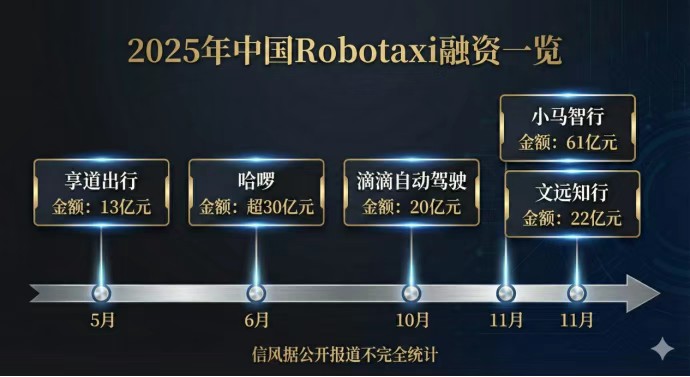 Analyzing the fundraising directions, it is primarily aimed at the expansion of Robotaxi fleet size.
According to incomplete statistics from Jixinfeng, the 2026 Robotaxi fleet size targets for Pony AI, WERIDE, and DiDi are expected to be 3,000 vehicles, 2,000-3,000 vehicles, and 1,000-2,000 vehicles respectively, totaling an expected 8,000 vehicles.
The milestone of 10,000 Robotaxis in China may no longer be far off.
In summary, the reasons why various companies choose to expand their fleet size in 2026 are as follows:
First, the decline in per-vehicle costs this year has released more profit space;
The company with the best performance in per-vehicle costs domestically is LoBo KuaiPao.
Currently, the cost of LoBo KuaiPao's sixth-generation unmanned vehicle is 204,600 yuan, a 60% reduction compared to the fifth generation, about 1/7 of Waymo's cost, and around 70% of the cost of Pony AI's seventh-generation vehicle; the BOM (Bill of Materials) cost of Pony AI's seventh-generation autonomous driving kit has decreased by 70% compared to its sixth-generation model.
The decline in hardware costs provides the confidence for accelerated fleet expansion.
Second, some autonomous driving technology companies have already achieved a positive unit economics model in certain cities, and the possibility of profitability has been preliminarily verified, which means that scalable profitability is expected to be realized in the future;
This year, LoBo KuaiPao and Pony AI achieved breakeven at the unit level in Wuhan and Guangzhou respectively, breaking away from the past situation of "losing money on every vehicle"; WERIDE is about to achieve unit breakeven in Abu Dhabi.
Third, policies are gradually being relaxed.
In December this year, the Nansha District of Guangzhou officially issued the "Implementation Guidelines for Open Roads for Unmanned Driving Equipment in Nansha District, Guangzhou (Trial)," implementing graded management for open roads for unmanned driving equipment across the district, and becoming the first administrative district in the city to publicly announce an open road area without application.
This means that qualified Robotaxis can operate on designated roads, significantly simplifying the process and reducing compliance and time costs for operations.
HSBC expects regulatory authorities to issue more licenses to operators and open more service areas. Taking Guangzhou as an example, it is expected that Robotaxi services will soon cover the entire city, rather than being limited to a few areas like Nansha.
However, amidst this fundraising boom, LoBo KuaiPao is an exception.
Whether in terms of per-vehicle costs, fleet size, or accumulated mileage, LoBo KuaiPao is undoubtedly the NO.1 player in the domestic Robotaxi sector.
Currently, LoBo KuaiPao has spread across 22 cities worldwide, including Beijing, Shenzhen, Wuhan, Chongqing, Shanghai, Hong Kong, Dubai, and Abu Dhabi.
As of the end of October this year, LoBo KuaiPao's total service order volume exceeded 17 million, with a total driving mileage of over 240 million kilometers, of which the fully unmanned driving mileage exceeded 140 million kilometers, making it the only company in the domestic Robotaxi sector with fully unmanned driving mileage close to that of Waymo.
Although Li Yanhong stated at the earnings conference that he plans to increase vehicle deployment in existing operating cities while expanding to more new cities by 2026, he has not promoted LoBo KuaiPao to expand its fleet through external financing An insider from Baidu confirmed to Xinfeng that Luobo Kuaipao is still just a department of Baidu's business and has not independently sought external financing.
This may be related to Baidu's stronger self-sustaining capabilities. Compared to independent Robotaxi players like Pony AI and WERIDE, Luobo Kuaipao, backed by Baidu, can obviously obtain more financial support.
However, at this moment when large-scale capital expenditure is required, whether Luobo Kuaipao, which has not engaged in much financing, can first establish a commercial closed loop remains to be observed. 
Singularity Moment or Experimental Year?
Amid the capital frenzy and fleet expansion, whether 2026 will be the singularity moment for Robotaxi or another experimental year is still shrouded in the dual fog of technology and commercial competition.
Although the financing amounts and vehicles from various companies seem to have laid the groundwork for scaling, there are still many uncertainties facing major players in truly transitioning from experimentation to city-wide deployment.
The biggest variable comes from the stability of technology.
Even with policy support, Robotaxi can exit the demonstration zone, but when entering the "old city" with complex road conditions and dense unstructured roads, the autonomous driving system will still face exponentially increasing random risks.
For example, the absolute number of accidents after scaling may rise with the expanding base.
On December 6, a test vehicle marked with "Hello Autonomous Driving" in Zhuzhou, Hunan, was involved in an accident that rolled a pedestrian under the vehicle. Currently, Hello has suspended its business operations and is cooperating with the investigation.
This incident has also cast doubt on Hello Robotaxi's declaration of "completing in two years what other players take ten years to achieve."
Large-scale operations may also bring more friction with cities. For instance, on December 21, a fire at a Pacific Gas and Electric Company substation caused widespread power outages, leading to malfunctioning traffic lights in San Francisco. Waymo, unable to perceive the status of the extinguished traffic lights, stopped in the middle of the road, causing local traffic congestion and trapping several passengers inside the vehicle.
From a longer-term perspective, the Robotaxi industry may also face competition from the passenger car sector.
Robotaxi not only has to contend with competition from traditional ride-hailing services like DiDi but also from passenger vehicles.
As early as 2016, Elon Musk proposed the idea of "turning Tesla vehicles into a shared fleet for profit." Now, ten years later, Tesla is indeed getting closer to this vision, having recently launched autonomous Robotaxi road tests in Austin, Texas, with test vehicles not equipped with any passengers.
At the same time, there seems to be a glimmer of hope in the domestic market.
Recently, the Ministry of Industry and Information Technology officially announced the first batch of L3-level conditional autonomous driving vehicle access permits in China, with one pure electric sedan each from BAIC Arcfox and Changan Deep Blue selected, starting road trials in designated areas in Beijing and Chongqing This implementation has restructured the driving responsibility chain. According to the national standard "Levels of Automation for Vehicle Driving," at Level 3, under specific conditions, the driving control and accident liability shift from the driver to the system itself.
Many industry professionals believe that while it is impossible to accurately predict when passenger vehicles will transition from Level 3 to Level 4 on a large scale, the implementation of Level 3 has exceeded expectations and indeed shows the industry a glimpse of the transition to Level 4 for passenger vehicles.
This makes the future vision of passenger vehicles achieving "hands-free and eyes-free" operation, or even "I am at work, and my car is running DiDi," more imaginative.
However, industry professionals remain cautious about whether the progress of Level 3 passenger vehicles will impact Robotaxi.
"Because private car scenarios are generally more point-to-point, they are suitable for broader scenarios. I believe that in the short term, it should not impact Robotaxi; it should be more about integration and complementarity, but in the long term, there may still be competition," said Liu Bo, founder of Guangaike (Shanghai) Technology Co., Ltd., to Xinfeng
