US-Iran, Russia-Ukraine, Israel-Iran – As we approach the end of 2025, geopolitical risks are rising, driving oil prices sharply higher

Wallstreetcn
2025.12.23 00:23
portai
I'm PortAI, I can summarize articles.

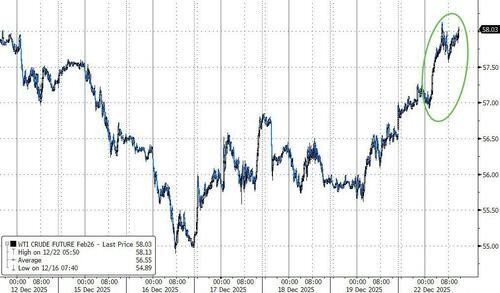
The United States intercepted Venezuelan oil tankers three times within two weeks, Israel is brewing a new round of actions against Iran, and Ukrainian drones struck Russian ports in the Black Sea. A series of geopolitical conflict risks have once again ignited market concerns over oil supply, overshadowing worries about weak fundamentals, leading to a significant surge in oil prices on Monday

As 2025 approaches its end, the global energy market is at the center of a geopolitical storm. From the interception of tankers in the Caribbean to attacks on energy facilities in the Black Sea, and potential new military strikes in the Middle East, three major geopolitical hotspots are resonating simultaneously, reigniting market concerns over supply disruptions and overshadowing weak fundamental expectations.

According to Global Times, the U.S. Coast Guard has taken more aggressive interception actions in waters near Venezuela, marking the third such incident this month and indicating a significant escalation in the U.S. blockade of Venezuelan oil exports.

The situation in the Middle East is also facing uncertainties. According to CCTV News citing NBC News, Israel is planning a new round of strikes against Iranian ballistic missile facilities and is seeking U.S. support. This potential escalation follows large-scale conflicts that erupted in the region in June of this year, casting a shadow over the recently emerging prospects for U.S.-Iran negotiations.

Meanwhile, Ukrainian drones have attacked key energy export infrastructure along the Russian Black Sea coast, causing damage to docks and vessels. Market analysts point out that these military actions directly targeting the energy transport chain are forcing traders to reassess supply security risks.

Driven by these multiple risk factors, international oil prices surged significantly on Monday. Brent crude futures rose by $1.60, an increase of 2.7%, closing at $62.07 per barrel; U.S. WTI crude futures rose by $1.49, an increase of 2.6%, closing at $58.01 per barrel.

U.S. Tightens Maritime Blockade on Venezuela

U.S. sanctions against Venezuelan oil exports are evolving into substantive maritime interception actions.

According to Global Times, the U.S. Coast Guard attempted to intercept a tanker named "Bella 1" in international waters on Sunday. The day before, the U.S. confirmed the seizure of the "Century" tanker carrying Venezuelan crude oil. On the 16th of this month, President Trump ordered a "comprehensive and thorough blockade" of all U.S.-sanctioned tankers entering or leaving Venezuela.

Market participants' expectations regarding Venezuelan supply disruptions are shifting. UBS analyst Giovanni Staunovo noted that the market had previously underestimated the risks of U.S. sanctions, and following consecutive interception actions, the likelihood of disruptions to Venezuelan oil exports has significantly increased. It is reported that Venezuelan crude oil accounts for about 1% of global supply Although the "Bella 1" was not loaded with cargo at the time, it refused to cooperate with inspections and issued a distress signal. This marks the third action taken by the U.S. against vessels related to Venezuela in less than two weeks. The previously seized "Century" and "Captain" were loaded with millions of barrels of crude oil.

Parker, head of emerging markets at Norwegian energy consulting firm Rystad Energy, stated that modern radar and satellite technology make it difficult for tankers to evade monitoring by shutting off transponders or flying "false flags," and the U.S. interception determination poses significant resistance to related trade.

However, this strategy has also raised concerns domestically in the U.S. According to Global Times, Republican Senator Paul said on an ABC program, "I think this is a provocation and a prelude to war. I hope we do not go to war with Venezuela." He stated, "The mission of American soldiers is not to be the world's police."

Israel Prepares for New Round of Actions Against Iran

A new storm is also brewing in the Middle East. According to CCTV News citing NBC, Israeli Prime Minister Netanyahu plans to propose a plan to strike Iranian-related facilities during a meeting with Trump later this month. The Israeli side argues that the expansion of Iran's ballistic missile program has endangered regional security and U.S. interests.

This potential strike comes just six months after a large-scale airstrike in June of this year. Although the previous actions were claimed to have "eliminated the nuclear threat," Israel still seeks to establish an "absolute security" advantage over Iran. Analysts believe that Israel is concerned that Iran may restore its military capabilities during negotiation gaps, thus leaning towards a preemptive strike.

This plan has once again strained U.S.-Iran relations. Although the Trump administration prefers to use maximum pressure to gain negotiation leverage, it is also reluctant to see the Middle East embroiled in large-scale regional wars that could disrupt its global strategic layout. However, Israel's military threats undoubtedly increase market uncertainty. Should a strategic miscalculation or accidental firing occur, not only would U.S.-Iran nuclear negotiations be stalled, but the entire oil supply landscape in the Middle East could also face reshaping.

Black Sea Energy Hub Attacked and Negotiation Stalemate

On the Eastern European battlefield, energy infrastructure has become a direct target for attacks. Reports indicate that Ukrainian drones attacked port facilities in Russia's Krasnodar region, damaging two ships and two docks and causing fires. The Black Sea region is a major artery for Russian energy exports, and this attack directly touched the nerves of the market.

Ritterbusch and Associates emphasized in a report that the rise in oil prices is partly attributed to reports of attacks on Black Sea ports, reminding the market that energy supplies in the region are very fragile. Although U.S. envoy Steve Witkoff stated that recent multilateral talks held in Florida were productive and aimed at coordinating positions to end the conflict, feedback from the Kremlin has dampened the prospects for a diplomatic resolution A senior foreign policy advisor to Russian President Putin stated that Europe's and Ukraine's response to the U.S. proposed amendments has not improved the prospects for peace.

This "talk and fight" situation makes it difficult for the market to relax its vigilance. Analysts point out that against the backdrop of weakening fundamental data, it is this ongoing geopolitical conflict that provides key support for oil prices, forcing short sellers to cover positions to avoid sudden risks