Since 1970, the 39th occurrence of the US dollar showing a "golden cross," which is still a very rare type

Bank of America stated that the US dollar generated its 39th golden cross signal on December 19, a technical indicator that often predicts a strengthening of the dollar. According to historical data, the probability of the US dollar index rising within 20-60 trading days after a golden cross is 68-79%, with an average increase of about 1.22%. More notably, this golden cross is of a very rare type—this is the 16th occurrence since 1970 when a golden cross appeared while the 200-day moving average was declining, and under this special circumstance, the probability of the dollar rising is as high as 80%. The S&P 500 shows mixed performance in the early stages after the "golden cross," but typically strengthens after 35 trading days. The probability of crude oil rising within 35 trading days after this signal is 100%
The US dollar index recently triggered a key technical buy signal, and US stocks and crude oil may also welcome a window for upward movement.
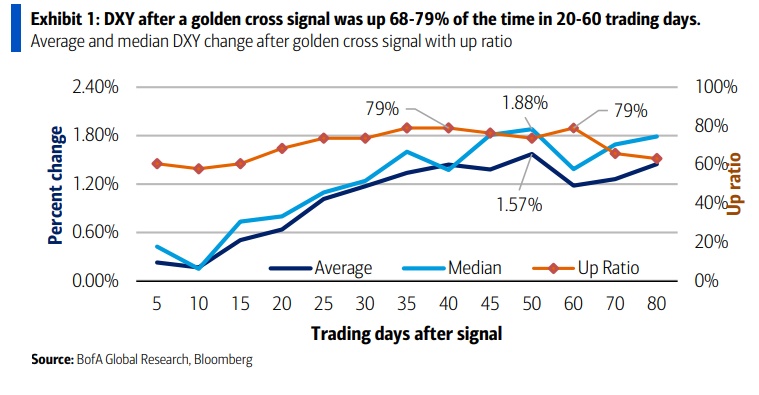
According to the Chase Wind Trading Desk, the latest analysis from the Bank of America Merrill Lynch technical strategy team shows that the US dollar index (DXY) generated its 39th golden cross signal on December 19. Historically, this technical indicator often predicts a strengthening of the dollar. Based on historical data, the probability of the dollar index rising within 20-60 trading days after the golden cross is 68-79%, with an average increase of about 1.22%.

More notably, this golden cross is of a very rare type—this is the 16th occurrence since 1970 of a golden cross appearing while the 200-day moving average is declining. In this special circumstance, historical data shows that the probability of the dollar rising is as high as 80%.
This signal also has significant implications for other asset classes. The S&P 500 index shows mixed performance in the early stages after the golden cross, but typically strengthens after 35 trading days. The probability of crude oil rising within 35 trading days after this signal is 100%. The trends of gold and the 10-year US Treasury yield are relatively neutral, with a rising probability of about 50%.
39th Golden Cross: Probability of Subsequent Rise Reaches 79%
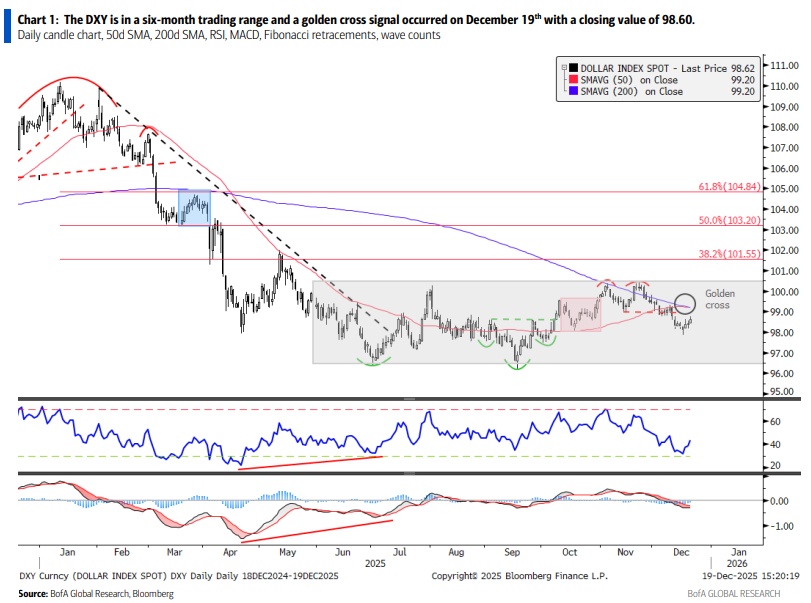
On December 19, the US dollar index closed at 98.60, with the 50-day moving average crossing above the 200-day moving average, forming a "golden cross" signal in technical analysis.

Historical statistics show that after the golden cross appears, the performance of the US dollar index shows a clear upward tendency. Since 1970, there have been 38 occurrences of such signals, and this is the 39th. The Bank of America Merrill Lynch report states:
"After the 'golden cross' signal appears, the effectiveness of the signal is most significant within a time window of 20-60 trading days, with the probability of the dollar rising reaching 68-79%. Specifically, the highest probabilities of rising occur after 35-40 trading days and 60 trading days, reaching 79%. In terms of average increase, it is about 1.22% within 20-60 trading days, with a median increase of about 1.40%."
This indicates that although the market typically experiences seasonal weakness at the end of the year, the dollar has a clear technical upward advantage in the first few months of the following year.
Extremely Rare Situation: Golden Cross During Declining Moving Averages
More importantly, when the golden cross signal appears while the 200-day moving average is declining (this is the 16th occurrence), the performance of the dollar is even stronger. In this special case, the probability of the dollar rising after 15, 25, 35, and 60 trading days is as high as 80%, meaning that it rises in 12 out of 15 instances.
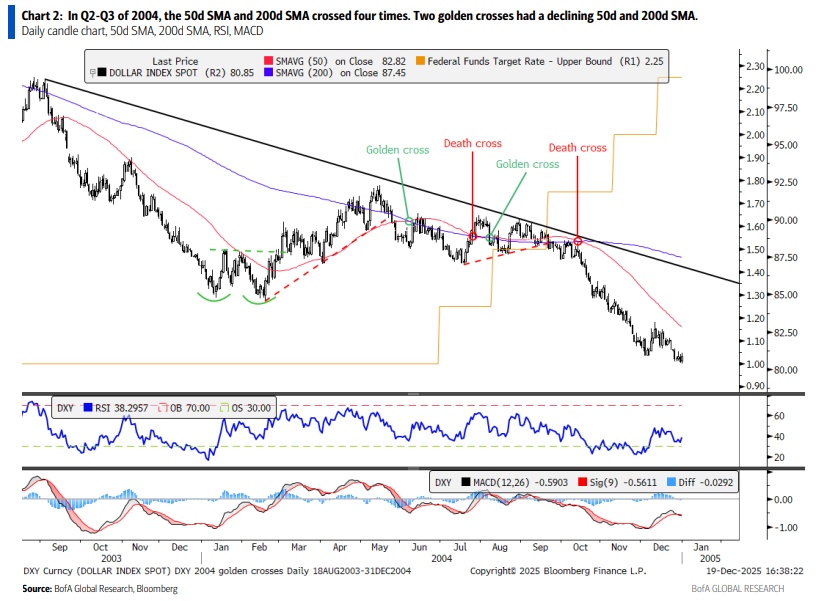
The uniqueness of this golden cross lies in the fact that both the 50-day and 200-day moving averages are in a downward trend. This situation is extremely rare, with the last occurrence in 2004. At that time, the dollar index experienced about six months of sideways consolidation, followed by a decline in the fourth quarter during the Federal Reserve's interest rate hike cycleExperience from 2004 indicates that a golden cross signal under a declining dual moving average backdrop may lead to increased market volatility. That year, after the dollar index experienced a golden cross on June 8, it subsequently encountered a death cross on July 27, followed by another golden cross and death cross, displaying clear oscillation characteristics.

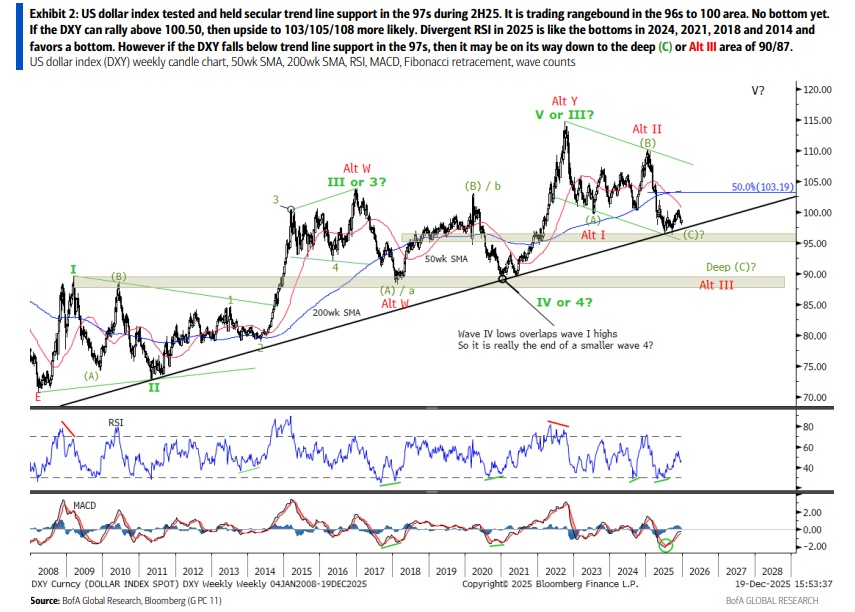
Bank of America Merrill Lynch's technical analysis shows that the current dollar index is testing the long-term trend line support in the 97 area. If this support level is broken, the dollar may further decline to the 90/87 area.

The "Perfect Record" of Crude Oil and the Lagging Rebound of U.S. Stocks
The golden cross signal not only affects the dollar itself but also has significant implications for other asset classes:
The S&P 500 index performs neutrally within 30 trading days after the signal appears, but begins to show an upward trend after 35 trading days. When the dollar index's 200-day moving average is declining, the S&P 500's performance is even stronger, with an 87% probability of rising after 60-80 trading days.
The crude oil market reacts most positively to this signal. Historical data shows that crude oil tends to rise within 40-70 trading days after a golden cross, with a success rate of about 70%. Under the condition of a declining 200-day moving average of the dollar index, crude oil's performance is even more pronounced, with a 100% probability of rising after 35 trading days (all 12 instances rose), and an average increase of 9.07%, with a median increase of 10.82%.
In contrast, gold and the 10-year U.S. Treasury yield respond relatively neutrally to the dollar's golden cross signal, with an upward probability hovering around 50%, showing no clear trend preference. This indicates that traditional safe-haven assets may face differentiation in the context of a strengthening dollar technically