


Ant Group's Wang Lei: The training cost of vertical large models has decreased by an order of magnitude, and the implementation of financial AI requires the construction of three major cornerstones of "trustworthy intelligent agents" | Alpha Summit

Wang Lei pointed out that the emergence of open-source foundational models has shortened the iteration cycle of vertical large models from several months to two weeks, and the computing power demand has decreased from "ten thousand cards" to "hundred cards." At the same time, he emphasized that the implementation of financial AI must also focus on rigor, professionalism, and compliance, with the primary task being to build a system that suppresses hallucinations and maintains safety boundaries. He believes that the application of large models in the industry is not only a technological revolution but also a reshaping of business strategy
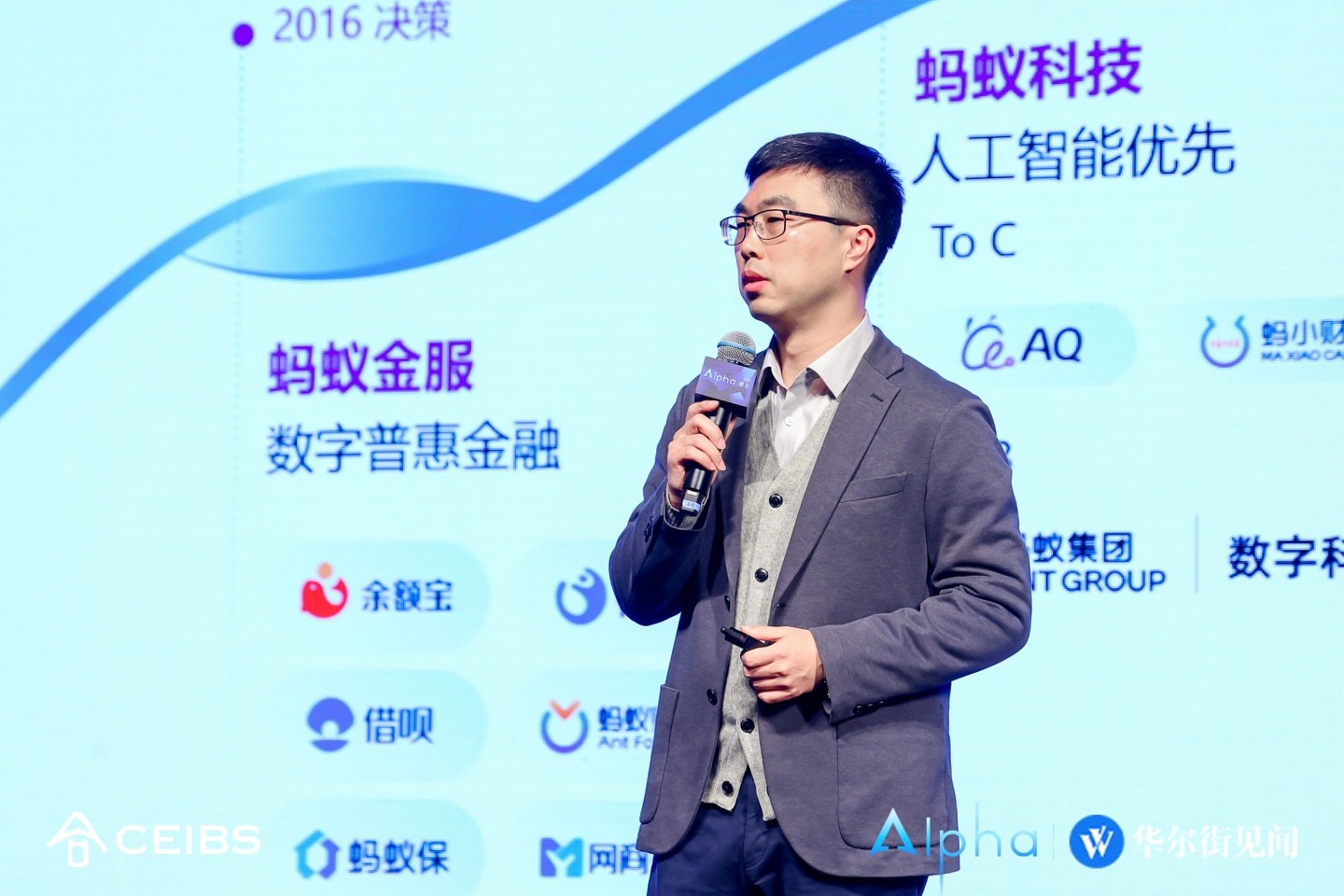
On December 20th, at the "Alpha Summit" co-hosted by Wall Street Insights and China Europe International Business School, Wang Lei, General Manager of Ant Group's AI Native Division, delivered a speech titled "Exploring the Deep Waters of Financial AI - Practices and Insights on the Vertical Implementation of Large Models."
He stated that with the emergence of open-source foundational models like DeepSeek and Qwen, the industry no longer relies on expensive pre-training for large models but has shifted to a "post-training" model. This transition has shortened the iteration cycle of financial vertical models from several months to two weeks, reducing computing power requirements from "ten thousand cards" to "hundred cards," achieving a hundredfold decrease in training costs, and significantly lowering the threshold for industrial applications.
He believes that when implementing AI in serious industries like finance, it is essential to focus on rigor, professionalism, and compliance. He emphasized that large models cannot completely avoid hallucinations, and as reasoning capabilities improve, hallucinations may even increase. Therefore, building a system and methodology to suppress hallucinations is the top priority for applying large models to vertical industries, and it is crucial to maintain a safety baseline.
He also pointed out that the core of implementing large models in the financial industry lies in constructing "trustworthy intelligent agents," which requires three foundational elements: first, a "financial large model" that incorporates industry data as the brain; second, a "financial knowledge base" that supplements timeliness and private data as experience; third, a "financial toolkit" that connects business systems as hands. The combination of these three elements allows AI to work like a professional employee.
Wang Lei, General Manager of Ant Group's AI Native Division, also stated that the application of large models in the industry is not only a technological revolution but also a reshaping of business strategy. He urged companies not to be mediocre neutral parties but to break through existing workflows and consider how to let large models reshape all business flows and workflows, thereby bringing real industrial value.
Here are some highlights from the speech:
With the advent of DeepSeek, the first to face elimination are those companies focused on foundational model research, prompting the entire industry to shift its focus to application implementation.
The emergence of large models has brought revolutionary breakthroughs in the field of natural language understanding, greatly lowering the threshold for human-computer interaction.
The industry no longer needs to rely solely on piling up massive computing power and manpower or purchasing large amounts of data for model retraining. We have explored a feasible path for industrial implementation, which is to empower models by overlaying specialized data from vertical fields.
We must recognize that large models are a "double-edged sword." In the process of deeply applying large models, building an effective system and methodology to suppress "hallucinations" is the primary task when applying them to vertical industries.
The construction of the model determines the upper limit of capabilities, while safety capabilities are an insurmountable baseline.
Evaluation is the starting point for the application of large models. The construction of intelligent agents is not a one-time software delivery but a continuous process of cultivation and iterative optimization
In the past, pre-trained models often relied on WanKa clusters, while training such financial vertical models only requires a scale of hundreds of cards, achieving a two-order-of-magnitude reduction in computing power demand.
When promoting the implementation of AI in the industry, it is necessary to pay attention to many credible features. To summarize it concisely, the core lies in three points: rigor, professionalism, and compliance.
When applying large models to the industry, I do not wish to stop at a mediocre neutral position, but firmly choose the side of transformation, that is, committed to "strategic reshaping."
In discussing the role of large models in business and workflows, we need to break through the constraints of existing frameworks and strive to use large models to comprehensively reshape existing workflows.
The following is the speech transcript:
Dear friends:
I am very pleased to have the opportunity to share with you today the thoughts and practices of ANT GROUP in the implementation of large models in the financial industry over the past year.
This theme is timely. We are at a critical juncture where the industry embraces AI, and the origin of this juncture can be traced back ten years.
I. The Ten-Year Journey and Transformation of AI Development
Looking back over the past decade, this has been a decade of vigorous development of the AI wave, and everyone can personally feel the significant changes AI has brought to life. This chart closely connects ANT GROUP's exploration in the field of AI with its main products, showcasing the context of technological development.
We can mark this starting point with technical language: in 2012, at that time, you might not be familiar with the company AlexNet, but you may have heard of "convolutional neural networks." In that year’s ImageNet competition in the United States, AlexNet significantly improved the accuracy, speed, and efficiency of image recognition with convolutional neural networks, achieving excellent results with a substantial lead over the second place. Since then, many companies focused on recognition technology, such as Megvii Technology and Hikvision, have emerged in the industry. The efficient operation of cameras widely used on the roads for license plate and facial recognition originates from this starting point.
Also in 2012, Alipay launched a revolutionary mobile payment technology—QR code payment. The improvement in recognition efficiency and its true entry into thousands of households is attributed to AI technology. In 2016, AlphaGo defeated the South Korean Go world champion Lee Sedol, breaking the human perception that Go, the "pearl of the palm," could not be defeated, proving that decision models built on reinforcement learning can surpass humans in complex decision-making fields.
Subsequently, we widely applied decision models to life. For example, products like Yu'e Bao, Huabei, Jiebei, and Wangshang Loan are not supported by human labor but by artificial intelligence. Inclusive finance is built on the foundation of AI, allowing us to quickly identify credit limits and loan durations, as well as recognize genuine demanders and potential fraud risks through models.
The emergence of decision models has allowed the public to enjoy the value of AI. If it was still the "small model" era at that time, then the release of ChatGPT by OpenAI in 2022 marked the beginning of the "large model" era, with the parameter scale jumping from tens of thousands to trillions. The core value of large models (often referred to as AIGC generative models) lies in the revolutionary breakthrough in natural language understanding From text understanding to multi-modal (images, audio, video) recognition and generation, the essential transformation lies in greatly lowering the threshold for human-computer interaction.
Over the past thirty years in the computer industry, every improvement in human-computer interaction efficiency and reduction in threshold has triggered industrial revolutions that impact the next five to twenty years. From Microsoft to the iPhone and now to large models, this process is irreversible and surging forward.
II. Ant Group's AI Industry Layout and the Year of Intelligent Agents
In this process, Alibaba and Ant Group are also adapting to technological changes, launching a series of AI applications, such as "Afu" (originally named AQ) in the medical field, the financial large model application "Ma Xiao Cai," the multi-modal assistant "Ling Guang," and numerous AI assistants under Alibaba Group.
The current landscape in the ToC field has become clear. Today, I want to focus on the industrialized ToB field. Ant Financial Technology, as a ToB technology company under Ant Group dedicated to empowering industrial AI, believes that this year is the year of AI Agents.
In the past few years, the construction of large models has often been limited to large companies with abundant data, computing power, and talent. The high threshold has made it unattainable for many enterprises. If the premise for industrial applications is that large models must be self-developed, true industrialization cannot be achieved.
However, the emergence of open-source models like DeepSeek this year has changed this situation. They not only provide excellent algorithms but also represent the opening of foundational models to the entire industry. This allows the industry to find an effective path to implementation without having to pile up resources for pre-training: On the basis of open-source foundational models (such as DeepSeek, Tongyi Qianwen, Ant Bai Ling), overlaying industry vertical data for post-training. This model shortens the model iteration cycle from three to six months to one month or even two weeks, greatly lowering the threshold for vertical applications and shifting the industry's focus from foundational models to the application layer.
III. Pain Points of Large Model Implementation in the Financial Industry and "Trustworthy Intelligent Agents"
Regarding whether large models can bring actual business value, our answer is affirmative. However, in discussions with CIOs in the banking industry, we summarized six major pain points for implementation in the financial sector: limited computing power, insufficient and low-quality data, rapid model iteration, insufficient knowledge and experience accumulation, lack of application implementation methodology, and talent shortages.
To address these pain points, Ant Financial Technology has proposed an AI-oriented strategy. When implementing AI in serious industries like finance, three core characteristics must be emphasized: rigor, professionalism, and compliance.
Rigor (Counteracting Hallucinations): Large models cannot completely avoid hallucinations, which to some extent reflects their level of intelligence (for example, the enhanced reasoning ability of DeepSeek R1 is accompanied by fluctuations in hallucination rates). Therefore, the primary task of applying large models is to construct a system that suppresses hallucinations.
Professionalism (Aligning with Experts): Large models need to reflect the institution's own will, avoiding uniformity Compliance (Regulatory Bottom Line): In heavily regulated industries, it is essential to ensure that models do not cross red lines and bottom lines.
We refer to those with the above characteristics as "trustworthy intelligent agents." In the financial sector, their construction relies on three major cornerstones:
Financial Large Model: Similar to a "financial PhD" who has studied diligently, possessing both general and specialized financial knowledge.
Financial Knowledge Base: Supplementing with high timeliness data and proprietary bank knowledge, making it akin to a "management trainee" familiar with industry conditions.
Financial Toolset: APIs that connect to the bank's internal digital systems, granting the intelligent agent the ability to "act," enabling it to perform specific operations.
IV. Training Methodology and Future Outlook
In constructing the financial large model, we adopt a two-phase training method, focusing on data understanding and governance. Simply stacking financial data is insufficient; it is necessary to reasonably balance general data (mathematics, history, etc.) with financial data to ensure that while enhancing financial capabilities, general capabilities are not diminished. Compared to pre-training, this specialized model training has a significantly lower cost, with computational requirements reduced by two orders of magnitude (only requiring hundreds of kilowatts).
At the same time, model training must establish safety fences, incorporating safety domain knowledge into the training to ensure that the intelligent agent is aware of business bottom lines.
The application of intelligent agents is not a one-time software delivery but a continuous cultivation and iteration process (similar to growth from school to work). We need to start from assessments, analyzing mistakes (Badcase) to determine whether they stem from knowledge gaps, insufficient tools, or hallucinations. For example, addressing the large model's shortcomings in large number calculations (such as numerical errors caused by probabilities), we restrict direct calculations and instead enforce the use of bank system APIs to ensure accuracy.
Finally, I want to emphasize: The application of large models in the industry is not only a reshaping of technology but also a reshaping of business strategy. We should break through traditional thinking frameworks and consider how to allow large models to reshape existing workflows.
Thank you all
