


The Arbitrage Game of Silver LOF

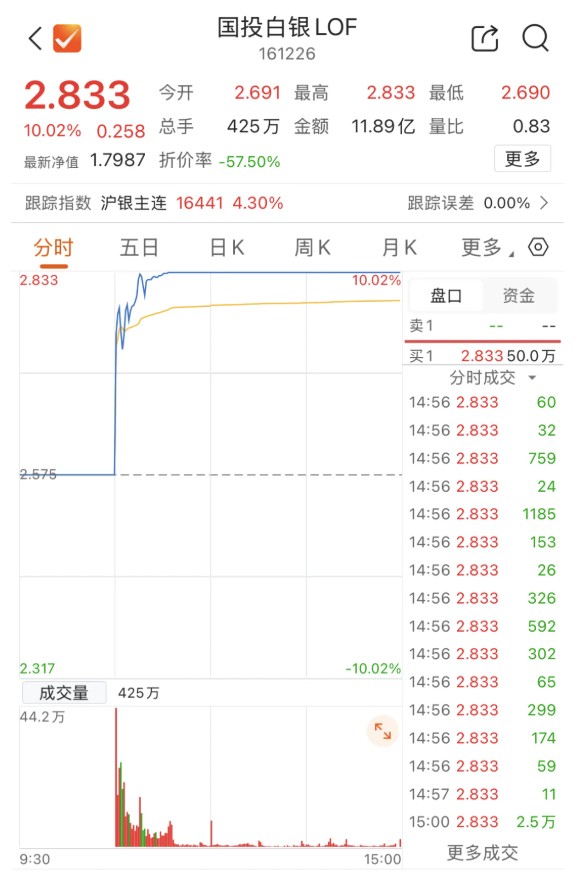
Recently, silver futures prices have risen, and the secondary market price of Guotou Ruijin Silver Futures (LOF) has hit the upper limit, with a premium rate of 57.5%. Investors are actively participating in arbitrage, and although the returns are limited, it still attracts capital. The fund has issued multiple premium risk warnings and adjusted the purchase limits to cool down the arbitrage sentiment
On one side, precious metals are soaring, with silver futures prices climbing steadily, while on the other side, there are arbitrage opportunities under high premiums for silver funds. Investors in silver funds have recently fallen into a "arbitrage frenzy."
On the morning of December 23, after another one-hour suspension, the secondary market price of China International Capital Corporation UBS Silver Futures (LOF) hit the daily limit, once again reaching a historical net asset value high.
"The high premium of this fund in the market is largely due to many people engaging in arbitrage, making a little 'meal money' every day."
According to the announcement, as of December 22, 2025, the closing price of the fund in the secondary market was 2.575 yuan, significantly higher than the fund's unit net value of 1.7442 yuan on December 19. In response to the high premium, China International Capital Corporation UBS Fund has issued 13 premium risk warning announcements since December and has suspended trading multiple times recently. As of the midday close on December 23, the premium rate had reached 57.5%.
Is arbitrage really that "attractive"? In fact, similar arbitrage situations have been common in history, but not every time can one "guarantee profits"!
Arbitrage Funds Under High Premiums
Silver futures have reached new highs.
Choice data shows that as of noon on December 23, the COMEX silver price once again hit a historical high, reaching $70.16 per ounce, with an increase of over 40% since November.
Against this backdrop, the silver fund, as a scarce variety in the domestic market, has also become "hot property." Since November, the price of China International Capital Corporation UBS Silver Futures (LOF) in the secondary market has increased by over 115%.
Behind the continuous rise in on-market prices, the price gap between on-market and off-market has been widening. According to the announcement, as of December 22, the on-market premium rate of this ETF exceeded 47%; by the midday close on December 23, the premium rate had risen to 57.5%, attracting arbitrage funds.
"Although there are limits, the money that can be made from arbitrage is not much, but earning a little 'meal money' every day is also appealing," said an investor.
The announcement from China International Capital Corporation UBS Fund indicates that starting from December 22, the purchase limit for the A and C shares of China International Capital Corporation UBS Silver Futures (LOF) has been set at 500 yuan. Previously, the purchase limits for A and C shares were 100 yuan and 1000 yuan, respectively.
Bi Mengdan, a researcher at Geshang Fund, told the Shanghai Securities Journal that the core purpose of adjusting the purchase limits for the fund is to "cool down" the arbitrage sentiment. "The purchase limit for A shares has been increased from 100 yuan to 500 yuan to increase the supply of on-market shares, guiding arbitrage funds to sell on-market after purchasing off-market, thereby stabilizing the premium; lowering the purchase amount for C shares is beneficial to suppress the frequent subscription and redemption of short-term funds," she said On December 23, the company announced further adjustments to the subscription limit for Class A fund shares, stating that the high premium rate of Guotou Ruijin Silver Futures (LOF) in the secondary market is not sustainable.
Attention to the Risks Behind Arbitrage
What logic lies behind arbitrage? Bi Mengni analyzed that when the on-market trading price is significantly higher than the net value, arbitrageurs subscribe to fund shares off-market at net value, confirm the shares on T+1, and sell them on T+2 in the on-market to profit from the price difference.
"However, this investment method may not be suitable for ordinary investors. Firstly, this silver fund requires a maximum subscription of 500 yuan per day per account, limiting the scale of arbitrage. Secondly, during the period until T+2, if the silver price falls or the premium rate converges, it may lead to investment losses. Additionally, if a large number of arbitrage positions are concentrated and sold on T+2, it may trigger a 'stampede', resulting in an inability to sell or low-price transactions." She added that arbitrage relies on "high premium rates covering costs," but profitability is uncertain.
In fact, there have been many historical instances of concentrated arbitrage funds. For example, during the oil price crash in 2020, the Huabao Oil and Gas LOF saw a rapid surge in on-market premium rates due to the suspension of subscriptions. Investors arbitraged by subscribing off-market and selling on-market, but the premium rate quickly converged, leading to significant losses for some investors.
There is no such thing as a guaranteed profit in trading. Another seasoned industry insider advised investors not to overly trust some influencers' investment recommendations regarding arbitrage.
"Many brokerages pay influencers commissions to attract users, encouraging fans to open multiple accounts for arbitrage, which actually serves to bring in new clients for the brokerages. At the same time, high-profile arbitrage topics can also bring traffic to influencers, allowing them to monetize through advertisements, paid courses, and other means. However, influencers often emphasize the low risk of arbitrage while downplaying key risk factors such as time differences and liquidity." The insider cautioned that investors should understand the implicit risks behind arbitrage and not blindly follow trends.
Risk Warning and Disclaimer
The market has risks, and investment should be cautious. This article does not constitute personal investment advice and does not take into account the specific investment goals, financial conditions, or needs of individual users. Users should consider whether any opinions, views, or conclusions in this article align with their specific circumstances. Investing based on this is at one's own risk
