高盛顶级交易员年终复盘:金银铜历史性新高,股债分歧加剧,美股 “结构性分化”…….

Goldman Sachs trader Pasquariello pointed out in the year-end review that the market in 2025 will exhibit three major characteristics: first, an epic bull market in precious metals, with gold and silver achieving their best performance since 1979; second, a rare divergence in the stock and bond markets, with the stock market pricing in an accelerating economy while the bond market remains cautious, leading to a high level of contradictory signals; third, continued internal differentiation in the U.S. stock market, with technology stocks strengthening their advantage over small-cap stocks, as the market progresses with low volatility and high dispersion. Overall, the market is entering 2026 amid structural contradictions and new highs in asset prices
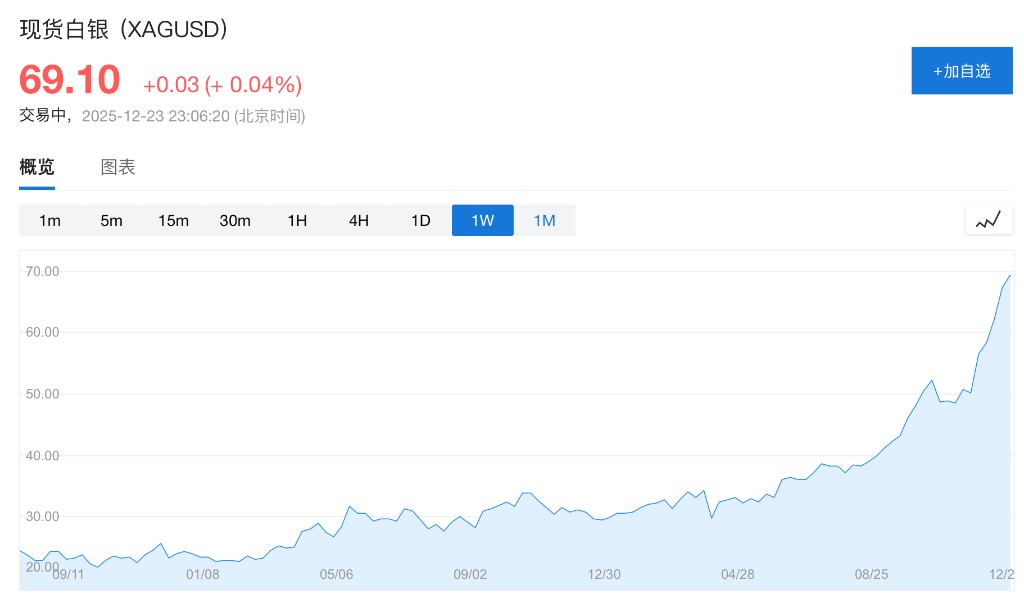
Goldman Sachs senior trader Tony Pasquariello pointed out in his year-end review that the global commodity market will perform exceptionally strong in 2025, with gold prices rising 68% throughout the year, silver prices skyrocketing 139%, both achieving their best annual performance since 1979, and copper prices also reaching historical highs.
At the same time, the U.S. stock market is showing significant structural differentiation. Pasquariello emphasized that the current stock market pricing implies expectations of an accelerating economic cycle, but this has not yet been universally validated in macroeconomic data. In stark contrast, the economic narrative reflected in the bond market is more cautious, with the divergence of signals between the stock and bond markets reaching rare levels in recent years.
He noted that the correlation within the U.S. stock market has been continuously declining over the past six months, indicating a very high level of dispersion, and this characteristic of low correlation and high dispersion is expected to continue into the next phase.
Scott Rubner from Citadel added that the market has a solid macro foundation as it enters 2026. Record household wealth, an expanding equity ownership ratio, and ample cash balances collectively provide structural support for the market, allowing retail investor participation to be maintained at higher levels.
Precious Metals Enter Historic Bull Market
2025 is undoubtedly a milestone year for the precious metals and industrial metals markets. Gold prices soared 68% throughout the year, achieving the best annual performance since 1979. Goldman Sachs' Tony Pasquariello analyzes that this may intertwine multiple narratives: it could be pricing against the global fiscal dominance pattern, reflecting growing concerns about the fiat currency system, or it may simply stem from unprecedented central bank demand. 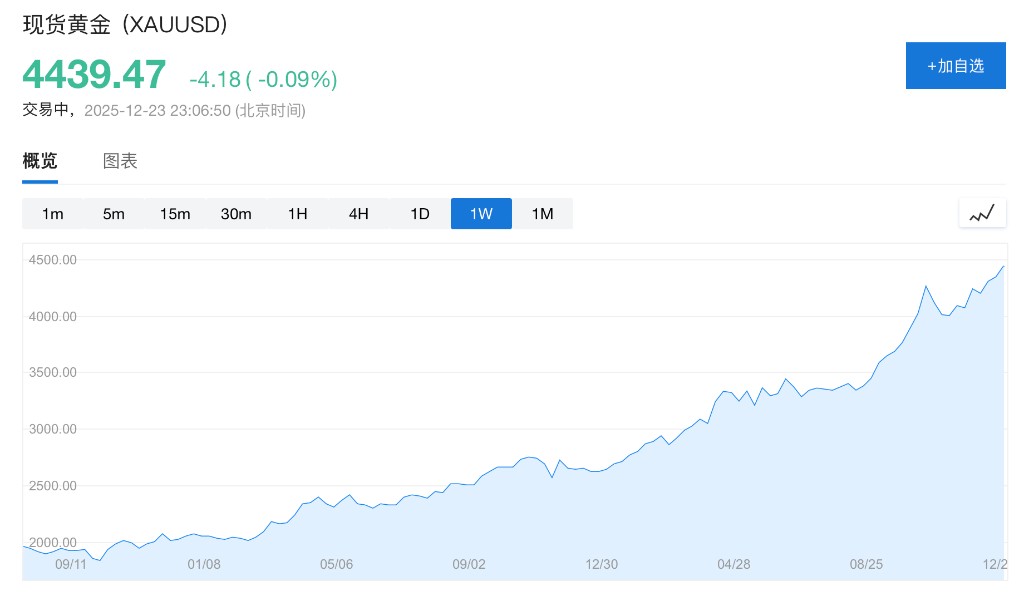 Silver's performance was even more astonishing, skyrocketing 139% for the year, also recording the largest increase since 1979. Looking back at history, silver experienced a fivefold increase in 1979, and this year's trend undoubtedly approaches that iconic level again.
Meanwhile, copper prices also achieved a decisive breakthrough to historical highs, driving related stocks significantly higher. The collective strength of gold, silver, and copper clearly indicates that, in the current macro landscape, investors' demand for allocation to physical assets is experiencing a structural increase.
Stock-Bond Divergence Reveals Market's Internal Contradictions
The U.S. stock and bond markets are conveying entirely different economic signals. Pasquariello pointed out that the U.S. 5-year Treasury yield is closely correlated with the Bloomberg Economic Surprise Index for U.S. labor market data, indicating that the bond market is primarily anchored to labor market signals. 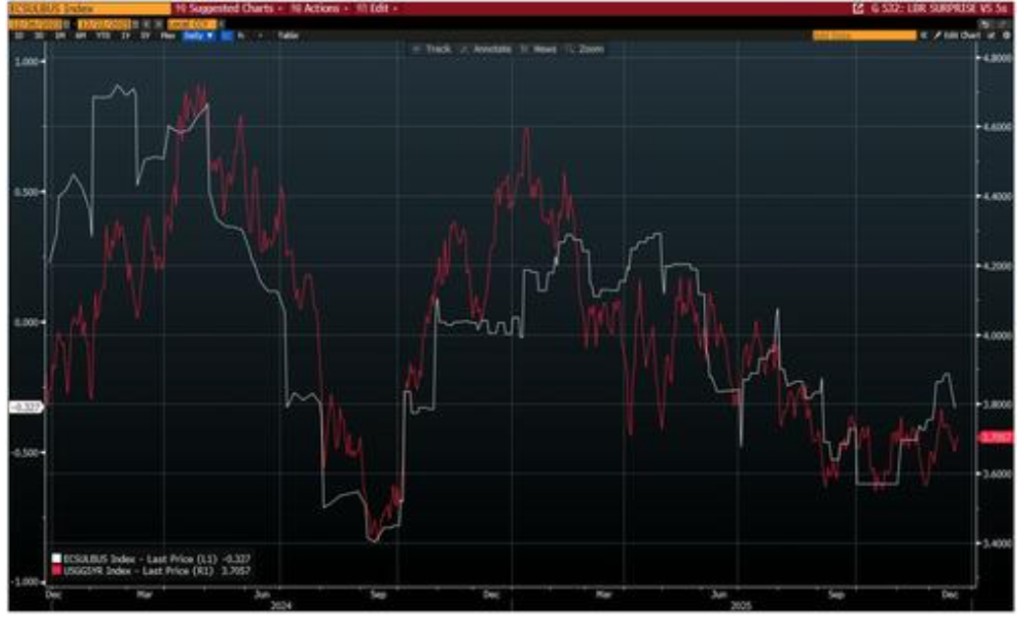 However, the stock market (represented by the S&P 500 index) presents a different picture. It significantly diverges from business surveys and cyclical indicators, pricing in an "economic cyclical acceleration" that has not yet been validated by widespread data. Pasquariello emphasizes that his view is not to judge which is right between stocks and bonds, but to highlight the risk: if the expected economic acceleration in the first half of 2026 does not materialize, the current optimistic pricing in the stock market will face adjustment pressure.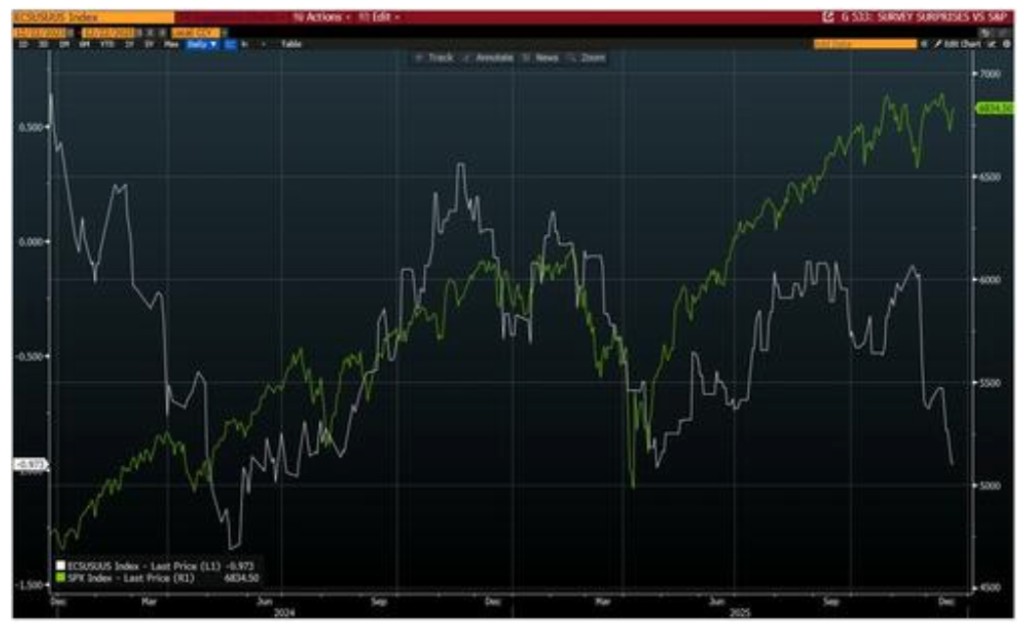
Another noteworthy divergence appears between the JOLTS job openings data and the S&P 500 index. This correlation between the labor market and the stock market, which has existed for years, may officially break in 2025, marking a significant structural change. 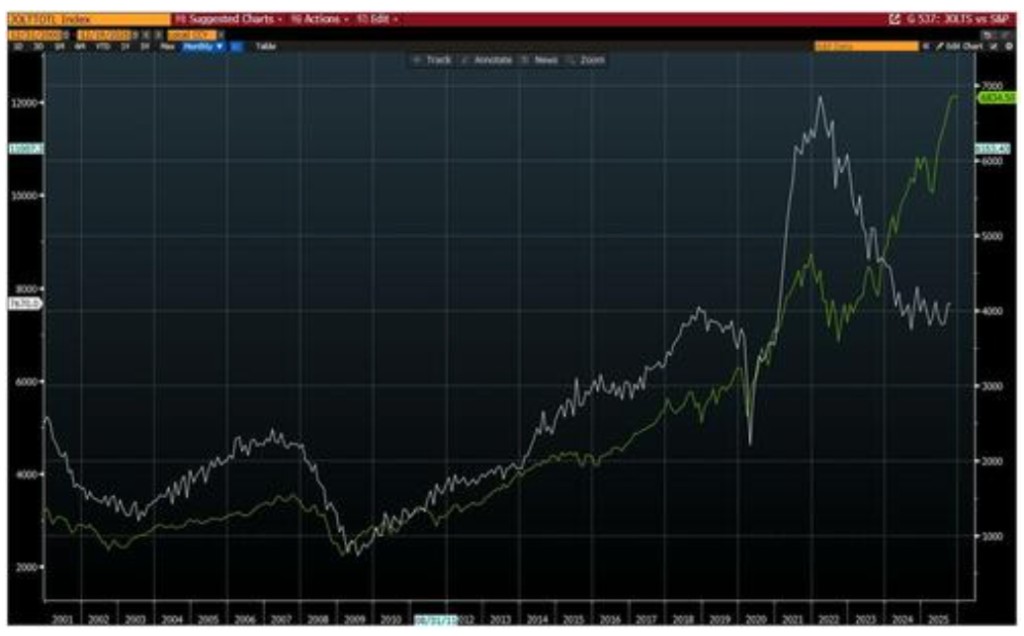
Structural Characteristics of the U.S. Stock Market Continue to Strengthen
Within the U.S. market, the divergence between growth stocks and value stocks continues to deepen. The ratio of the Nasdaq 100 index to the Russell 2000 small-cap index continues to rise, maintaining the market characteristic of "the strong getting stronger." Pasquariello analyzes that although small-cap stocks may experience a phase of performance under potential liquidity support from the Federal Reserve, from a structural perspective, he does not believe small-cap stocks can consistently outperform large-cap stocks represented by tech giants. 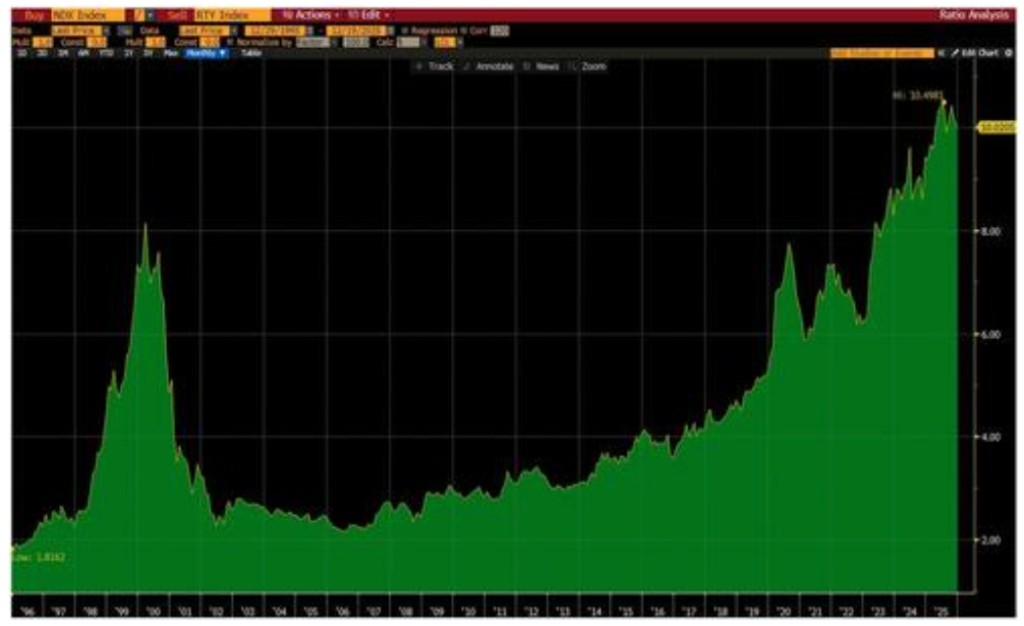
In terms of market volatility, the six-month realized volatility of the S&P 500 index is at a low level, confirming the recent high dispersion characteristics of the market. The VVIX index, which measures the degree of market panic sentiment fluctuations, outlines a unique path of market sentiment evolution since 2025. 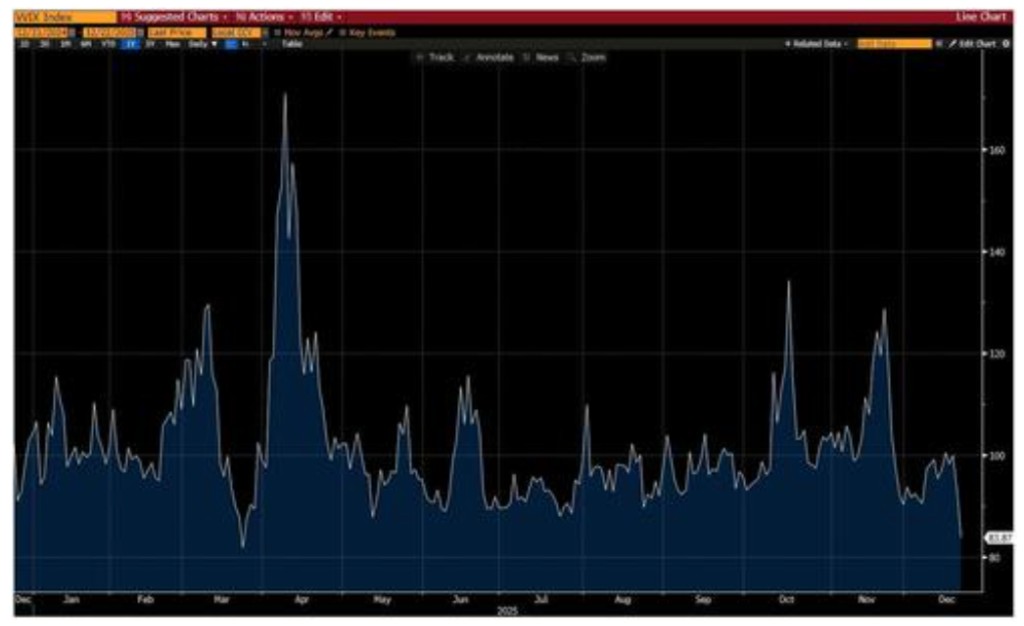
Additionally, Goldman Sachs' hedge fund VIP basket has shown sustained robust long-term performance. Except for a brief deviation during the meme stock frenzy in 2021, this basket has maintained a clear and stable excess return pattern relative to the S&P 500 index, making 2025 a standout year for the hedge fund industry. 
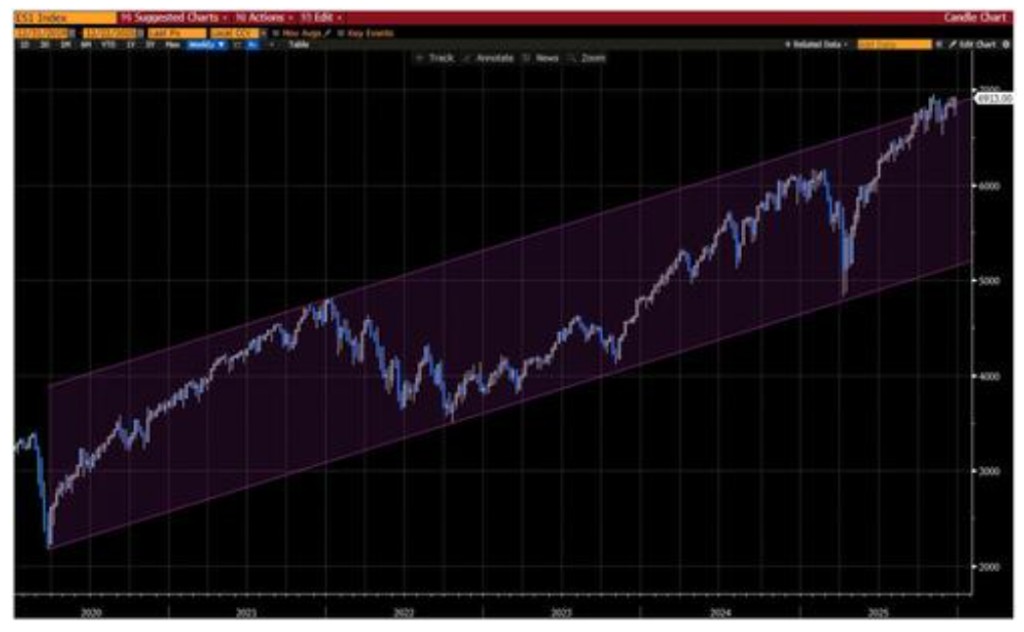
Pasquariello concludes his analysis with the long-term upward trend of the S&P 500 index since the pandemic low. Although the market faced tests of intuition and reality again in 2025, U.S. stocks ultimately continued their long-term upward trajectory
The current key issue is how the market's risk-reward ratio will evolve as the index approaches the upper boundary of this long-term trend channel.