Why did the U.S. Q3 economy greatly exceed expectations?

Wallstreetcn
2025.12.24 03:15
portai
I'm PortAI, I can summarize articles.

On December 23, 2025, the U.S. Department of Commerce's Bureau of Economic Analysis released data showing that the preliminary annualized rate of U.S. real GDP for the third quarter of 2025 was 4.3%, exceeding expectations. The main driving factors were the recovery in personal consumption expenditures and government investment. Following the data release, the U.S. dollar index rebounded slightly, and U.S. Treasury yields rose. Specifically, personal consumption expenditures showed significant growth, while AI and real estate investments within fixed asset investment displayed a divergence, with residential investment's decline leveling off and net exports balancing, along with corporate inventory adjustments

Event

On December 23, 2025, the U.S. Department of Commerce's Bureau of Economic Analysis (BEA) released: The initial value of the U.S. real GDP annualized quarter-on-quarter growth rate for Q3 2025 is 4.3% (previous value 3.8%).

Core Viewpoint

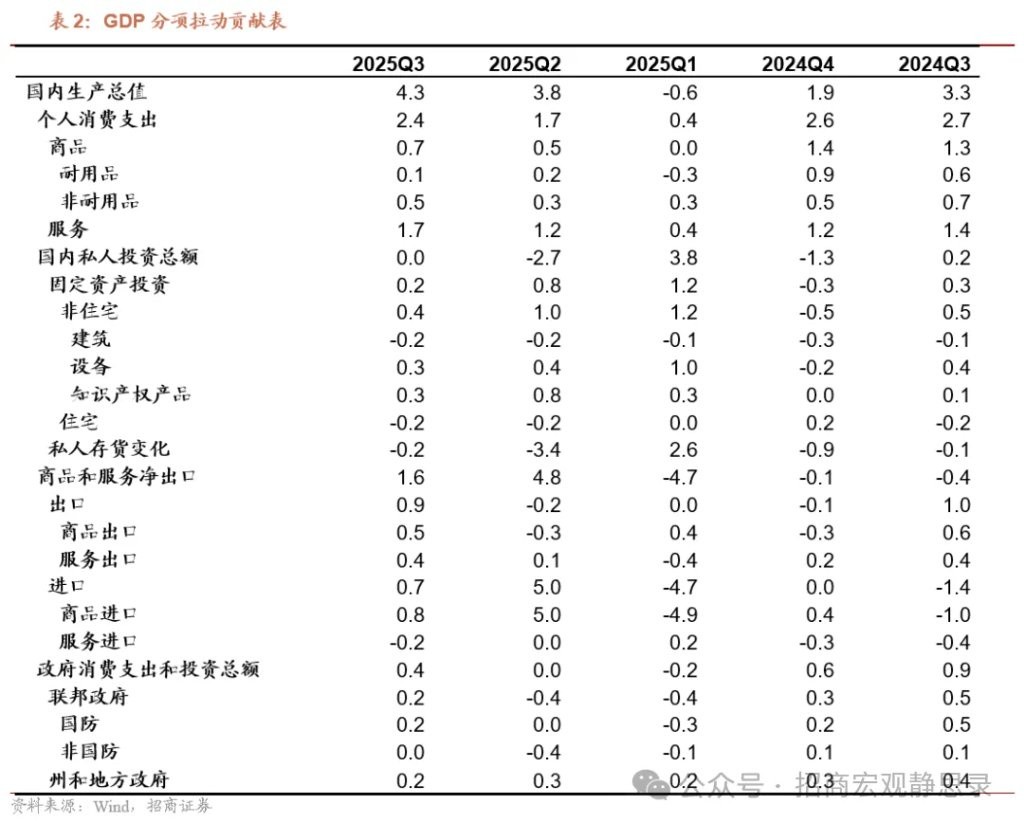
The initial value of the U.S. Q3 2025 real GDP annualized quarter-on-quarter growth rate exceeded expectations at 4.3%, with over half contributed by personal consumption expenditures. Meanwhile, government investment has rebounded, and net exports have continued to stabilize after the impact of "import grabbing" in the first quarter has faded. Investment has had a slight drag. Following the data release, the U.S. dollar index rebounded slightly to around 98.1, and the 2-year U.S. Treasury yield, sensitive to Federal Reserve policy, rose significantly by 4.4 basis points to around 3.54%, while the 10-year U.S. Treasury yield increased by 2.6 basis points to around 4.19%.

Specifically:

  1. In Q3 2025, the annualized quarter-on-quarter growth rate of U.S. personal consumption expenditures recorded 3.5% (previous value 2.5%), contributing 2.4 percentage points to GDP growth (previous value contributed 1.7 percentage points). Among them, the growth rate of goods consumption rose to 3.1% (previous value 2.2%), and the growth rate of service consumption was 3.7% (previous value 2.6%).

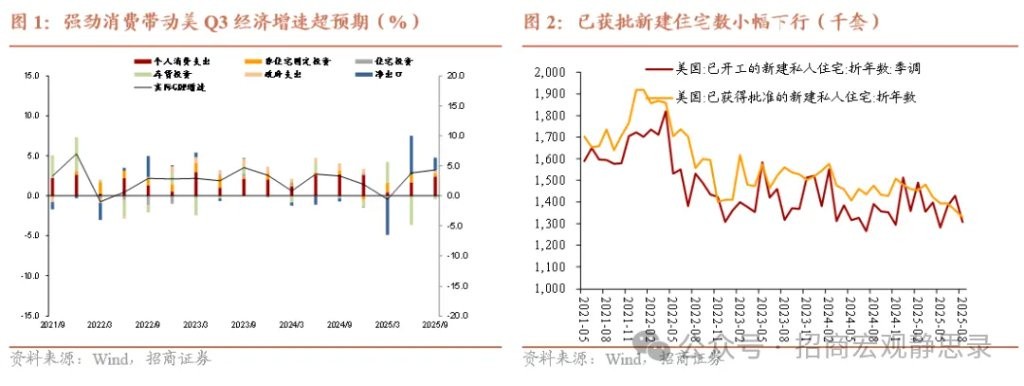
  2. In terms of fixed asset investment, there is a significant divergence between the AI mainline and real estate investment. Non-residential investment recorded 2.8% (previous value 7.3%), contributing 0.4 percentage points to GDP growth (previous value contributed 1.0 percentage points), with equipment and intellectual property investment being the main contributors. In Q3 2025, the decline in non-residential investment construction expanded to -6.3% (previous value -7.5%), equipment investment was 5.4% (previous value 8.5%), and intellectual property products were 5.4% (previous value 15.0%). Residential investment's decline flattened at -5.1% (previous value -5.1%), dragging GDP growth by 0.2 percentage points (previous value -0.2 percentage points). With the Federal Reserve's interest rate cuts, the fixed rate for 30-year mortgages in the U.S. slightly fell to around 6.3% in Q3 2025, and existing home sales stabilized at around 4 million units. However, due to changes in immigration policy and cooling demand, the annualized number of newly approved private residential constructions in the U.S. continued to slow in Q3 2025, dropping to 1.33 million units by August (previous value 1.362 million units), and the annualized number of newly started private residences slowed to 1.307 million units (previous value 1.429 million units).

  3. Due to the "import grabbing" by U.S. companies in the first quarter, a large amount of inventory was accumulated, and inventory investment dragged GDP growth by 0.2 percentage points in Q3 2025 (previous value -3.4 percentage points), with corporate inventories continuing to deplete.

  4. In terms of government spending, government spending this quarter contributed 0.4 percentage points to GDP growth (previous value 0.0 percentage points), with federal government spending contributing 0.2 percentage points (previous value -0.4 percentage points), defense spending contributing 0.2 percentage points (previous value 0.0 percentage points), and non-defense spending contributing 0.0 percentage points (previous value -0.4 percentage points). The impact of spending cuts by the Trump administration and staff reductions at DOGE is gradually fading State and local government spending contributed 0.2 percentage points (previous value 0.3 percentage points).

  5. In terms of net exports, this quarter contributed 1.6 percentage points to GDP growth (previous value 4.8 percentage points), with the trade deficit in goods continuing to narrow after the "import rush" effect in the first quarter. According to the latest trade data released by the BEA for September 2025, the trade deficit for the month recorded USD 52.828 billion (previous value USD 59.265 billion), with the goods trade deficit recorded at USD 78.985 billion (previous value USD 86.059 billion), and the services trade surplus recorded at USD 26.157 billion (previous value USD 26.795 billion).

After the data release, the 2-year U.S. Treasury yield, sensitive to Federal Reserve policy, rose sharply by 4.4 basis points to around 3.54%, while the 10-year U.S. Treasury yield rose by 2.6 basis points to around 4.19%. CME data reflects that overseas markets still expect two rate cuts in 2026 as a high-probability scenario. The U.S. dollar index rebounded to around 98.1, and the yen fluctuated around 156 after support from verbal intervention by the Japanese Finance Minister. The three major U.S. stock indices rebounded after short-term pressure, with the S&P fluctuating around 6881 points and the Nasdaq slightly adjusting to around 23430 points.

Risk Warning and Disclaimer

The market has risks, and investment should be cautious. This article does not constitute personal investment advice and does not take into account the specific investment goals, financial situation, or needs of individual users. Users should consider whether any opinions, views, or conclusions in this article are suitable for their specific circumstances. Investment based on this is at their own risk