Morgan Stanley's Heavyweight Robotics Yearbook (6): Autonomous Driving is on the Verge of Explosion, and China has Taken the Lead

Morgan Stanley's report believes that autonomous driving has entered the eve of an explosion, with China occupying 60% of the global L2+ market share due to its advantages in electric vehicle scale and data, leading the way. In the United States, there is a route dispute between Waymo's hardware redundancy and Tesla's pure vision solution. It is expected that by 2050, there will be over 700 million autonomous vehicles globally, completely reshaping the way people travel
The global automotive industry is at a significant turning point. According to Morgan Stanley's report released on the 21st, "The Robot Almanac Vol. 6: Autonomous Vehicles," the analyst team led by Adam Jonas pointed out that although humans currently spend a cumulative time equivalent to 82 million years in cars each year, this traditional driving model is about to be broken, and autonomous driving technology is on the brink of an explosive transition from "0 to 1."
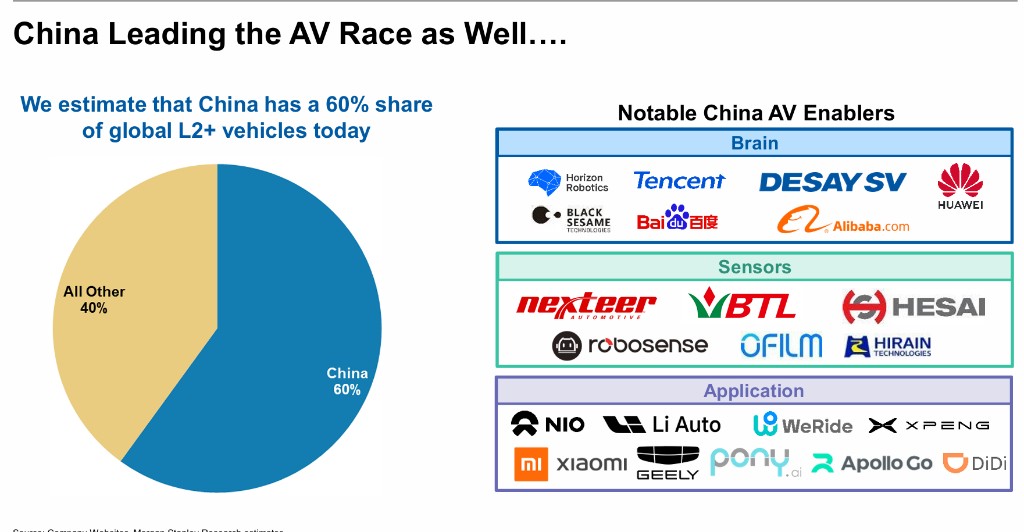
In this round of global technological competition, Morgan Stanley clearly stated that China is already in a leading position. According to news from the Wind Trading Desk, the report indicates that China currently holds about 60% of the global L2+ level autonomous vehicle market share, which is not only attributed to China's victories in the electric vehicle (EV) sector but also to its "data probe" advantage built through a massive electric vehicle fleet.
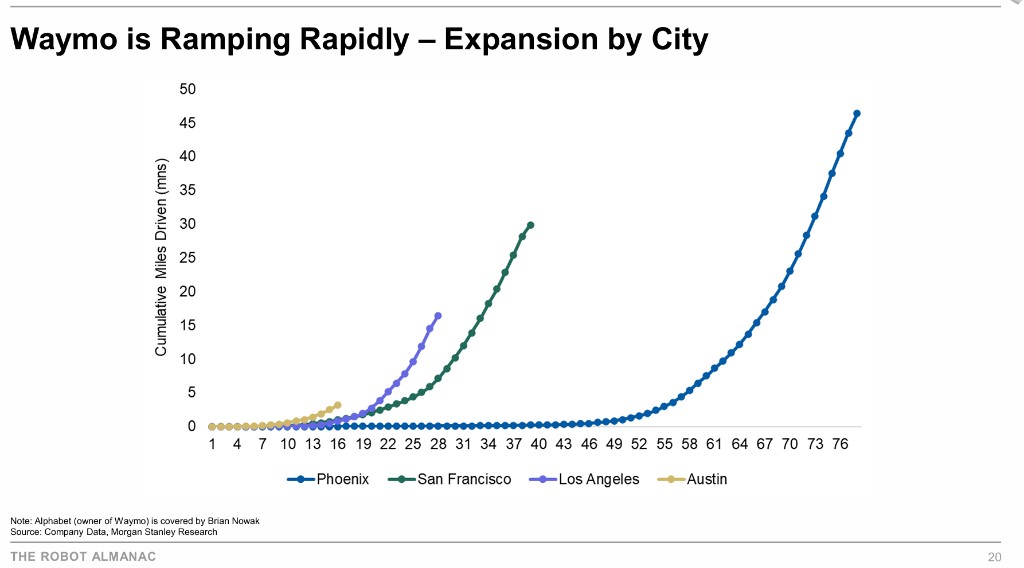
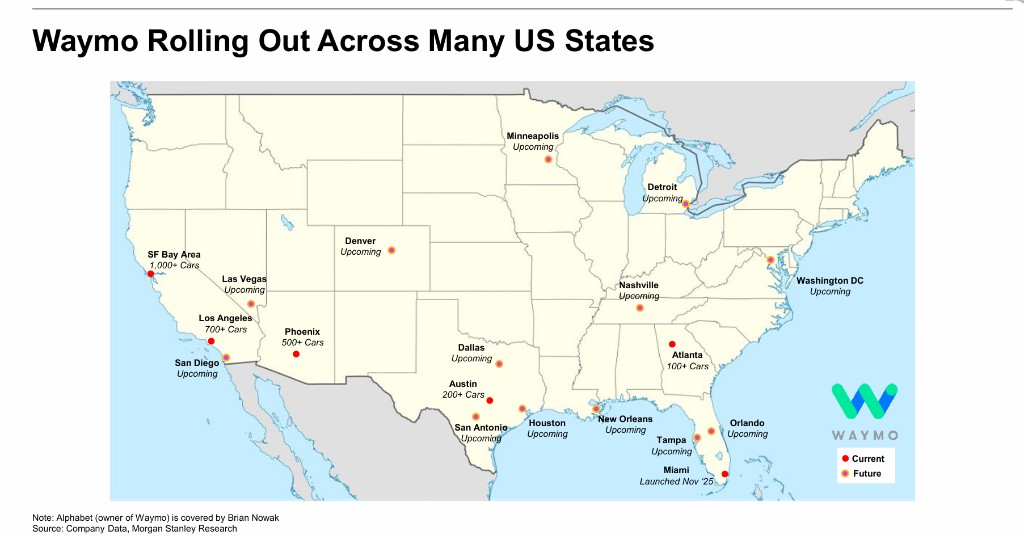
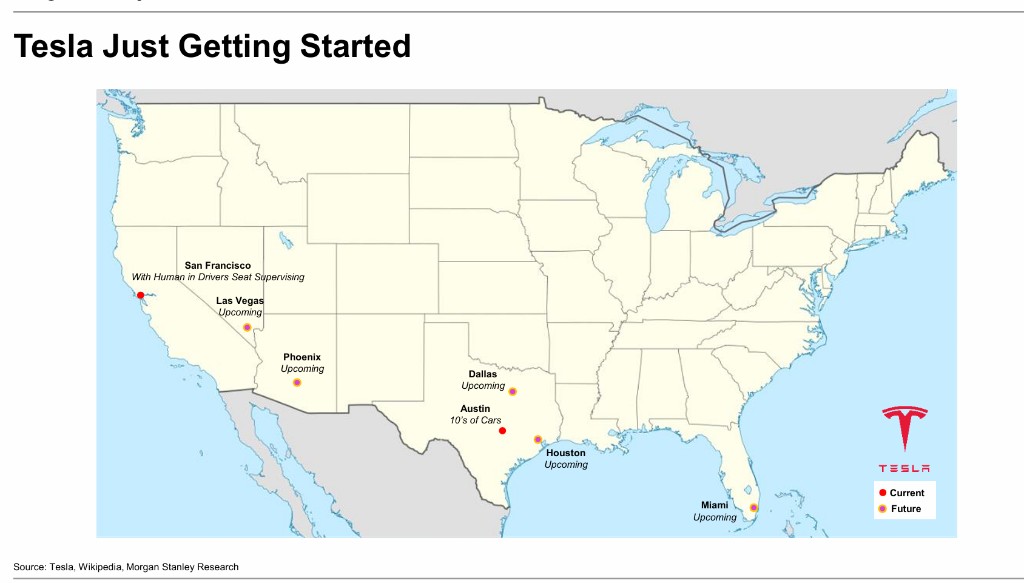
At the same time, the competitive landscape in the U.S. market is also undergoing profound changes, with the rivalry between Waymo and Tesla intensifying. Waymo is rapidly expanding from cities like Phoenix and San Francisco to major cities across the U.S., including Los Angeles, Austin, and Atlanta, with its operational mileage expected to experience explosive growth in the coming years; while Tesla's pure vision solution is seen as "just getting started," with extremely low hardware costs but aiming to achieve superiority through vast fleet data. The report compares the current sensor technology route competition to the "War of the Currents" in the late 19th century, suggesting that different technological paths may coexist in the long term.
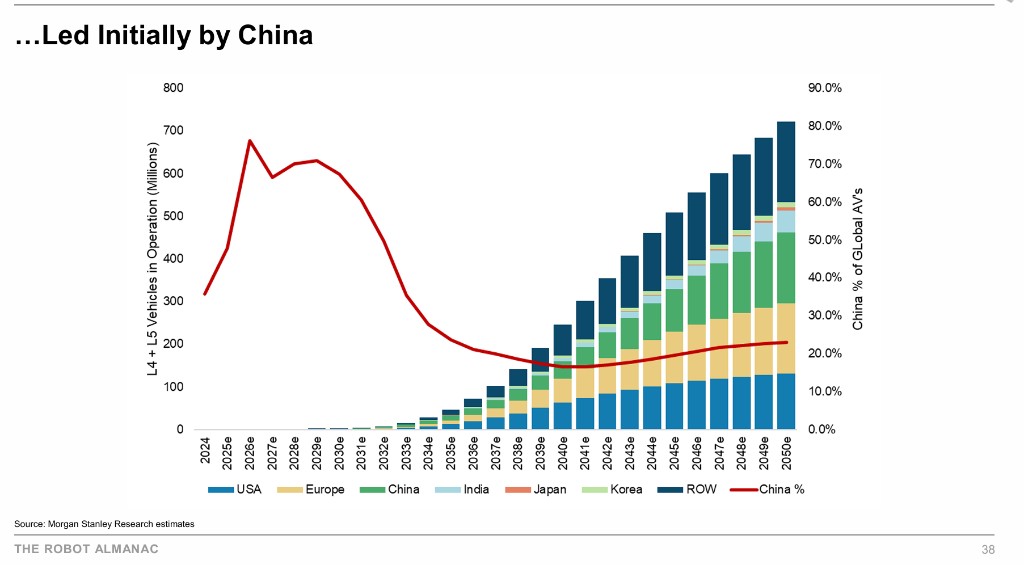
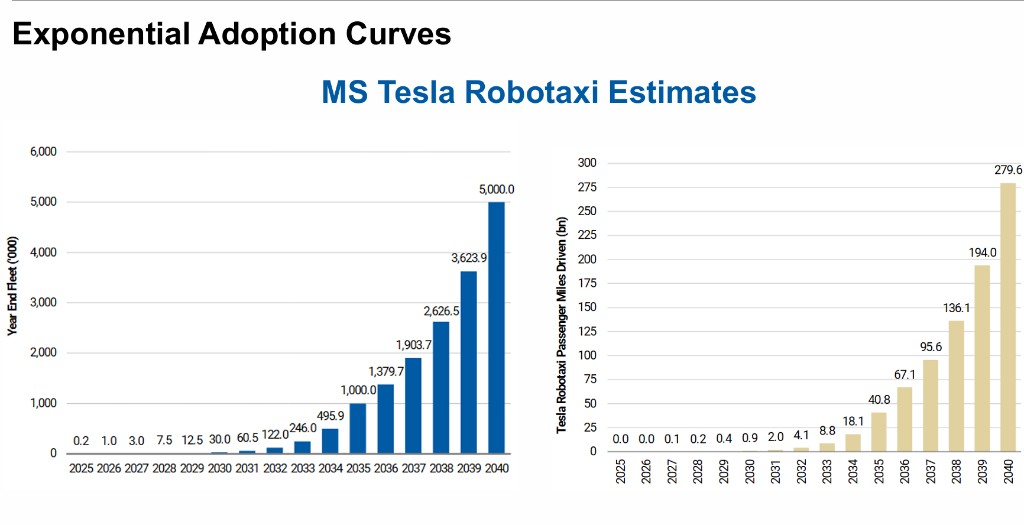
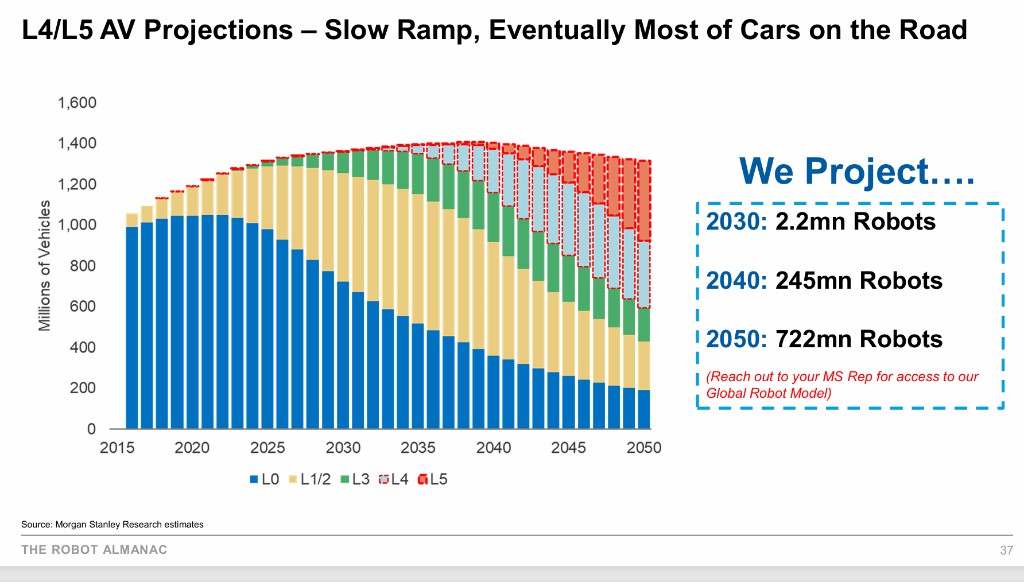
Morgan Stanley holds an extremely optimistic view on the long-term adoption rate of autonomous driving. The report predicts that although the initial phase will have a slow ramp-up, this trend is irreversible. It is expected that by 2030, there will be 2.2 million robot taxis in operation globally, and this number will surge to 245 million by 2040, ultimately reaching 722 million by 2050. Morgan Stanley emphasizes that autonomous driving will be the "ultimate accelerator" for the electric vehicle industry, fundamentally changing human mobility and economic models.
China's Dominance: The Victory of Scale and Data
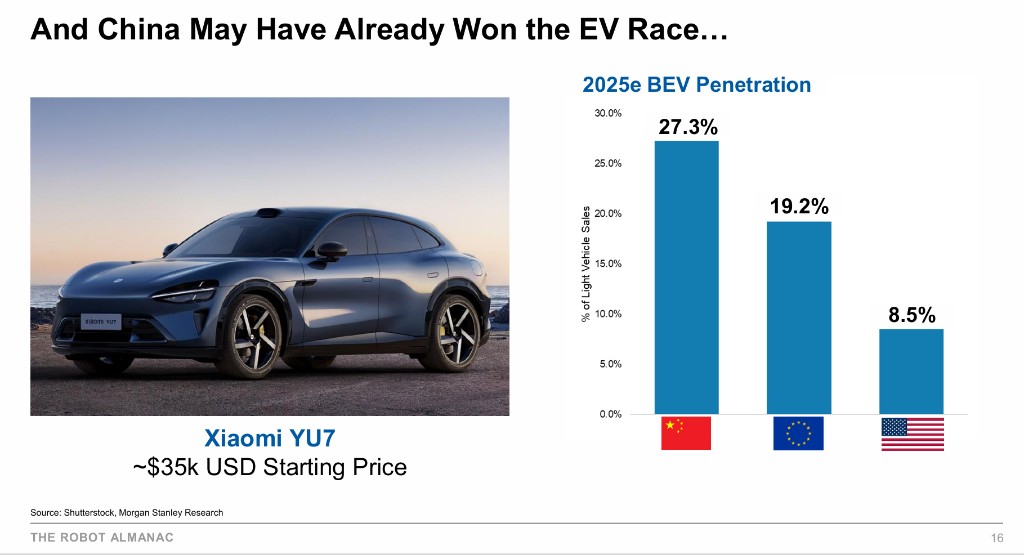
Morgan Stanley pointed out in the report that China may have already won the electric vehicle race and is leading the autonomous driving competition. Taking the Xiaomi YU7 as an example, its starting price is about $35,000, showcasing the significant cost control advantages of Chinese manufacturing. More critically, electric vehicles are inherently more suitable for autonomous driving than gasoline vehicles: they default to drive-by-wire systems, and the abundant electricity can significantly reduce the per-mile operating costs of the fleet, thereby shortening the investment payback period.
 The report particularly emphasizes the concept of "Data Probes." Electric vehicles are not just modes of transportation; they are mobile data collectors. Through a continuous loop of "collect-improve-recollect," China's vast electric vehicle fleet is training smarter AI algorithms. Morgan Stanley believes that without cooperation with China, it is difficult for Western countries to economically and efficiently manufacture vehicles with equivalent data collection capabilities in a situation where they are not profitable and lack scale. China's comprehensive layout in sensors, brains (computing platforms), and applications has allowed it to occupy about 60% of the global L2+ vehicle market.
Route Controversy in the U.S. Market: The Game of Redundancy vs. Simplicity
In the United States, autonomous driving technology is evolving through two distinctly different paths. Morgan Stanley attributes this mainly to the "Sensor Redundancy" faction represented by Waymo and the "Sensor Parsimony" faction represented by Tesla.
Waymo adopts an L4 level solution, equipping vehicles with LiDAR, radar, and cameras, with the cost of sensors and computing hardware per vehicle being about $30,000. This solution emphasizes safety redundancy and has night vision capabilities. Currently, it has hundreds to thousands of vehicles in Phoenix, San Francisco, and Los Angeles, with plans to expand to more cities like Miami and Washington, D.C.
In contrast, the FSD hardware equipped in the Tesla Model Y costs only about $3,000 and relies on a pure vision solution, requiring no LiDAR and even discarding radar. Morgan Stanley's analysis points out that this has sparked a debate about the feasibility of "pure vision." The report suggests that if AI can make every driver the "best driver" and significantly reduce the daily traffic accident death toll (currently about 110 in the U.S.), then the pure vision solution is logically valid.
Morgan Stanley compares this to the historical battle between alternating current (AC) and direct current (DC): the first mover is not always the winner, and low-cost, easily scalable solutions (similar to AC) may have advantages in long-term scaling, but both have their own space for survival in their specific use cases
Long-term Outlook and Global Landscape
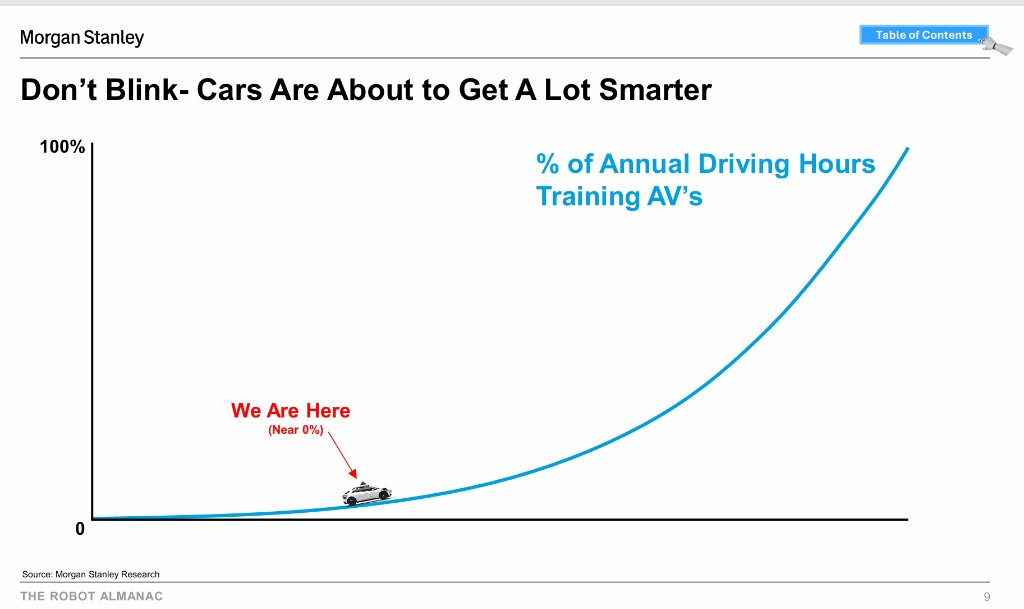
Looking ahead, Morgan Stanley depicts a steep adoption curve. According to its forecasting model, the sales penetration rate of autonomous vehicles is expected to soar from nearly zero to close to 100% over the next few decades.
- By 2030: Approximately 2.2 million fully autonomous vehicles worldwide.
- By 2040: This number will grow exponentially to 245 million, at which point most cars on the road will be intelligent.
- By 2050: The global stock of autonomous vehicles will exceed 722 million.
Not only the giants in China and the U.S., but also a number of emerging companies worldwide are accelerating this process. The report mentions the UK's Wayve, which is committed to achieving autonomous driving through an "AV 2.0" end-to-end AI model; the U.S.'s Applied Intuition, which provides simulation and software validation tools for automakers; and China's WeRide and Pony.ai, both of which operate Robotaxis in major Chinese cities and have expanded their business to the Middle East and Europe, and have already listed on the U.S. stock market. Morgan Stanley concludes that as technology matures and costs decline, autonomous driving will transform from a science fiction concept into an undeniable tangible force in the global economy.