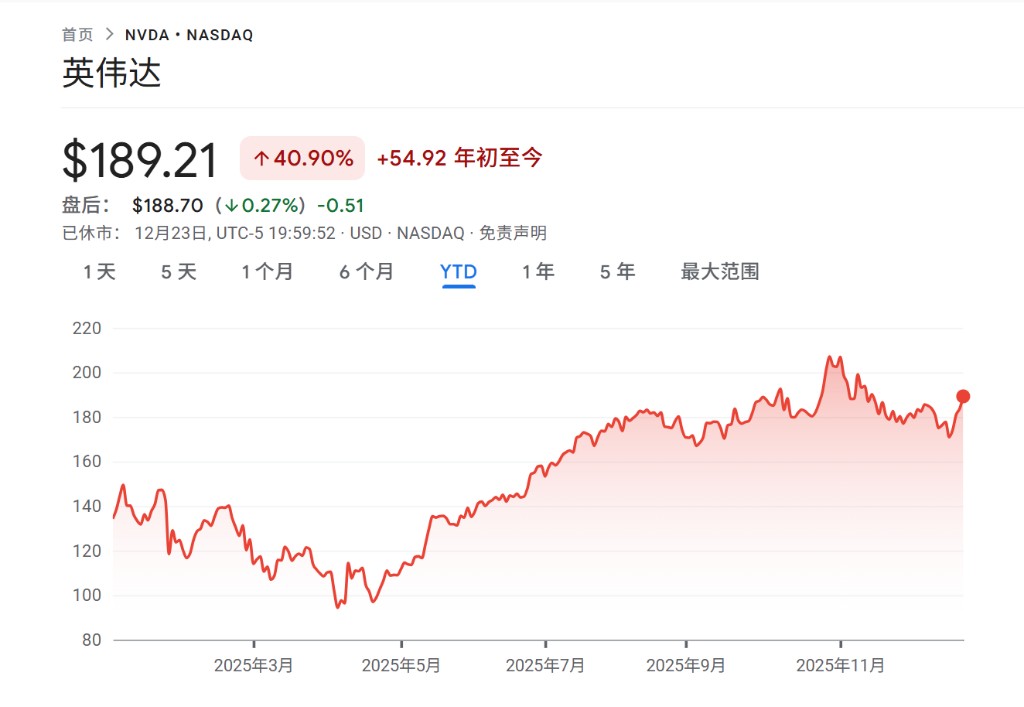
Senior Technology Analyst: NVIDIA is really cheap

Bernstein's research report points out that NVIDIA's valuation has fallen to a historical low, with the expected price-to-earnings ratio dropping below 25 times, representing a rare discount compared to the semiconductor industry. Despite the recent stagnation in stock price, its earnings continue to be revised upward, and new architectures such as Blackwell are poised for launch. Analysts believe that now is an excellent buying opportunity, with a target price of $275
On the 19th, the well-known Wall Street investment bank Bernstein released a research report stating that although NVIDIA's stock performance this year has been decent, its valuation has undergone severe compression against the backdrop of continuously revised upward earnings expectations, currently sitting at an extremely attractive historical low.
According to news from the Wind Trading Desk, the report shows that since July of this year, NVIDIA's stock price has stagnated, with a year-to-date increase of about 30%, underperforming the Philadelphia Semiconductor Index (SOX) by 38%. This stagnation in stock price, coupled with the divergence from earnings growth, has led to its expected price-to-earnings ratio (P/FE) falling significantly below 25 times.

Bernstein analysts, including Stacy A. Rasgon, believe that NVIDIA is currently extremely "cheap" from both absolute and relative valuation perspectives. Relative to the overall semiconductor industry, NVIDIA's current trading price is at about a 13% discount, placing it in the "first percentile" of the past decade.
Analysts emphasize that the current price level is an excellent buying opportunity. Historical data shows that if investors buy NVIDIA when its price-to-earnings ratio is below 25 times, they typically see substantial returns, with an average one-year return rate exceeding 150%, and there has been no negative return during this period.
Valuation Hits "Floor Price," Multiple Catalysts Awaiting
According to Bernstein's calculations, a 25 times expected price-to-earnings ratio means that NVIDIA's current valuation is at the 11th percentile of the valuation range over the past decade, which is considered an absolute low. More notably, in terms of relative valuation data: over the past decade, there have only been 13 trading days when NVIDIA's trading price relative to the SOX index was cheaper than it is now.
In response to recent market concerns about the sustainability of AI capital expenditures (Capex), Rasgon pointed out that current capital expenditure intentions remain healthy, and the competitive narrative of GPUs versus ASICs is regaining momentum. Looking ahead to the new year, the CES and GTC conferences are expected to provide further catalysts, with Rubin architecture products set to be launched soon. Additionally, the Trump administration's approval of the H200 chip may bring upward potential for the Chinese market.
Bernstein reiterated its "outperform" rating on NVIDIA and set a target price of $275, believing that current market expectations may be too low in the context of the company's guidance of over $500 billion for Blackwell/Rubin