


The Resilience of the U.S. Economy and the Triple "K" Divergence

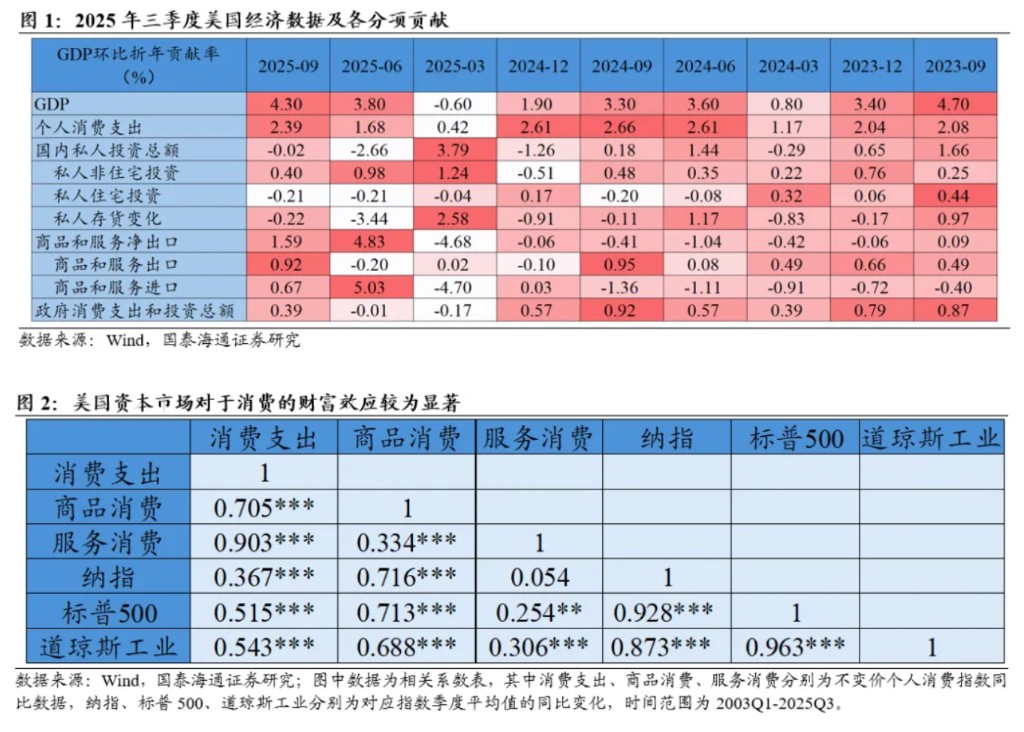
In the third quarter of 2025, the U.S. economy grew beyond expectations, with a seasonally adjusted annual rate of GDP growth at 4.3%. The resilience of the economy mainly comes from the growth in personal consumption, public spending, and exports. Personal consumption expenditure contributed 2.39% to GDP, supported by the wealth effect from the capital markets. Government consumption expenditure and investment increased by 0.55% quarter-on-quarter, with significant increases in defense spending. The global economic recovery drove a quarter-on-quarter increase in exports of 2.13%
U.S. Economic Growth Exceeds Expectations in Q3, Driven by Consumption, Public Spending, and Exports
On December 23, 2025, Eastern Time, the U.S. Bureau of Economic Analysis (BEA) released the economic data for Q3 2025, which was originally scheduled for release on October 30 but was delayed due to the longest government shutdown in U.S. history. According to the data, the annualized quarter-on-quarter GDP growth rate for the U.S. in Q3 2025 was 4.3%, compared to an expectation of 3.3% and a previous value of 3.8%, indicating that the overall economic resilience of the U.S. exceeded expectations.
From the perspective of various economic components, the resilience of the U.S. economy in Q3 was primarily driven by strong personal consumption, growth in public spending, and an increase in export contributions.
First, the wealth effect from the capital markets continues to support high growth in U.S. personal consumption expenditures. In Q3 2025, the contribution rate of personal consumption expenditures to GDP on a quarter-on-quarter annualized basis reached 2.39%, with real personal consumption expenditures growing by 2.8% year-on-year, including a 3.3% increase in goods consumption and a 2.5% increase in services consumption. The wealth effect from the capital markets is a significant source supporting consumption, and U.S. consumption is significantly correlated with capital market performance (as shown in Figure 2). In Q3 2025, the three major U.S. stock indices reached historical highs, sustaining resilient consumption.
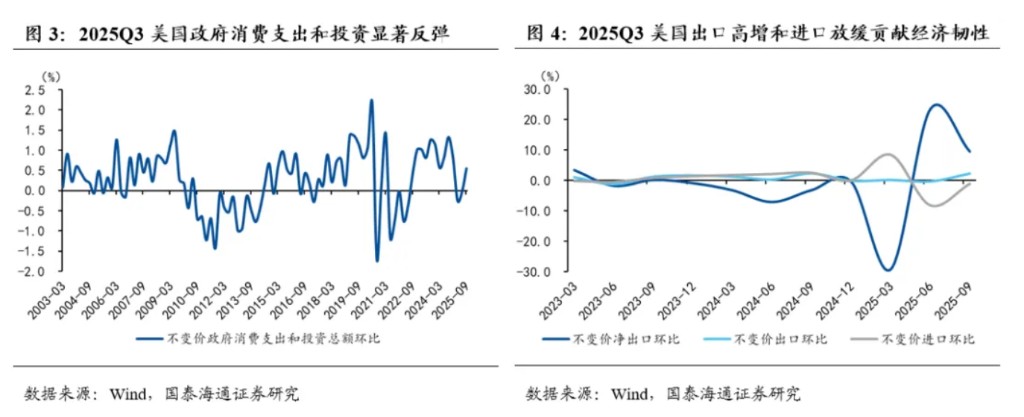
Second, growth in government consumption expenditures and investments is an important driving factor for U.S. economic resilience in Q3 2025. In Q3 2025, the total real government consumption expenditures and investments in the U.S. grew by 0.55% quarter-on-quarter, showing a significant rebound compared to the contractions of -0.25% in Q1 and -0.02% in Q2. On one hand, there was a noticeable increase in federal government defense spending in Q3 2025, which grew by 1.43% quarter-on-quarter, while the U.S. government invested in companies like Intel, leading to a significant narrowing of the decline in non-defense spending; on the other hand, in July 2025, the U.S. Treasury significantly raised its borrowing plan for Q3, increasing the estimated borrowing from $554 billion in April to $1.01 trillion, providing funding space for government spending.
Third, the recovery of global economic activity has driven a significant increase in U.S. exports, thereby enhancing economic contributions. In Q3 2025, real exports from the U.S. grew by 2.13% quarter-on-quarter, a significant increase compared to 0.04% in Q1 and -0.46% in Q2. On one hand, the recovery of global economic activity has increased external demand, with the average global manufacturing PMI for Q3 2025 at 49.6%, up 0.3 percentage points from Q2, and manufacturing PMIs in Asia and Africa rebounding significantly, both above the threshold line, thus supporting U.S. exports; on the other hand, in July 2025, the U.S. reached trade agreements with the UK, EU, Japan, South Korea, and several Southeast Asian countries, which lowered tariffs on these countries while corresponding economies also reduced or eliminated retaliatory tariffs on the U.S., providing a boost to U.S. exports. In Q3 2025, real imports of goods and services in the U.S. decreased by 1.2% quarter-on-quarter, following a significant surge in imports in Q1, with continued slowdown in imports in Q2 and Q3, thereby enhancing economic contributions from net exports, although the marginal contribution of the decline in imports was lower compared to Q2
The Triple "K" Divergence Characteristics of the U.S. Economy
Although the overall U.S. economy remains resilient, the characteristics of "K" type divergence are also quite evident. Specifically:
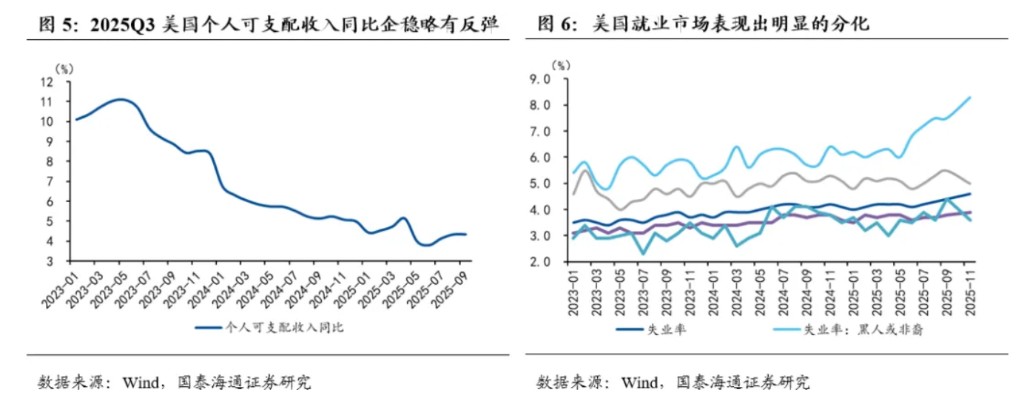
First, at the individual level, income divergence leads to consumption divergence. In the third quarter of 2025, the year-on-year growth rate of U.S. personal disposable income stabilized and slightly rebounded, reaching a short-term low of 3.81% in June 2025, and then rebounding to 4.35% year-on-year by September. However, the growth of income exhibits certain divergence characteristics. On one hand, the U.S. job market shows significant divergence, with the overall unemployment rate rising from 4.0% in January to 4.6% in November 2025. The unemployment rate for Black or African Americans increased from 6.2% in January to 8.3% in November, while the unemployment rate for whites only rose from 3.5% to 3.9% during the same period. Policies such as Trump's immigration deportation have played a role, and the divergence in the job market has led to income divergence. On the other hand, the U.S. capital market has performed well, highlighting the wealth effect, but this wealth effect is more concentrated among a small group of wealthy individuals. According to the 2022 Federal Reserve's Survey of Consumer Finances, the wealthiest 10% of households in the U.S. hold 93% of all stock assets. These two aspects together constitute the current characteristics of income divergence in the U.S., which further leads to consumption divergence. High-income groups contribute to the prosperity of high-end tourism, dining, and investment consumption, while low-income groups experience a decline in actual purchasing power, with a high proportion of expenditure on necessities.
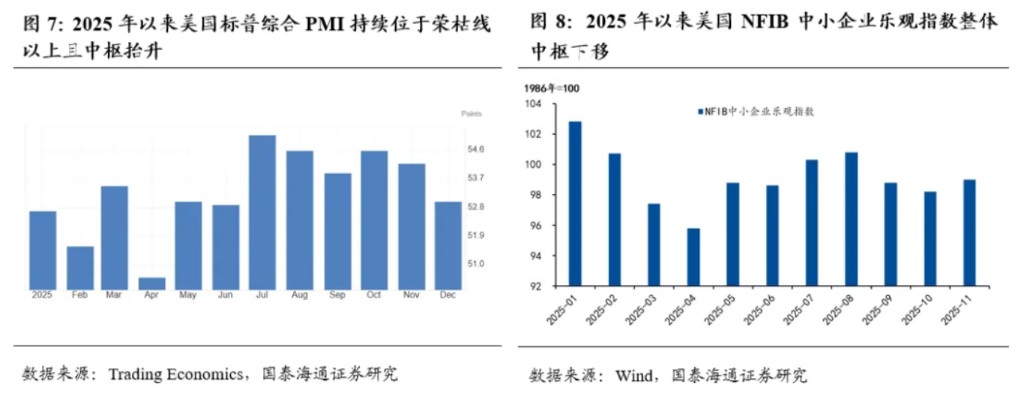
Second, at the enterprise level, the economic climate diverges between large and small enterprises. We use the S&P Global Composite PMI and the NFIB (National Federation of Independent Business) Small Business Optimism Index to observe the divergence in the economic climate of large and small enterprises in the U.S. Although the S&P Global Composite PMI includes large, medium, and small enterprises, it primarily reflects the economic climate of large manufacturing and service enterprises due to the dominance of large companies. Since 2025, the S&P Global Composite PMI index has consistently remained above the expansion-contraction line, and the overall central tendency has further increased in the second half of the year, reflecting that large enterprises have maintained a good economic climate in terms of cost transfer, profit maintenance, and increased capital expenditure. In contrast, the NFIB Small Business Optimism Index has shown a downward trend, indicating that small and medium-sized enterprises have performed relatively weakly in coping with tariffs, inflation, and economic transformation
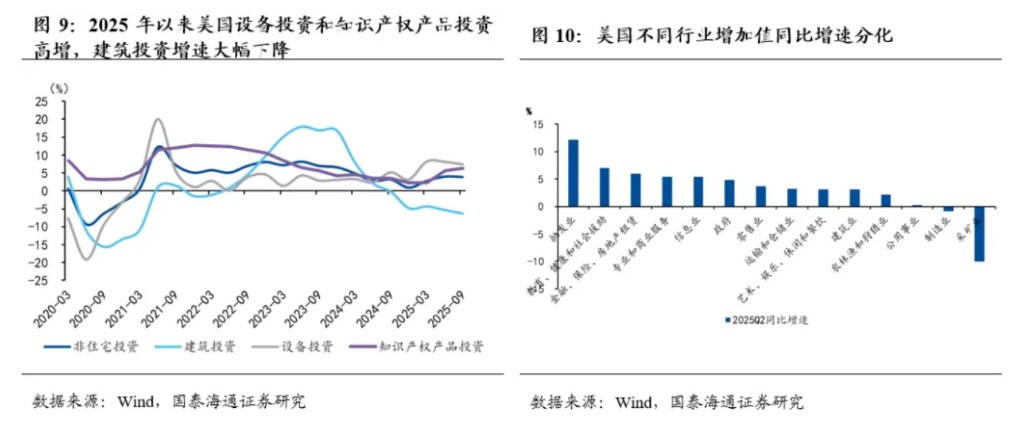
Third, at the industry level, there is a differentiation in investment and growth between the old and new economies. Since 2025, private non-residential investment in the United States has shown strong overall resilience, with a year-on-year growth rate of 3.9% in the third quarter. Among these, equipment investment and investment in intellectual property products have maintained high growth, with year-on-year growth rates of 7.4% and 6.4% respectively in the third quarter. However, construction investment has seen a further decline in year-on-year growth, dropping to -6.3% in the third quarter from a previous value of -5.3%, indicating a clear differentiation within investments. From the perspective of industry value-added, in the second quarter of 2025, the wholesale industry, education and health, finance and insurance, business services, and information industries ranked high in year-on-year growth rates, while mining, manufacturing, utilities, agriculture, forestry, fisheries, and construction ranked low, reflecting the differentiation in growth between the old and new economies.
Expected strong resilience after economic shocks in Q4 2025
Due to the impact of the U.S. government shutdown, it is expected that the U.S. economy will be affected in the fourth quarter of 2025, but overall resilience will remain strong in 2026. From October 1 to November 12, 2025, the U.S. government experienced the longest shutdown in history, lasting a record 43 days, which will impact the economy. On one hand, the closure of some federal agencies and the reduction in government procurement and investment consumption activities will have a direct impact on the economy; on the other hand, the delayed or reduced income of federal employees and contractors, as well as restrictions on approvals in certain industries, such as pharmaceutical listings, IPOs, and loans from the Small Business Administration, will have an indirect impact on the economy. However, overall, the impact of the shutdown is mainly concentrated in the short term, and there may be a gradual recovery rebound afterward, with only a small portion of job, income, and confidence losses being permanent. In the first quarter of 2026, the economy is likely to further recover, driven by the short-term demand release effect after the government shutdown, leading to a moderate economic rebound; strong consumption and new economic investments will continue, supported by the wealth effect of the capital market; and the easing of tariff frictions and global economic recovery will still support U.S. exports.
We maintain our judgment that the Federal Reserve will cut interest rates 2-3 times in 2026. After the release of U.S. economic data in the third quarter of 2025, expectations for a soft landing of the U.S. economy have further heated up, and expectations for interest rate cuts by the Federal Reserve have cooled somewhat. However, the U.S. federal funds futures market still reflects an expectation of 2 rate cuts for the entire year. We also maintain our judgment of 2-3 rate cuts in 2026. Although the U.S. economy shows strong resilience, there are signs of structural and persistent weakening in the labor market, and the change in the Federal Reserve chairmanship will have a certain boosting effect on interest rate cuts, indicating that the preventive interest rate cut cycle will continue
Risk Warning and Disclaimer
The market has risks, and investment requires caution. This article does not constitute personal investment advice and does not take into account the specific investment goals, financial situation, or needs of individual users. Users should consider whether any opinions, views, or conclusions in this article are suitable for their specific circumstances. Investment based on this is at one's own risk
