Elon Musk predicts that the U.S. economy will achieve double-digit growth within 18 months, with AI as a key driving force

Wallstreetcn
2025.12.24 21:42
portai
I'm PortAI, I can summarize articles.

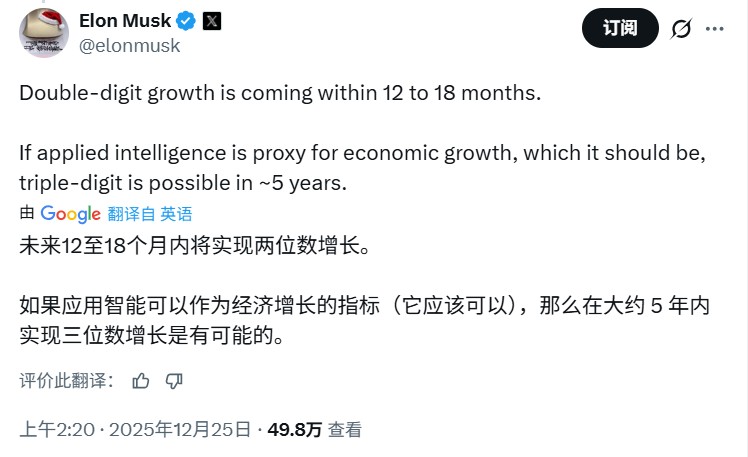
Elon Musk expects the U.S. economy to enter a double-digit growth period within the next 12 to 18 months. He stated that if intelligent applications are considered as a proxy indicator for economic growth, "triple-digit growth could be achieved in about five years."

The world's richest man, Elon Musk, predicts that the U.S. economy will enter a double-digit growth period in the next 12 to 18 months, with artificial intelligence seen as a major driving force.

On Wednesday, Musk posted on the X platform that if applied intelligence is considered an indicator of U.S. economic growth, "triple-digit growth could be achieved in about five years." This statement comes at a time when U.S. economic data is showing strength.

According to Wall Street News, the annualized GDP growth rate for the third quarter reached 4.3%, the fastest growth in two years. Federal Reserve officials have listed AI data center investments as one of the key factors for raising economic growth expectations for 2026.

Meanwhile, major Wall Street institutions have also raised their forecasts for market performance. Morgan Stanley expects the S&P 500 index to record double-digit percentage gains by 2026. Goldman Sachs believes that the global stock market has entered an "optimistic phase" of a bull market, with earnings in 2026 continuing to support the trend, and total returns, including dividends, reaching 15%.

AI Investment Drives Growth Expectations

Federal Reserve officials have ranked AI data center spending alongside consumer spending and fiscal aid as multiple factors supporting stronger growth expectations for 2026.

Analysts believe that the widespread penetration and application of AI technology is expected to significantly enhance productivity and innovation capabilities, thereby driving the U.S. economy into a higher growth range (10% or above).

Musk has repeatedly linked economic growth to what he calls "applied intelligence" in his businesses.

At Tesla, he stated that he is focused on developing the next generation of AI chips to support autonomous driving systems. At SpaceX, the company continues to expand its satellite network and launch capabilities through Starlink, aiming to meet the growing global demand for data connectivity and transmission.

This week, the U.S. third-quarter GDP data was released, showing that the U.S. economy is expanding at its fastest pace in two years, with an annualized GDP growth rate of 4.3%, primarily driven by strong consumer spending and stable business policies.

This report, delayed due to the government shutdown, shows that even with consumer confidence faltering in December and factory output flat in November, economic resilience persisted through the mid-year period. Data from the U.S. government and central bank highlights the resilience of consumer spending and the continued strength of business investment.

Goldman Sachs: 13% Return for Global Stock Market in 2026

Looking ahead to 2026, Goldman Sachs' core advice is "diversification is a must."

Based on research of U.S. stock market cycles over the past 50 years, Goldman Sachs points out that the stock market typically goes through four stages of evolution: Despair, Hope, Growth, and Optimism.

The market is currently in the final part of the cycle— the "optimistic phase." **According to Goldman Sachs' predictive model, the weighted price return for the global stock market in 2026 is expected to be 13% in U.S. dollars, and if dividends are included, the total return will reach 15% **

Due to the current stock market being geographically dominated by the United States, industry-wise dominated by technology, and stock-wise dominated by large U.S. companies, this high concentration is both a driving force and a risk. Goldman Sachs recommends that investors adopt the following strategies:

  • Maintain Investment: The bull market is not over yet.
  • Cross-Regional Diversification: Focus more on emerging markets (EM).
  • Cross-Style Diversification: Combine selected growth stocks with value stocks. In non-U.S. markets, value stocks typically outperform growth stocks, partly because industries like finance and mining have successfully transformed from "value traps" to value creators.
  • Cross-Industry Diversification: Leverage the expansion of technology capital expenditures (Capex) to invest in "old economy" infrastructure sectors that can benefit from AI development.
  • Focus on Alpha Returns: Take advantage of the potential low correlation of stocks to capture individual stock opportunities