The wave of deposit maturities has arrived. How significant is its impact on the market?

After 2020, residents' precautionary savings increased, and banks absorbed a large amount of medium- and long-term fixed deposits. Deposit interest rates were lowered, and the repricing of early high-interest deposits affected the market. It is expected that the scale of fixed deposits maturing for more than one year next year will be about 50 trillion yuan, concentrated in the 2-5 year term. State-owned large banks account for a large proportion, with a scale of about 30 trillion yuan. The impacts include alleviation of banks' net interest margin pressure, favorable conditions for the stock market and short-duration credit, potential disruptions to liquidity due to "relocation" of deposits, a downward trend in certificate of deposit rates after fluctuations, and pressure on banks' allocation of ultra-long-term interest rate bonds
Core Viewpoint
After 2020, the household sector has shown a tendency for precautionary savings. The weak performance of the stock and real estate markets, along with limited investment channels, has significantly increased the willingness of residents to save, leading the banking system to absorb a large amount of medium- to long-term fixed deposits. In recent years, the benchmark interest rates for deposits have continued to decline, and this batch of early deposits locked in at relatively high interest rates is gradually reaching maturity, making their "repricing" and "reallocation" effects the focus of recent market attention. Our rough estimates suggest that the maturity volume of fixed deposits with a term of over 1 year next year will be about 50 trillion yuan; concentrated in the 2-5 year term; state-owned large banks may account for a larger share, with a scale of over 30 trillion yuan. In terms of impact, the most direct effect is to help alleviate the pressure on banks' net interest margins, but the scale and stability of liabilities are more critical. Additionally, the benefits from the stock market and short-duration credit are relatively more certain, while the "migration" of deposits may temporarily increase market disturbances, and deposit certificate rates may first fluctuate before declining, putting greater pressure on banks holding ultra-long-term bonds.
Event Background: This Round of Deposit Maturity Wave Originates from Past Precautionary Savings by Households
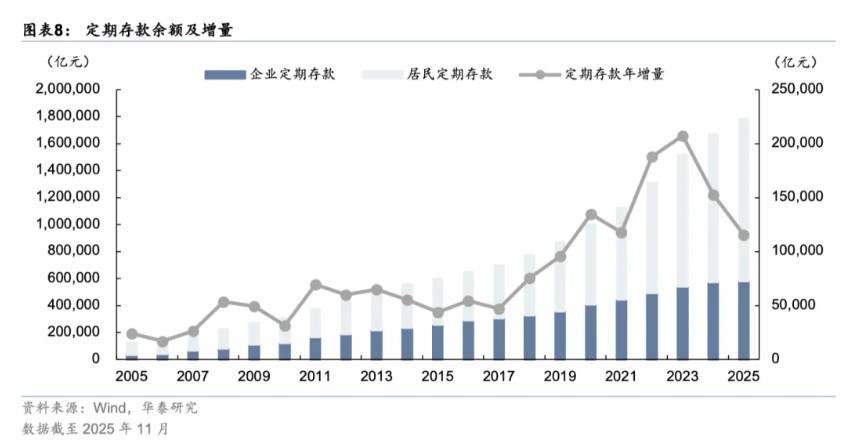
In recent years, the self-discipline mechanism has been committed to promoting a decrease in the cost of bank liabilities, but before 2023, the cost of bank deposits has risen instead of falling, seemingly contradicting the trend of declining deposit interest rates. Beyond the pressure to attract deposits, a deeper reason lies in the tendency for deposits to be fixed and for deposit terms to be extended. After the pandemic, the demand for leverage from households and enterprises has not been strong, leading to an increase in precautionary savings. Coupled with the weak performance of the stock and real estate markets and limited investment channels, this has significantly enhanced the willingness of residents to save, resulting in the banking system absorbing a large amount of medium- to long-term fixed deposits. From a total data perspective, since 2020, the annual increase in fixed deposits from households and non-financial enterprises has been over 10 trillion yuan, with the new scale in 2022-2023 reaching as much as 20 trillion yuan at one point. Considering that most of these new deposits have terms of 1-5 years (2 years, 3 years, 5 years), they are logically concentrated in maturities over the next two years.
Volume Assessment: The Estimated Scale of Fixed Deposits Maturing Over 1 Year Next Year is About 50 Trillion Yuan
Currently, there is no ready-made data on deposit maturities or new deposits for the entire banking industry available through public channels, but most annual reports of listed banks disclose the balance of deposits of various terms (including large certificates of deposit issued to general customers), which can be used for simple calculations: 1) From a total volume perspective, based on two logical calculations, the scale of fixed deposits maturing over 1 year next year is estimated to be around 50 trillion yuan, an increase of about 10 trillion yuan compared to this year; 2) In terms of term structure, the maturing volume of 2-year and 3-year deposits next year is expected to exceed 20 trillion yuan each, with 5-year deposits roughly at 5-6 trillion yuan; 3) By type of bank, it is expected that state-owned large banks will have the largest maturing deposit scale next year, with their fixed deposits over 1 year estimated to be around 30-40 trillion yuan; 4) In terms of the maturity rhythm within the year, it is expected that the volume maturing in the first half of the year will be higher than that in the second half.
Impact on Banks: Helps Improve Net Interest Margin, Key Factors are Liability Scale and Stability
If we only consider the repricing logic, the maturity of deposits helps reduce the cost of bank liabilities. Considering that large banks have a larger volume of maturing deposits, this logically benefits the demand for medium- and short-term interest rates, while ultra-long-term bonds face greater pressure on indicators (a reduction in long-term deposits will exacerbate the mismatch in asset-liability duration, "ΔEVE," and LCR indicators will become "tight") In addition, the improvement in net interest margin will also expand the space for counter-cyclical monetary policy adjustments. However, under the trend of "deposit migration" and the preference for demand deposits, banks' high-interest deposit gathering without asset matching may face deposit outflows in a market-driven manner, which could also pose risks in liability management or even balance sheet contraction. Considering that the weakening of credit demand on the asset side is more rapid and evident, we believe banks do not need to rush to sell bonds, but the flow of funds from banks to wealth management, "fixed income +", and other non-bank channels will certainly benefit short- to medium-term credit bonds.
Market Impact: Stock Market, Short-Duration Credit More Certain, Funding Environment Faces Phase Disturbances
Firstly, under the background of "deposit migration," if banks passively increase interbank certificates of deposit and interbank deposits to fill funding gaps, there will be short-term disturbances in the trends of certificates of deposit and funds. However, the expansion effect of non-bank scale may ultimately still be favorable; secondly, the stock market will benefit overall from the reallocation of deposit funds, with wealth management, "fixed income +", and dividend insurance likely being the main vehicles. Of course, these types of products have a low proportion of rights, are biased towards absolute returns, and can easily lead to simultaneous rises and falls in stocks and bonds; thirdly, insurance and annuities also face strong pressures for reallocation of maturing deposits, and under regulatory requirements such as duration gaps, the allocation direction of these funds is expected to remain biased towards longer durations and local government bonds.
Main Text
The Current Wave of Deposit Maturities and Market Impact
Since 2020, the household sector has shown a tendency for precautionary savings. With weak performance in the stock and real estate markets and limited investment channels, the willingness of households to save has significantly increased, leading the banking system to absorb a large amount of medium- to long-term fixed deposits. In recent years, the listed interest rates on deposits have continued to decline, and this batch of early deposits locked in at relatively high interest rates is gradually entering the maturity window. The issues of "repricing" and "reallocation" after maturity have become the focus of market attention recently.
China has experienced two significant rounds of "deposit migration" and one round of deposit return since 2010:
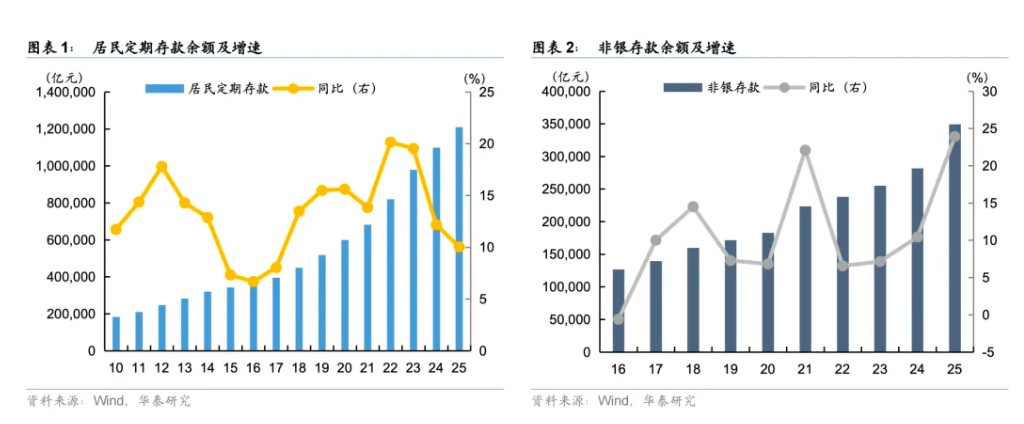
2013-2016: The asset management industry flourished, with banks' wealth management, trusts, and internet money market funds attracting a large amount of capital. According to data from the Asset Management Association of China, by the end of 2015, the total scale of the asset management industry exceeded 39 trillion yuan, with a year-on-year growth of over 90%. Securities companies' asset management products, public offerings, and their subsidiary accounts accounted for a significant share. Correspondingly, the growth rate of household time deposits fell from a high of 18% in 2012 to 7% in 2016, while non-bank deposits rose year-on-year.
2018-2023: The new asset management regulations in 2018 effectively curbed off-balance-sheet rigid repayment and the expansion of shadow banking, leading some disintermediated funds to return to on-balance-sheet banks. Coupled with the turning point in real estate trends and the risk aversion caused by the pandemic, this collectively drove deposits "home." The growth rate of household deposits rebounded from 7% to 20% in 2023, while the growth rate of non-bank deposits fluctuated at a low level.
2024 to Present: With deposit rates continuing to decline and the capital market warming up, combined with the concentration of newly issued fixed deposits maturing in recent years, household deposits are entering a new round of "migration." By November 2025, the growth rate of household time deposits is expected to fall from 20% in 2022-2023 to around 10%, corresponding to a year-on-year increase in non-bank deposits to over 20%

How large is the volume of deposits maturing in this round? Which terms and banks are mainly affected? What is the impact on the market? We provide a brief overview in this report.
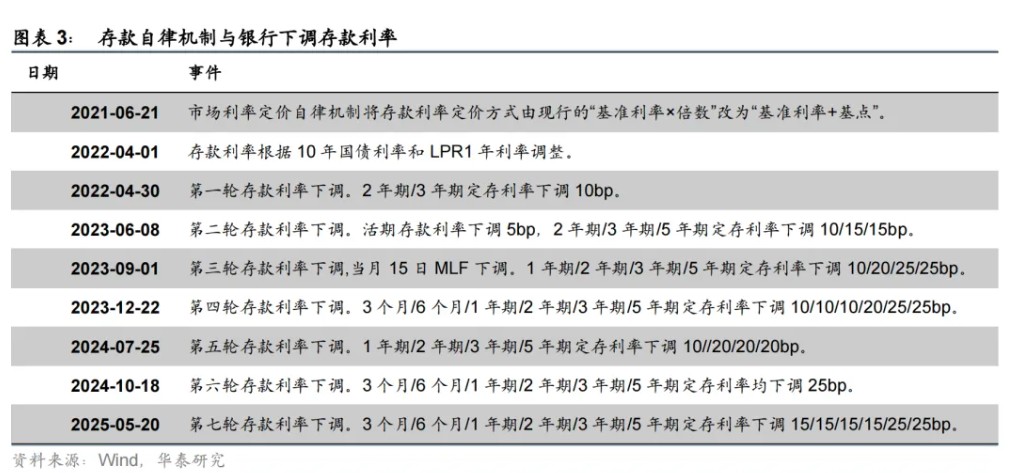
In recent years, the self-discipline mechanism has been committed to reducing the cost of bank liabilities:
-
In June 2021, under the guidance of the central bank, the self-discipline upper limit for deposit interest rates was changed from a multiple of the benchmark deposit rate to a fixed point. This effectively suppressed the leverage effect of the "multiple management era" and created space for long-term deposit interest rates to decline;
-
Due to intense competition in the deposit market, in practice, many banks' fixed deposit and large-denomination certificate of deposit rates approached the self-discipline upper limit. In April 2022, the central bank again guided the establishment of a market-oriented adjustment mechanism for deposit interest rates, where member banks of the self-discipline mechanism adjusted deposit interest rates reasonably based on bond market rates represented by the 10-year government bond yield and loan market rates represented by the 1-year LPR, further promoting the decline of deposit interest rates;
-
Since the reform of the deposit interest rate self-discipline mechanism, there have been seven rounds of deposit interest rate reductions, generally led by large banks with smaller banks following suit.

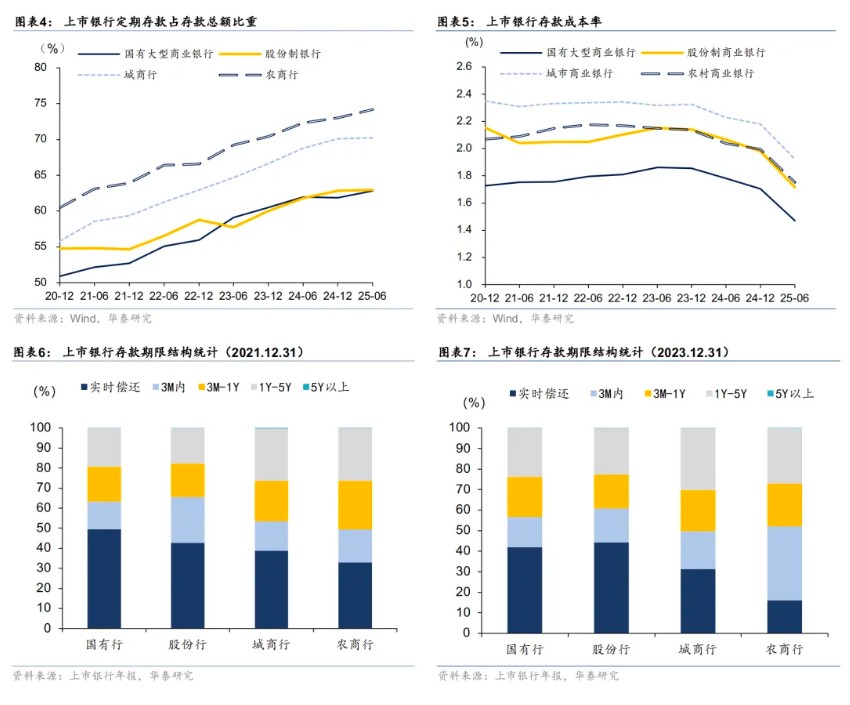
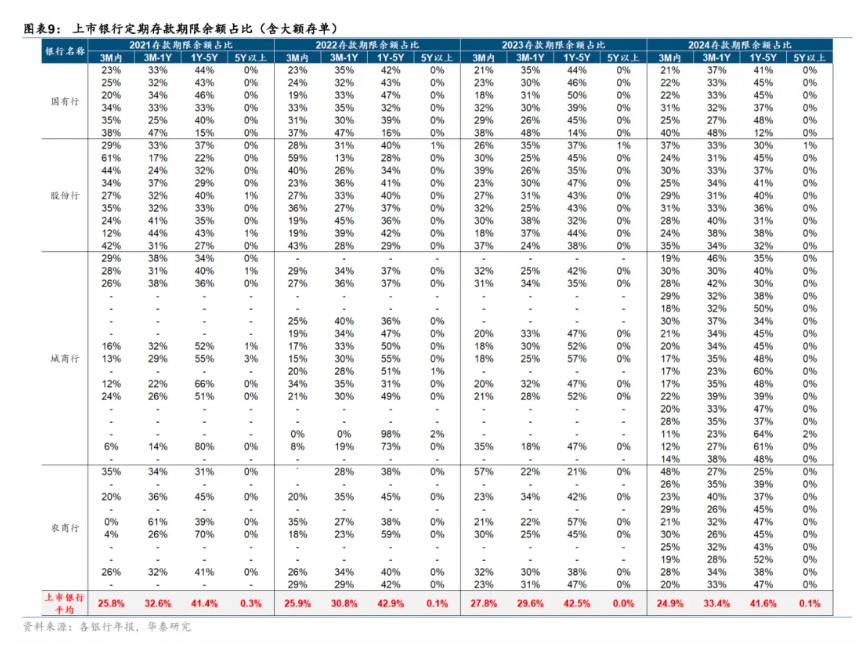
However, before 2023, the deposit costs of banks, especially state-owned large banks, rose instead of falling, which superficially seems to contradict the trend of declining bank deposit interest rates. On one hand, this reflects that banks still face pressure to attract deposits while expanding their balance sheets ("high interest to buy deposits"), although this has eased somewhat after the central bank regulated manual interest compensation and interbank deposit interest rate pricing, and established a deposit bidding interest rate reporting mechanism last year. On the other hand, a deeper reason stems from the trend of deposit regularization and lengthening of deposit terms. In recent years, the proportion of fixed deposits in total deposits for various types of listed banks has been on the rise, structurally, the proportion of "real-time repayment" has decreased, while the proportion of deposits over one year has increased.
Behind the trend of deposit regularization and long-termization, one is the change in risk preferences of residents and enterprises. After the pandemic, the demand for leverage among residents and enterprises is not strong, leading to an increase in precautionary savings; two is the limited investment channels, with the downturn in the real estate market, risks of breaking net in wealth management, and significant fluctuations in the stock market, residents and enterprises tend to choose stable and safe investment methods to avoid potential risks; three is that at that time, there was still a significant interest rate spread between demand and fixed deposits, and under the general trend of declining deposit interest rates, residents had a strong willingness to convert demand deposits into fixed deposits to make up for returns.
In addition, from the perspective of total data, since 2020, the balance of household + non-financial corporate time deposits (in RMB) has seen an annual increase of over 10 trillion, with the highest amounts in 2022-2023, averaging an annual increase of around 20 trillion. Considering that most of these new deposits have maturities of 1-5 years (2 years, 3 years, 5 years, etc.), they are logically concentrated in the near-term maturities over the past two years, which is an important background for the large scale of deposits maturing this year and next.

How much will the maturing deposits be next year? This is a question of great concern in the recent market.
Currently, there is no readily available data on deposit maturities or new deposit issuance for the entire banking industry from public channels, but most annual reports of listed banks disclose the balances of deposits of various maturities (including large certificates of deposit issued to general customers), which can be used for simple estimations. There are several perspectives for calculation that can be referenced:
First, from a total perspective, based on the annual reports of listed banks for 2024, the scale of maturing time deposits over 1 year next year is estimated to be about 45-50 trillion, an increase of 5-10 trillion compared to this year. According to the data from the annual reports of listed banks for 2024, the balance of time deposits within 1 year (including 1 year) accounts for about 61% of the total time deposits. Assuming this ratio applies to the entire banking industry and that these deposits all mature in 2025, the total scale of maturing deposits this year is approximately 102 trillion (2024 total market 167 trillion time deposits * 61%), which also includes the new issuance of products with maturities within 1 year in 2024, showing an increase of about 13.7% compared to the maturing amount in 2024 (based on calculations from the 2023 annual report). Extrapolating this growth linearly, the maturing scale next year is estimated to be about 116 trillion, an increase of about 14 trillion compared to this year.
Of course, the above calculations also include the new issuance of time deposits within 1 year over the past two years. If we only consider the scale of maturing deposits over 1 year (time deposit products issued in the past few years), assuming that the structure of new deposit issuance each year is consistent with the balance structure disclosed in the annual reports, the corresponding maturing scale of 40% is estimated to be 45-50 trillion, an increase of 5-10 trillion compared to this year's maturing amount.
Second, from the perspective of maturity structure, based on the extrapolation of annual report data from listed banks over the past few years, the scale of maturing time deposits over 1 year next year is estimated to be about 60 trillion (slightly higher than the first calculation), with maturing amounts for 2-year, 3-year, and 5-year deposits estimated at about 30 trillion, 24 trillion, and 6 trillion respectively. Logically, the scale of maturing deposits in 2026 is approximately equal to the sum of the 5-year deposits issued in 2021, the 3-year deposits issued in 2023, the 2-year deposits issued in 2024, and the new issuance of deposits with maturities within 1 year this year (not considering for now). Due to the small proportion of products with maturities over 5 years, they are ignored. The annual reports do not further detail the deposit structure for the 1-5 year maturity segment, so we assume that 2-year, 3-year, and 5-year products account for 50%, 40%, and 10% respectively (corresponding to scales of about 30 trillion, 24 trillion, and 6 trillion), estimating that listed banks will have a total of about 44 trillion in time deposits maturing over 1 year next year Considering that the total balance of fixed deposits in listed banks in 2024 accounts for about 75% of the total market fixed deposits (non-financial enterprises + residents), it can be inferred that the total scale of deposits maturing is nearly 60 trillion. On average, the two calculation logics yield about 50 trillion, an increase of about 10 trillion compared to this year.

Thirdly, by bank type, it is expected that the maturing deposits of state-owned banks will be the largest next year, with a scale of approximately 30-40 trillion (for fixed deposits over 1 year). According to the first calculation logic, the maturing deposit balances of state-owned banks, joint-stock banks, city commercial banks, and rural commercial banks in 2024 will account for 68%, 21%, 9%, and 2% of the total fixed deposits of listed banks within 1 year, respectively. Based on the aforementioned total maturity amount of 50-60 trillion, it is expected that the maturing deposits of state-owned banks will exceed those of other banks, approximately 35-40 trillion; joint-stock banks will follow with about 10-13 trillion; and the total maturing scale of city and rural commercial banks will be about 5-7 trillion (not considering new deposits issued within 1 year).
Fourthly, regarding the maturity rhythm within the year, it is expected that the maturity amount in the first half of the year will be higher than in the second half. Due to the "New Year’s Red" demand at the beginning of each year, new deposits in the first quarter are often the highest, which may correspond to a larger maturity scale. According to the mid-year report data disclosed by listed banks for 2025, the balance of 3M~1Y deposits is about 30 trillion. Assuming that 2/3 (6M~1Y) will mature in the first half of next year, the corresponding scale is about 20 trillion, which translates to about 30 trillion for the entire market. Based on this, the maturity scale of fixed deposits in the second half of the year is estimated to be around 20 trillion.

Finally, what impact will such a scale of maturing deposits have on the market?
First, considering only the repricing logic, it will help alleviate the pressure on banks' net interest margins, benefiting the demand for medium- and short-term interest rates, but the key lies in the scale and stability of liabilities. Referring to the first half of 2024 and 2025, due to the large amount of maturing deposits + multiple reductions in listed interest rates + standardized manual interest supplementation, the average deposit cost rate of listed banks will significantly decrease, with an average decline of 10-20 basis points. Considering that the maturing scale of large banks is larger, the reduction in liability costs will be transmitted downwards:
-
It benefits the demand for medium- and short-term interest rates. On one hand, large banks have a preference for this; on the other hand, the reduction in long-term deposits will exacerbate the mismatch in asset-liability duration and increase the scale of liquid liabilities (net cash outflow within the next 30 days), which will put more pressure on indicators such as "ΔEVE" and LCR, necessitating stronger liquid assets for hedging.
-
There is a transmission effect on the improvement of banks' net interest margins, which may also widen the space for counter-cyclical monetary policy adjustments But the problem is that while the self-discipline of the deposit industry promotes a decline in liability costs, it also leads to the "migration" of bank deposits and a tendency towards demand deposits. If banks choose to attract deposits with high interest rates at this time, without high-interest assets to match, it will restrict the improvement space on the liability side. If they follow the market, deposits are likely to flow out, and during this process, banks will face risks in managing liabilities and even risks of balance sheet contraction.
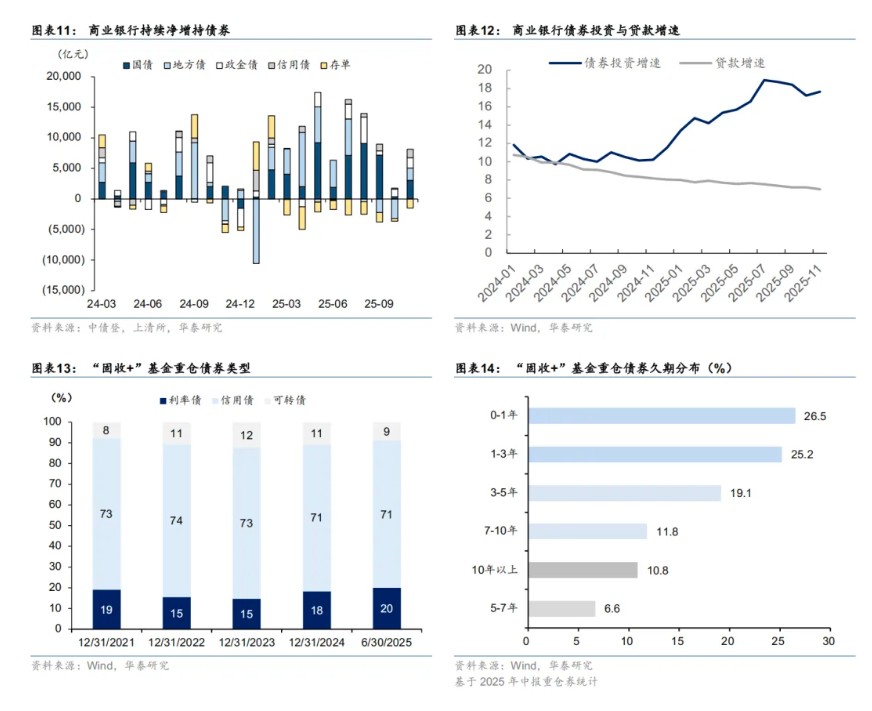
We previously discussed in "Observations on Institutional Behavior Under the Stock-Bond Teeter-Totter" (August 31) that logically, active balance sheet contraction leads to a reduction in banks' allocation to interest rate bonds + a decline in deposit interest rates + increased pressure for non-bank scale expansion or reallocation (as deposits mature) → more favorable for medium- and short-term credit bonds. If there is no balance sheet contraction → in the case of weak financing demand → limited supply + strong demand + inability to invest in stocks → the bond market will still face asset scarcity. From this year's bank bond investment and custody data, banks have continued to net increase their bond holdings rather than net selling, and the growth rate of bond investments has risen, corresponding to a continuous decline in the year-on-year growth rate of various bank loans. The main reason is that although banks are contracting their balance sheets, the weakening of credit demand on the asset side is faster and more evident, and banks still need to buy bonds to fill the asset side, so there is no need to sell bonds. However, during the "migration" of deposits, funds are flowing from banks to non-banks, with wealth management, "fixed income +", and dividend insurance expanding, which is certainly beneficial for medium- and short-term credit bonds.

Second, under the background of deposit "migration", there will be more disturbances in the funding environment, and the rates on certificates of deposit may first fluctuate and then decline. If high-interest deposits drive a large-scale migration of time deposits, banks, under pressure on the liability side, may also tend to passively increase interbank certificates of deposit and interbank deposits to fill funding gaps, causing short-term disturbances in the trends of certificates of deposit and funds. However, as time goes on, the expansion effect of non-bank scales may ultimately still benefit certificates of deposit.
Third, insurance, annuities, and others also face strong reallocation pressure from maturing deposits. In the past two years, non-standard and high-interest deposits allocated by insurance companies are still facing a large number of maturities, and the resulting asset gap still needs to be filled by bond assets, among which long-term interest rate bonds are a rigid demand, and credit bond allocations may increase slightly. In addition, on December 19, the Financial Regulatory Administration released the "Asset-Liability Management Measures for Insurance Companies (Draft for Comments)", which for the first time proposed quantitative regulatory indicators regarding duration and yield, requiring that the effective duration gap not exceed 5 years or be less than 5 years, especially for small and medium-sized life insurance companies that need to extend the duration of their assets. Similarly, annuities also face a large demand for reallocation of maturing high-interest deposits, and the allocation direction of these maturing funds remains primarily focused on local government bonds.

Fourth, the stock market overall benefits from the reallocation of deposit funds, with wealth management, "fixed income +", and dividend insurance likely being the main vehicles. Due to the significant decline in deposit interest rates, reallocation after deposit maturity is inevitable, and wealth management, "fixed income +", and dividend insurance are likely to be the main alternatives These products all have a certain "equity content," which helps to provide new funds for the stock market. Of course, these types of products have a low equity content and are more focused on absolute returns. When hybrid products expand, they buy both stocks and bonds, but when facing redemptions, they need to cut both stocks and bonds simultaneously, which can easily lead to both stocks and bonds rising and falling together.
Overall, the large-scale maturity of deposits next year will be more favorable for the stock market and short-duration credit bonds. The interest rates on certificates of deposit may first fluctuate and then decline, while banks' allocation of ultra-long-term bonds will face greater regulatory pressure. The relocation of deposits may also temporarily increase disturbances in the funding environment.
Risk Warning and Disclaimer
The market has risks, and investment requires caution. This article does not constitute personal investment advice and does not take into account the specific investment goals, financial situation, or needs of individual users. Users should consider whether any opinions, views, or conclusions in this article are suitable for their specific circumstances. Investing based on this is at one's own risk