


CEB Bank stated that it is "steadily planning" AIC, and has previously been continuously exploring "investment-loan linkage."

The fourth joint-stock bank AIC may already be on the way. On December 22, CEB Bank responded on the investor interaction platform, "Is it in line with the initiation of establishing a gold
The fourth joint-stock bank AIC may already be on the way.
On December 22, CEB Bank responded on the investor interaction platform to the inquiry about "whether it meets the conditions for initiating the establishment of a financial asset investment company (AIC)," clearly stating that it "will continue to strengthen communication with regulatory agencies and steadily plan related establishment work."
The bank stated that it will fully leverage its product innovation advantages and comprehensive service capabilities in the field of financial technology, continuously promote equity investment and credit for technology-based enterprises, and further enhance the quality and efficiency of services to the real economy.
In March 2025, regulators will further support national banks in establishing AICs and expand the pilot scope of equity investment from cities to the provinces where they are located, welcoming a dual expansion of establishment and business scope for AICs.
As of now, 8 bank-affiliated AICs have officially commenced operations.
The three leading joint-stock banks, China Merchants Bank, Industrial Bank, and CITIC Bank, have successively launched their AICs since November, with corresponding registered capital of 15 billion yuan, 10 billion yuan, and 10 billion yuan, respectively.
At the end of October, Postal Savings Bank also announced approval to establish an AIC, but it has not yet officially opened.
AIC May Expand Further
As a stepping stone for the banking industry to open up mixed operations, the current business scope of AIC is no longer limited to debt-to-equity swaps, but has also expanded to equity direct investment business, which is strictly restricted for commercial banks.
This grants banks holding licenses the convenience of equity investment through AIC, avoiding the cumbersome process of indirect investment through wealth management subsidiaries or circumventing overseas investments through licensed subsidiaries.
In comparison, the three joint-stock banks that have been approved to operate AICs each have their own strengths in equity investment.
China Merchants Bank's advantage lies in its rich experience and mature team.
Before establishing AIC, the bank had already engaged in indirect equity investment through the private equity asset management business of its Hong Kong subsidiary, China Merchants International.
In 2024, among the overseas private equity products of China Merchants International, four investment projects successfully went public and exited, and there were also four projects that successfully IPOed domestically. In the future, some employees of China Merchants Jin Investment may come from China Merchants International.
Industrial Bank's advantage lies in its rich project resource reserves.
The bank's technology enterprise loan volume ranks among the top in the industry, and it can achieve deep integration of production and finance through AIC.
On the day of its opening, Xinyin Investment signed strategic cooperation agreements with four investment institutions, including Fujian Jin Investment, and project cooperation agreements with 12 enterprises, with a total intended amount exceeding 10 billion yuan.
CITIC Bank's core competitiveness lies more in leveraging the group's synergy.
As a key part of CITIC Bank's comprehensive operations, Xinyin Jin Investment will rely on CITIC Group's full-license financial resources and integrate into the "CITIC Equity Investment Alliance" ecosystem to enhance the full-chain service capability of "raising, investing, managing, and exiting."
Xinfeng noted that CEB Bank also has practices in the field of equity investment, with its wealth management subsidiary and overseas subsidiaries involved in related businesses, especially achieving significant results in the "investment-loan linkage" collaborative model.
For example, CEB Wealth Management is at the forefront of the industry in exploring equity options.
In this type of business, the parent bank first provides loans to technology enterprises and obtains the option for equity investment at a specific future time through an agreement; "Debt + Options" not only meets the early financing needs of enterprises without excessively diluting equity but also provides wealth management funds with the opportunity to share in the growth dividends of high-growth companies.
In 2023, CEB Wealth Management registered the first batch of stock option projects at the Beijing Equity Exchange, becoming the first bank wealth management subsidiary to carry out stock option registration and custody at the Shanghai Stock Option Comprehensive Service Pilot Platform the following year.
The "Sunshine Zixin Enjoy" series of private placements, pioneered by it, embeds stock option projects, directing funds towards "specialized, refined, distinctive, and innovative" enterprises.
As of the end of November 2025, CEB Wealth Management has signed stock option cooperation agreements with over 280 sci-tech enterprises.
The Hong Kong subsidiary, CEB International, also has relevant practices.
In mid-2024, CEB International revealed that the company had participated as an equity investment institution in the first "Silver-Stock Investment Collaborative" stock option project within the system, engaging in equity financing for Jumping New Energy.
According to the announcement, Jumping New Energy has authorized CEB International to exercise stock options in one or more of the agreed methods, and has also authorized CEB International to transfer the stock options to subsidiaries of CEB Group or private equity investment funds managed by the aforementioned parties.
If the AIC license is implemented in the future, CEB Bank will also welcome greater space to "show its skills" in equity investment.
Empowering the Sci-Tech Ecosystem
In recent years, CEB Bank's development path has been challenging.
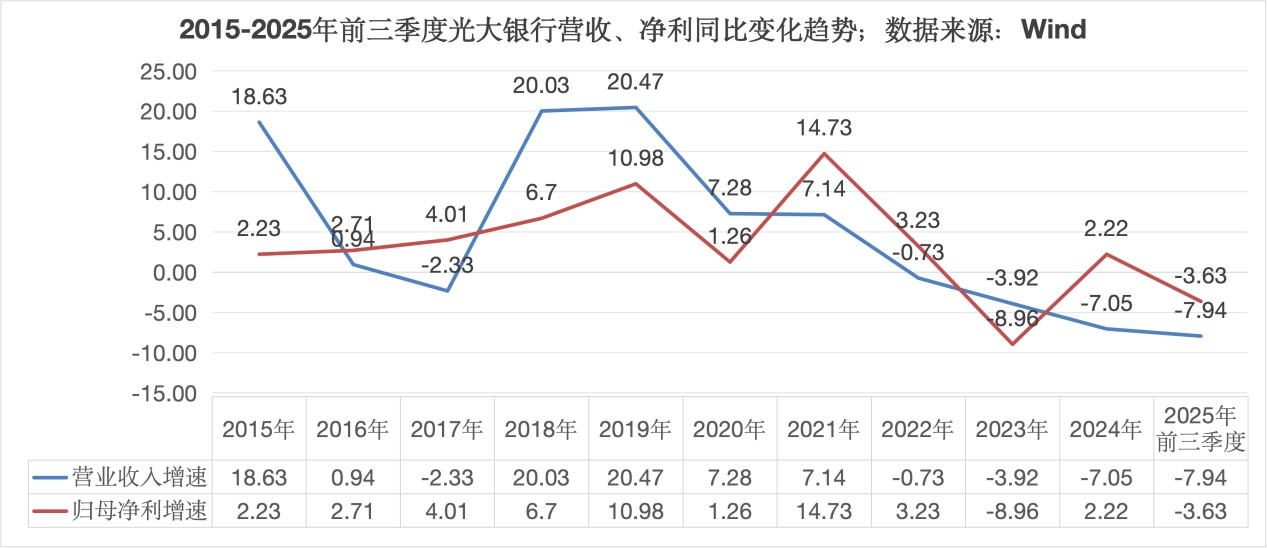
Since 2022, the bank's revenue has been on a long-term decline, and although profits have shown fluctuations, the rare growth has come from provisions being replenished.
Since 2020, the amount of provisions the bank has set aside has shown a decreasing trend, with an exception occurring only in 2023.
In the fourth quarter of that year, CEB Bank unusually increased its provision allocation, resulting in a year-on-year decline of 62.24% in net profit after hedging, dragging down the annual net profit by 8.96%.
At that time, Wang Zhiheng, who had just completed one year as president, stated, "The main factor for the decline in net profit in 2023 is the increase in credit impairment provisions, which affects short-term profitability but is a more fundamental guarantee for long-term profitability."
With Wang Zhiheng's subsequent transfer to Agricultural Bank, CEB Bank seems to have returned to the path of reducing provisions.
According to Xinfeng's calculations, after excluding the impact of provisions, the bank's profits have continued to decline over the past three years;
Frequent reductions in provision allocations have led to the bank's provision coverage ratio dropping to 168.92% by the end of the third quarter of 2025, which is 41.19 percentage points lower than the overall level of joint-stock banks, placing it at a relatively low level among listed companies (39/42).
 Throughout the continuous decline in profitability, CEB Bank has never given up on exploring transformation.
Since 2022, the bank has proposed the guiding role of three indicators: FPA (comprehensive financing scale for corporate clients), AUM (retail asset management scale), and GMV (interbank financial transaction volume), emphasizing the importance of focusing on the total amount of financing solutions provided to clients, the total management of clients' financial assets, and the total transaction volume in the interbank financial market; Replacing the balance sheet with the total volume of plans, management, and transactions reflects CEB Bank's focus on business ecology and its ambition to transition from a traditional commercial bank to a "first-class wealth management bank."
After 2024, the newly formed team of Wu Lijun and Hao Cheng proposed a transformation direction of "six brands" (science and technology innovation, wealth, transportation bank, gold market, investment banking, cloud payment) based on three major indicators, emphasizing technology business in ecological construction, placing the "Sunshine Science and Technology Innovation" brand at the forefront of the six brands.
Today, CEB Bank has established a service system covering the entire life cycle of technology enterprises, building a "1+16+100" three-level specialized structure, setting up financial centers for science and technology innovation in key branches, and providing specialized products.
In the first half of 2025, the loan balance for technology enterprises at the bank increased by nearly 10% compared to the beginning of the year, with the number of borrowers growing by 16.91%.
President Hao Cheng revealed that by the end of the first half of the year, the company's loan balance for the entire industrial chain of Chinese chips had exceeded 20 billion yuan.
In the absence of equity financing licenses, CEB Bank has explored various "investment-loan linkage" initiatives through its wealth management subsidiary and overseas subsidiaries' equity subscription businesses.
The most prominent advantage of the AIC license lies in filling the business gap in this industry, utilizing "debt + equity" to address the blank in credit solutions when facing science and technology and startup enterprises, and it may even drive subsequent businesses such as loans, settlements, and payroll distribution.
At the same time, facing the "Sunshine Wealth" among the six brands, AIC can also convert the growth dividends of science and technology enterprises into products, serving the equity assets of high-net-worth clients, or by making equity investments to engage with the management of quality enterprises, opening up increments for wealth management.
From this perspective, the layout for the AIC license will also become a key move in CEB Bank's overall strategy.
However, transitioning from traditional debt-to-equity business to pure equity investment, AIC institutions still need to confront high capital consumption, difficulties in exit after the slowdown of IPO rhythms, and shortcomings in professional capabilities under long-term debt-oriented thinking.
Currently, the management teams of China Merchants Jin Investment, Xingyin Investment, and Xinyin Jin Investment have been basically selected:
The chairman of China Merchants Jin Investment is Lei Caihua, the vice president of China Merchants Bank, and the president may be Zheng Xinying, the general manager of the investment banking department;
The chairman of Xingyin Investment is Chen Wei, the president of the Xiamen branch of Industrial Bank, and the president is Zheng Rongbin, the deputy general manager of the inclusive finance department;
The chairman of Xinyin Jin Investment is Jiang Dongming, the former president of the Guiyang branch of CITIC Bank, and the president is Wu Wei, the former vice president of the Shenzhen branch.
In the future, if CEB Bank's AIC is approved, who will "steer" the new institution is also worth paying attention to
