


POS machines are exploding! $20 billion, $5 billion, $1 billion, Jensen Huang is "buying up" everything with US dollars

NVIDIA further consolidates its dominance in the AI field through a series of large-scale acquisitions and investments in 2025. On December 24th, NVIDIA reached a $20 billion licensing agreement with Groq, acquiring its core team and technology. In addition, NVIDIA also committed to investing $100 billion in OpenAI and injecting $5 billion into Intel. These initiatives demonstrate NVIDIA's efforts to enhance its influence in the AI ecosystem through acquisitions and investments
NVIDIA, whose market value once approached $5 trillion, has been on a "buy, buy, buy" spree throughout the soon-to-end 2025, acquiring everything from Groq to OpenAI, from Nokia to Intel, from buying technology and companies to ultimately "buying" the entire track.
On December 24 local time, NVIDIA reached a $20 billion "licensing agreement" with Groq, bringing the core team and technology of the most threatening potential competitor, AI inference chip startup Groq, into its fold.
From committing to invest $100 billion in OpenAI to injecting $5 billion into former rival Intel, NVIDIA is transforming the cash flow brought by the AI wave into structural influence over the entire AI ecosystem with unprecedented intensity.
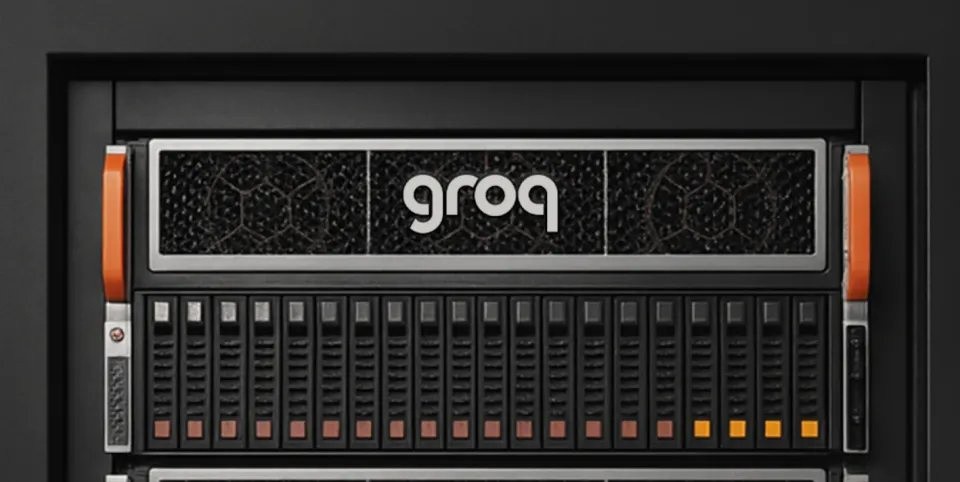
Internalizing Variables: $20 Billion "Incorporating" Groq
The deal between NVIDIA and Groq superficially appears to be a technology licensing arrangement worth approximately $20 billion, with Groq maintaining independent operations at the company level; however, at a substantive level, Groq's co-founders, CEO, and core technology executive team will be fully integrated into NVIDIA, and their key technological capabilities will also be incorporated into the NVIDIA system.
As described in the teasing remarks of netizens on social media, this is more like a "straightforward invitation" from NVIDIA: "You (referring to Groq) have great technology, $20 billion, bring your team and architecture over to work for NVIDIA."
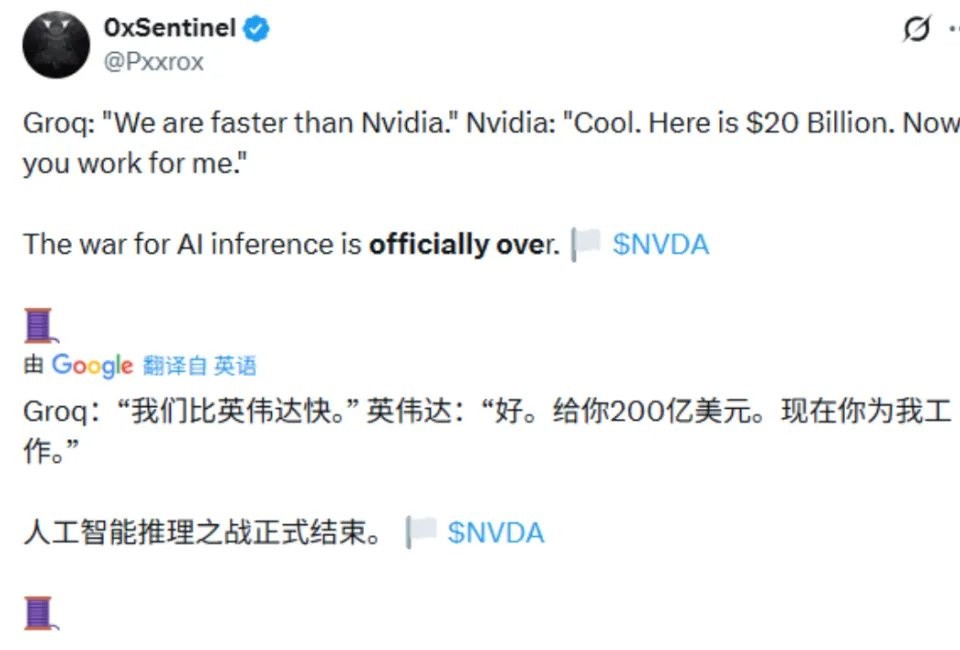
This is not an ordinary acquisition, but a precise strategic defense and capability enhancement.
Groq's trump card lies in its LPU (Language Processing Unit) architecture, which achieves extreme inference speed by storing model weights in SRAM instead of traditional HBM, sometimes even being 10 times faster than GPUs.
This directly threatens NVIDIA's "latency control advantage" in the AI inference market. Bestselling author and advertiser Mark Beckman analyzes that inference is the key to scaling development in the next decade.
Through this transaction, NVIDIA not only eliminates a challenger with a "real architectural alternative" but also transforms the opponent's disruptive innovation into fuel for its own acceleration.
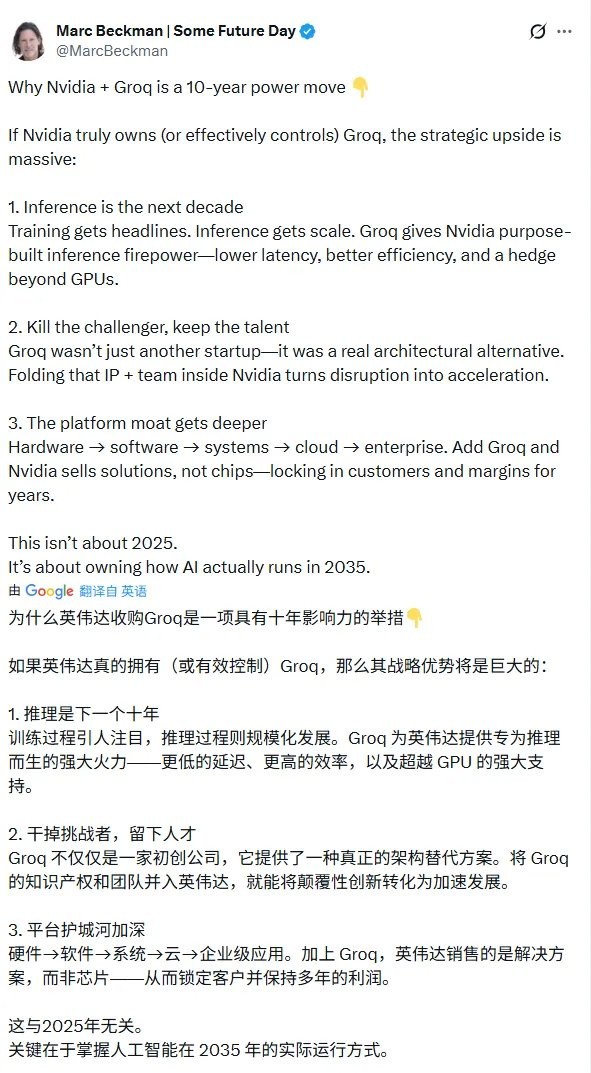 Image: Netizen comments, NVIDIA's acquisition of Groq technology will impact the landscape of the inference field for the next decade
So, where will the "hollowed out" Groq go? Transactions show that its cloud service business GroqCloud has been separated and remains independent.
Image: Netizen comments, NVIDIA's acquisition of Groq technology will impact the landscape of the inference field for the next decade
So, where will the "hollowed out" Groq go? Transactions show that its cloud service business GroqCloud has been separated and remains independent.
Netizens pessimistically predict that without the support of the core team and chip roadmap, GroqCloud is like a "lamb to be slaughtered," and may face the fate of being acquired at a low price or gradually marginalized.
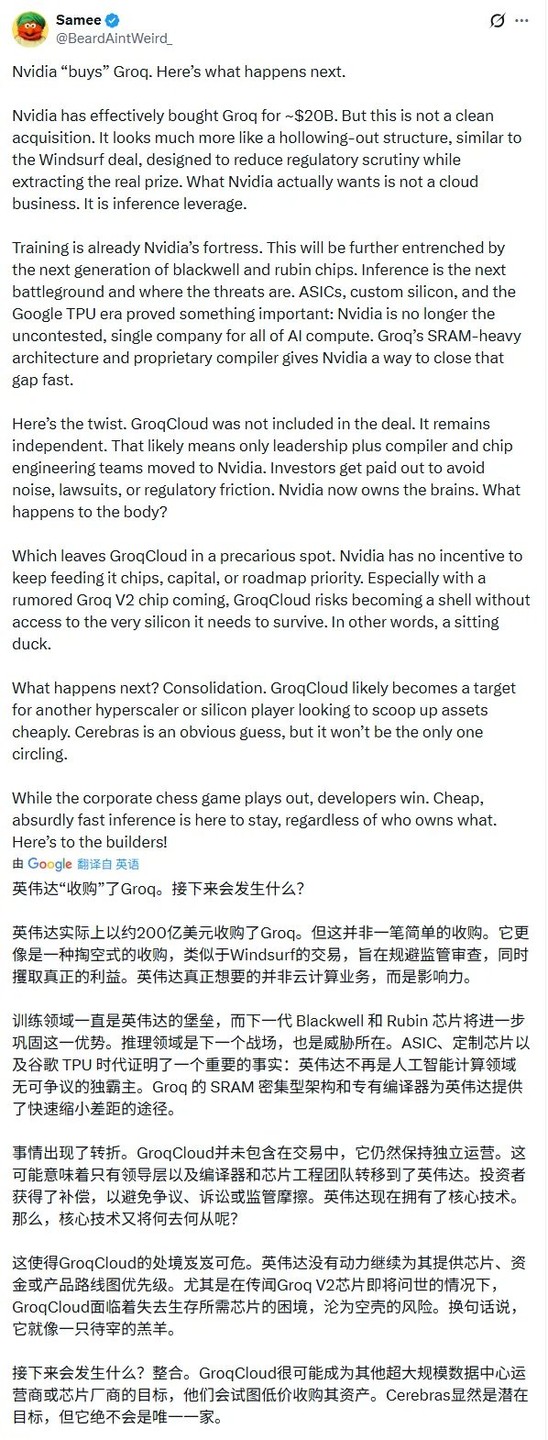 Image: Netizens predict that without the core team and technology, Groq will ultimately become a lamb to be slaughtered.
This "hollowing out acquisition" or "talent acquisition" model achieves the locking of key technologies and talents while avoiding strict antitrust scrutiny. As regulations tighten, this strategy will become a common tactic for tech giants to eliminate threats and consolidate their moats.
This licensing agreement is somewhat similar to the deals Meta made with data labeling startup Scale AI and Google with AI programming tool startup Windsurf. In these transactions, tech giants made substantial investments in smaller startups, obtained technology licenses, and hired their CEOs.
These cases point to a clear trend: when a capability proves to be irreplaceable, cooperation is no longer the end, and internalization becomes the final choice. Whether it is reasoning architecture or data and model alignment, the core variables determining the competitive landscape are shifting from an open ecosystem to internal capabilities that are controllable and can be accumulated over the long term.
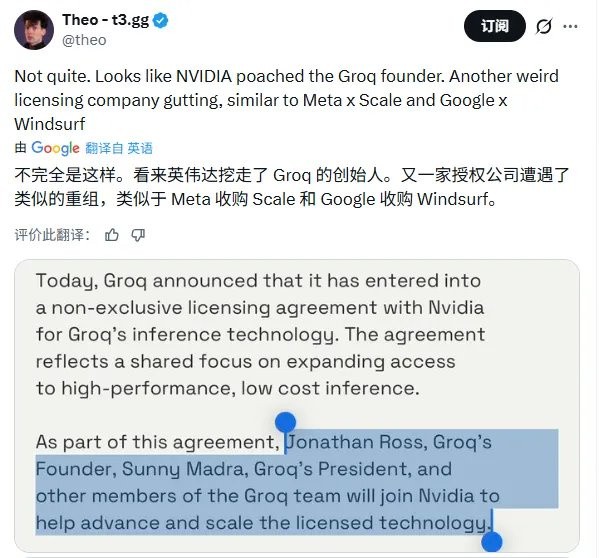 Image: The transaction method between NVIDIA and Groq is similar to Meta's acquisition of Scale AI and Google's recruitment of the core team from Windsurf.
Building Walls Upwards: From Synopsys to Intel, a Cash Fortress Built with Hundreds of Billions
Looking at a series of strategic moves in 2025, a clear logical mainline can be seen: NVIDIA is converting its excess capital into "flexible control" over every key node in the AI computing value chain.
To fundamentally accelerate the iteration of its chips, NVIDIA has penetrated upstream to the source of chip design, investing $2 billion in Synopsys, the leader in semiconductor design software.
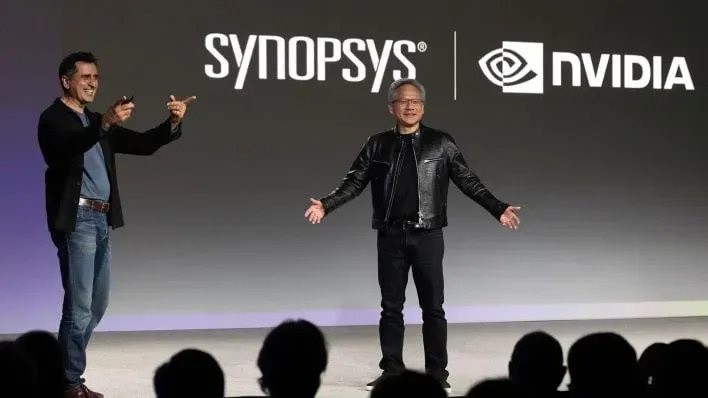 Image: NVIDIA CEO Jensen Huang with Synopsys CEO Sassine Ghazi.
This transaction is by no means a simple financial investment; its core is to directly embed NVIDIA's accelerated computing capabilities into the design tools of all future chips. This means that the design cycle of various chips, from smartphones to autonomous vehicles, will be shortened due to NVIDIA's technology, and NVIDIA will further embed its hardware standards into the research and development processes of the entire semiconductor industry.
At the same time, NVIDIA has demonstrated a more sophisticated art of "turning enemies into friends." It has extended a $5 billion olive branch to its traditional rival in the processor field, Intel. This investment brings not only financial returns but also a profound strategic reconciliation and technological alliance.
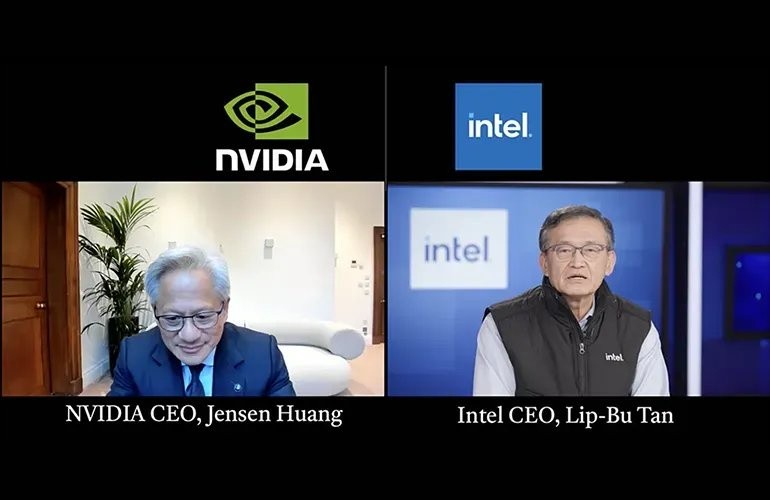 Image: NVIDIA CEO Jensen Huang with Intel CEO Pat Gelsinger
Intel will develop customized x86 CPUs for NVIDIA's data centers, which means that NVIDIA's core computing fortress will be partially built on Intel's foundation, while Intel will integrate NVIDIA's GPU cores into the chips of the next generation of personal computers, opening up a vast consumer market channel for NVIDIA.
NVIDIA's vision is not limited to data centers.
As the demand for low-latency, high-bandwidth networks surges due to AI, communication infrastructure has become a new battleground. To this end, NVIDIA has invested $1 billion in telecommunications equipment giant Nokia, jointly targeting AI-native 5G and future 6G networks.
At the top of the value chain, NVIDIA's binding with top AI model companies has reached an unprecedented depth.
NVIDIA's commitment to invest up to $10 billion in Anthropic is not a one-way capital output but is closely tied to the latter's future $30 billion procurement commitment for NVIDIA systems, forming a perfect "investment - procurement" capital closed loop. This model not only locks in the most certain large orders for the coming years but also fundamentally couples the research and development direction of top AI laboratories with NVIDIA's hardware evolution path.
Through these intricate investments, NVIDIA is proving that in an era of tightening regulations, capital can build its own empire more flexibly and sturdily than acquisition contracts.
These transactions resonate with each other, collectively pointing to one goal: to make NVIDIA's technology the ubiquitous underlying pulse driving everything from chip design, personal computers, communication networks to ultimate artificial intelligence.
Paving the Way Down: From OpenAI to Nuclear Fusion, NVIDIA's "AI Starlink"
NVIDIA's investment landscape is not a series of scattered financial bets but a highly systematic long-term layout. It resembles building a network covering the entire AI industry chain: from the model layer that determines intelligence limits, to the infrastructure that carries the flow of computing power, to the cutting-edge application scenarios, layer by layer, with only one goal—ensuring that any potential AI scenario that may erupt in the future cannot do without NVIDIA's hardware and software systems At the top of this network is the model layer that determines the boundaries of AI capabilities.
NVIDIA is betting almost limitless resources on "model creators." Whether it's providing OpenAI with capital and infrastructure support worth up to hundreds of billions of dollars or participating in the financing of top model companies like xAI and Mistral AI, the core objective is very clear: to deeply bind the most advanced large models to NVIDIA's hardware architecture during both the training and operational phases.
The model is just the "brain," but for the brain to function, it relies on a stable and sufficient supply of computing power.
Therefore, NVIDIA's capital has begun to flow massively into the computing power infrastructure layer. By increasing its stake in dedicated AI cloud service providers like CoreWeave, NVIDIA not only gains considerable equity returns but, more importantly, establishes a large-scale, highly efficient, and well-coordinated channel for deploying its most advanced chips.
In addition, NVIDIA has further invested in data center developers like Crusoe, indicating a direct involvement in the construction of "computing power factories," even providing a safety net for these capacities through long-term procurement agreements. This effectively creates a direct path from chip manufacturing and deployment to end users, significantly reducing the uncertainty of future computing power expansion.
The endpoint of this network points to the application scenarios where all AI capabilities truly land.
NVIDIA is directing funds into various seemingly disparate cutting-edge fields such as autonomous driving (Wayve), humanoid robots (Figure AI), life sciences (Lila Sciences), intelligent agents, and nuclear fusion (Commonwealth Fusion).
These investments are not a result of "cross-border impulse," but follow the same logic: wherever there is a heavy reliance on large-scale computing power and the potential to give birth to the next generation of platform-level products, NVIDIA will intervene early, embedding its hardware standards and CUDA software ecosystem.
This is also the goal that Jensen Huang repeatedly emphasizes—expanding the ecological boundaries of CUDA. Today's NVIDIA sells not just chips, but a complete system from underlying computing power, intermediate software, to upper-level application standards.
Behind the Bill: "Too Much Money" is Not a Worry, Investment is the Best Defense
Supporting all these grand strategies is NVIDIA's astonishing financial strength.
As of the end of October 2025, its cash and short-term investment reserves reached $60.6 billion, which is 4.5 times that of early 2023 ($13.3 billion). Analysts expect that its free cash flow will reach $96.85 billion in 2025 alone, totaling over $576 billion in the next three years.
In the face of the "trouble" of having "too much cash," NVIDIA has provided a clear answer: large-scale strategic investment is the best capital allocation. Although the company continues to conduct stock buybacks (spending $37 billion in the first three quarters of this year), Jensen Huang has clearly prioritized strategic investments. He believes that a strong balance sheet gives confidence to customers and suppliers, and that investing in the ecosystem is "very important work" that can directly drive additional consumption of AI and NVIDIA chips This massive cash is being transformed into insurmountable competitive barriers. It allows NVIDIA to lock in core customers (such as Anthropic) through "prepayments" or "investments for commitments," bind key partners (such as Intel), and preemptively "recruit" potential competitors (such as Groq).
This is far from a simple financial investment; it is a strategic action to build an "energy shield" for a technological empire using capital. In today's heated AI competition, NVIDIA's "cash troubles" are precisely its most powerful weapon.
Risk Warning and Disclaimer
The market has risks, and investment requires caution. This article does not constitute personal investment advice and does not take into account the specific investment goals, financial situation, or needs of individual users. Users should consider whether any opinions, views, or conclusions in this article align with their specific circumstances. Investment based on this is at one's own risk
