


日本 2 年期国债标售疲软,市场预计通胀或倒逼央行 “更猛烈加息”

Driven by persistently rising inflation expectations, the market anticipates that the Bank of Japan will be forced to adopt a more aggressive interest rate hike path. Demand for Japan's 2-year government bond auction was weak, with the bid-to-cover ratio falling to 3.26, causing yields for this maturity to rise to their highest level since 1996. Meanwhile, the 10-year breakeven inflation rate, a key indicator, has reached a new high since data began in 2004, further reinforcing investors' concerns that the central bank may fall behind the inflation curve
Due to rising inflation expectations and intensified pressure from the depreciation of the yen, the Bank of Japan is expected to be forced to raise interest rates more aggressively, leading to weak demand in the Japanese 2-year government bond auction held on December 25.
On December 25, according to Bloomberg, the key indicator measuring demand, the bid-to-cover ratio, was only 3.26, down from 3.53 in the last auction and below the 12-month average of 3.65. Following the announcement of the auction results, the yield on the 2-year government bond rose by 2.5 basis points to 1.125%, reaching a new high since 1996.
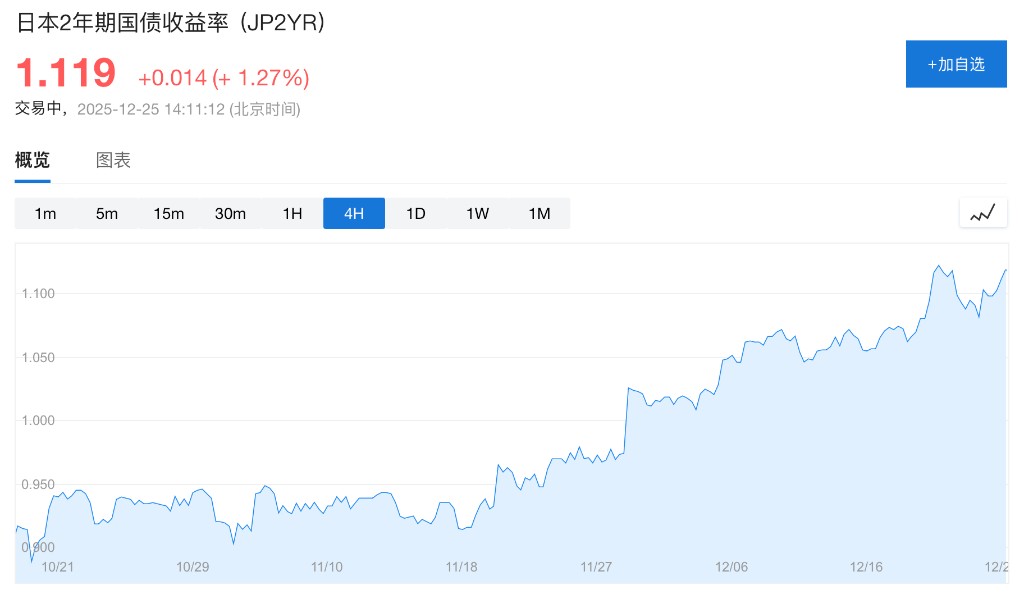
This auction took place less than a week after the Bank of Japan raised its policy interest rate to a 30-year high. The weak auction results further highlight market unease regarding the Bank of Japan's policy stance. The 10-year breakeven inflation rate has risen to its highest level since data began in 2004 this week, reinforcing widespread concerns that the central bank is lagging behind the inflation curve.
Rate Hike Expectations Push Up Short-Term Yields
The yield on the 2-year government bond is more sensitive to monetary policy expectations, with overnight index swaps indicating that the market sees a certain possibility of the central bank raising rates again before September next year.
Katsutoshi Inadome, a senior strategist at Sumitomo Mitsui Trust Asset Management, stated:
"The market remains concerned that the Bank of Japan is lagging behind developments. This is likely to prompt investors to avoid 2-year bonds, as these bonds are most susceptible to such risks."
Although the momentum of yen depreciation and rising yields has eased somewhat following verbal warnings from Japanese authorities regarding the exchange rate this week, the auction results are still viewed as a key indicator of market sentiment towards the central bank's policy stance. Previously, Finance Minister Shunichi Suzuki warned that Japan has the "discretion" to take bold actions against exchange rate fluctuations that do not align with fundamentals.
Bond Issuance Plans Increase Supply Concerns
Investors are also paying attention to the government's bond issuance plans related to the fiscal year 2026 budget, which is expected to be approved by the cabinet on Friday. According to Bloomberg, major Japanese dealers indicated this month that they hope to increase the issuance of 2-year, 5-year, and 10-year government bonds in the next fiscal year while calling for a reduction in the sale of ultra-long-term bonds.
According to Reuters, citing two unnamed government officials, Japan may reduce the new issuance of ultra-long-term government bonds in the next fiscal year to about 17 trillion yen (approximately $109 billion), the lowest level in 17 years.
Miki Den, a senior interest rate strategist at SMBC Nikko Securities, pointed out:
"Now is not a good time to buy. The issuance of 2-year bonds is likely to increase, so there is a high risk of realizing losses immediately after purchase."
Inflation Expectations Hit Record High
Market expectations for future price pressures continue to heat up, with the "10-year breakeven inflation rate," a key indicator, soaring to its highest level since data became available in 2004 this week. As a result, investors generally believe that the Bank of Japan may need to take more aggressive and larger interest rate hikes than previously anticipated in the future.
Bloomberg strategist Mark Cranfield stated that for the Bank of Japan, raising interest rates is a long and winding process. However, last week, the Bank of Japan Governor hinted that next year, when trying to convince politicians that another rate hike is reasonable, the central bank will have to start from scratch. For this reason, traders currently only expect a 25 basis point rate hike in September 2026
