DingTalk creates "Silicon-based Employees"

Wallstreetcn
2025.12.25 12:45
portai
I'm PortAI, I can summarize articles.

DingTalk has launched dedicated hardware Ding Talk Real and AI system Agent OS for enterprise organizations, aiming to connect the physical world directly through AI and create an operating system for the AI era, realizing the future of "silicon-based employees" working. CEO Chen Hang stated that all AI Agents on DingTalk will operate based on Agent OS in the future. DingTalk hopes to liberate productivity through a unified scheduling AI system and become the Android and iOS of the artificial intelligence era

Author | Chai Xuchen

Editor | Zhou Zhiyu

As the Doubao Assistant enters mobile phones, DingTalk, with its "D Plan," brings the future of AI working for humans into everyone's view.

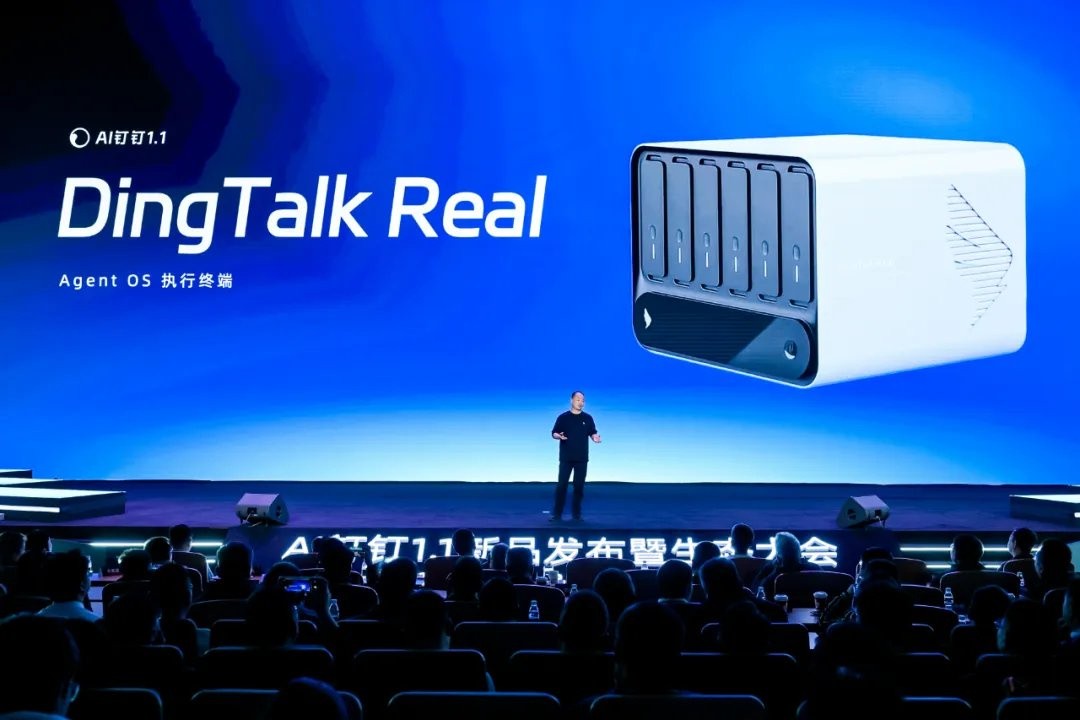
Recently, DingTalk launched its exclusive hardware for enterprise organizations, Ding Talk Real, along with an AI system called Agent OS. CEO Chen Hang stated, "In the future, all AI Agents on DingTalk will be built and run based on Agent OS, allowing AI to connect directly to the physical world."

DingTalk's ambition is significant; it hopes to bid farewell to the application architecture of the mobile internet era with its ecological partners by creating an operating system for the AI era, making "silicon-based employees" a reality.

At this year's OpenAI Developer Conference, Sam Altman predicted that the first truly meaningful Agents would enter enterprise systems, becoming a "new occupation" involved in production. Meanwhile, human responsibilities would be reduced to decision-making and instructions, with execution handed over to machines.

However, a mere chat box cannot support such ambition. To transform AI capabilities into productivity, a unified AI system is needed to coordinate fragmented models and platforms, truly liberating productivity.

As an important entry point for Alibaba's AI strategy in the B-end, DingTalk aims to unify AI capabilities at this critical moment, becoming the Android and iOS of the artificial intelligence era, allowing AI capabilities to truly achieve "monetization."

Igniting AI Productivity

2025 is expected to be a year of explosive AI application growth, and people are well aware that the wave of artificial intelligence has arrived, yet the landscape is chaotic.

On one hand, AI capabilities are unprecedentedly powerful, able to write reports, create videos, code programs, and make predictions, but the flourishing AI applications leave enterprises exhausted from running between various AI platforms. Moreover, AI tools are fragmented, with data not interoperable and intentions not aligned. Individual Agents can only operate on specific platforms.

This "island state" is quite similar to the early software incompatibility during the PC era.

The true intelligent productivity tool should allow users to say, "Help me prepare for next week's report to the boss," and AI would automatically retrieve project data, generate PPTs, book meeting rooms, and notify participants—without any manual effort from the user.

However, this requires a unified scheduling hub, not just more independent tools. Clearly, the AI era also needs an ecological platform that integrates Agents to collaborate in production.

As a key player in managing productivity in the B-end, DingTalk has taken the lead and fired this shot.

On December 23, DingTalk launched over twenty AI-native products at once, with the flagship being a new intelligent work infrastructure based on "Agent OS" as the core and "Ding Talk Real" as the terminal It allows large models, AI tools, and processes to run, schedule, and collaborate uniformly like apps within the Agent OS. It liberates people from a large number of repetitive process operations.

With the collaboration of Agent OS, DingTalk has successfully implemented multiple high-frequency, reusable enterprise-level Agent scenarios: covering core business segments such as AI travel, AI recruitment, and AI customer service. It can be said that DingTalk is no longer making small adjustments along the lines of office software but is beginning to build itself as a complete system designed for AI.

All these functions are aimed at serving real productivity needs.

Previously, Chen Hang found that the entire industry, including the DingTalk team at that time, still understood AI at the tool stage—using AI to write weekly reports, create PPTs, generate images and copy, but this barely touched the essence. He believes that the way of working in the AI era needs to change.

"In the past, humans were the executing thinking subjects, and AI was just an assistant; the essence of the new generation of DingTalk is to make AI the subject, possessing almost infinite memory and global computing capabilities, able to actively perceive, judge, plan, and execute, while humans step back to become decision-makers and commanders, making key judgments based on the results produced by AI," Chen Hang said.

It can be said that DingTalk aims to upgrade AI from "bulk capabilities" to "systemic productivity." If Windows allowed everyone to use computers, then Agent OS enables every enterprise to utilize systematic AI.

However, simply connecting Agents is not enough; AI also needs data accumulation, and hardware serves as the entry point for it to acquire data and connect with the real world.

Ding Talk Real subsequently emerged, which DingTalk describes as a key extension of Agent OS into the physical world, akin to the body of AI. "The mobile phones and computers we usually use are designed for people; today, we are creating Ding Talk Real as a device specifically for Agents," Chen Hang said.

In DingTalk's vision, it can allow DingTalk to continuously work for you on your computer, accessing all your data in the internal environment, solving problems and discovering opportunities for you 24/7. As long as enterprises deploy Ding Talk Real locally, employees can remotely call Agents using DingTalk regardless of their location.

DingTalk intends to build a new moat in the B-end market through this "soft and hard integration" strategy. Pure software SaaS services are easily replaceable, but once an enterprise deploys DingTalk Real, deeply binding business flows and physical devices with Agent OS, the migration costs will rise exponentially. This is a physical barrier more solid than "user habits."

Alibaba's B-to-B Blitz

At this moment, DingTalk officially bids farewell to the application form of the mobile internet. Chen Hang said, "Today we can announce that DingTalk has completely changed and transformed into an AI operating system." Many people will ask, why does DingTalk, a super app with 700 million users, take the huge risk of developing hardware and an operating system, undergoing such a thorough reconstruction? The answer is simple: because in the AI era, the old map cannot find the new continent. In the competition for entry points among major companies, DingTalk must defend Alibaba's position in the B-end market.

According to publicly available data, the scale of China's collaborative office market will exceed 30 billion yuan by 2025, with DingTalk, WeChat Work, and Feishu accounting for over 75% of the market share, with DingTalk in the lead at approximately 32.7%; WeChat Work follows with about 23.4%; and Feishu comes in third with around 18.9%.

It is evident that DingTalk's previous monopoly has been disrupted. Previously, even AI startups like MiniMax, Dark Side of the Moon, and Zhipu, which Alibaba had invested in, have shifted to Feishu. "Feishu's multi-dimensional spreadsheets are at least 12 months ahead of DingTalk," said Feishu CEO Xie Xin in an interview this July.

DingTalk has reached a critical point where it must break down to build up. Under the strategic groundwork of Alibaba's AI initiatives, things have taken a turn.

Over the past two years, Alibaba has consistently championed the slogan "Let AI penetrate into thousands of industries," aiming to have AI redo all business processes and redefine productivity, much like the arrival of the internet did years ago.

Alibaba CEO Eric Wu stated internally that the greatest value created by mobile internet is the redistribution of human attention economy, but there is a limit to this value; each person only has 24 hours a day. In the AI era, the biggest difference is the significant enhancement of human productivity.

With the wind of AI blowing in, there is a possibility of moving from Q&A to actual work. It can be imagined that DingTalk will have the opportunity to explore possibilities in an office scenario that encompasses 700 million people, becoming another ticket for Alibaba to enter the AI era. DingTalk, which reaches the capillaries of the real industry, will be able to find more growth and commercialization potential, becoming an omnipresent "screw" in every link of the market supply side.

Therefore, Chen Hang returned to DingTalk, choosing to reclaim lost ground in an almost "redo everything" manner.

However, this is not easy. In the C-end consumer market, AI can penetrate and spread through dialogue boxes, but the B-end market is relatively harsh; corporate organizations will not pay for "intelligence," they only pay for "certain results," and whether it can promote productivity is the top priority.

Thus, DingTalk's greatest value lies in aligning with the theme of the era, enhancing the productivity of users and enterprises using DingTalk, and enabling users to become super individuals. The new version of DingTalk uses AI to redistribute time and attention, allowing people to focus their energy on key decisions and high-value outputs, freeing up space for work rhythm.

"With stronger data and environment, AI will ultimately make software disappear; people only need to receive the best delivery results," Chen Hang asserted. "Whoever can help AI entities understand the industry and enterprises first will definitely stand out in the productivity revolution."

Under the new strategy, initial results are showing; by December, DingTalk's daily AI call volume has increased fivefold over the year; the total number of Agents created by enterprises and developers on the platform has tripled over the year "Eight months ago, only 10% of people believed in DingTalk's AI transformation, now 30% of people believe." Chen Hang described this as a snowball process: the first step is for those who choose to believe to start running, using DingTalk's new AI products and new methods to get started.

In this battle for AI, DingTalk cannot afford to lose. If successful, it will redefine the industry's delivery standards, turning DingTalk from an app into an indispensable "infrastructure" in corporate offices, thereby solidifying Alibaba's dominance in the B-end market.

Recreating Alibaba with AI serves as an anchor for reassessing the value of this giant ship, with DingTalk being a key link in commercialization and scenario-based applications. This elimination round has just begun, and DingTalk must accelerate its pace.

Risk Warning and Disclaimer

The market has risks, and investment requires caution. This article does not constitute personal investment advice and does not take into account the specific investment goals, financial situation, or needs of individual users. Users should consider whether any opinions, views, or conclusions in this article align with their specific circumstances. Investment based on this is at one's own risk