For 2026, these are the top 10 questions that Goldman Sachs' leading technology traders are most concerned about

Goldman Sachs trader Callahan pointed out that in 2026, the focus of technology stocks will shift from hardware hype to AI investment returns and market breadth. Although the contribution of the "Mag7" remains significant, the growth rate is slowing down and differentiation is intensifying. He listed ten key issues covering the sustainability of AI spending, software valuation repair, Apple's positioning, the LLM landscape, and cyclical turning points
After experiencing three consecutive years of strong returns in technology stocks, accompanied by significant volatility, Wall Street's focus is shifting from mere hardware speculation to a deep examination of the return on investment in artificial intelligence and the sustainability of market breadth as 2026 approaches.
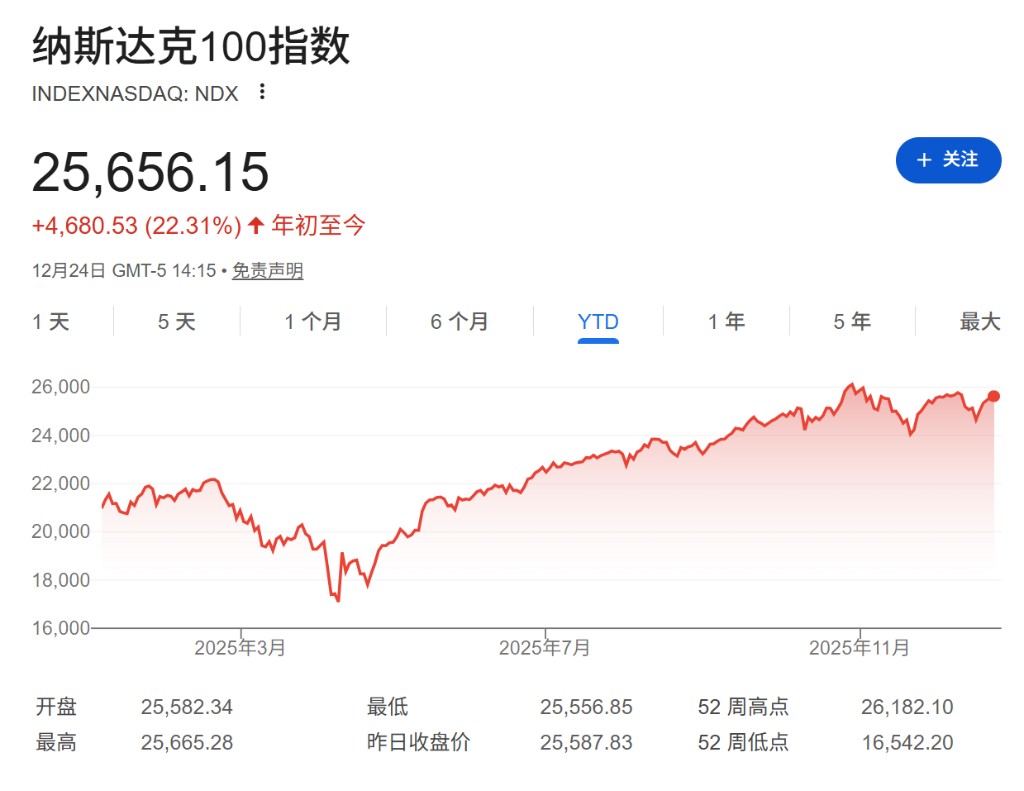
According to the latest outlook report released by Goldman Sachs' top technology trader Peter Callahan, although the Nasdaq 100 index is expected to rise over 20% in 2025, it will not be a year of "easy wins." Callahan pointed out that while the "Mag 7" collectively contributed about $3.5 trillion in market value growth in 2025, this growth rate shows signs of slowing compared to $5.4 trillion in 2024 and $4.8 trillion in 2023, with a high level of internal market divergence, as over 30% of the components in the Nasdaq 100 index ended the year in decline.

As investors increasingly focus on whether generative AI (GenAI) can deliver on its lofty capital expenditure promises in the next 12 months, market sentiment is undergoing a subtle shift. Callahan emphasized that the core of the current debate revolves around the sustainability of AI infrastructure spending—such as the data from NVIDIA suggesting it could reach $3 trillion to $4 trillion annually by 2030—and when this massive investment can translate into tangible productivity gains.
To clarify this complex market environment, Callahan outlined ten core questions that will determine the trajectory of technology stocks in 2026. These questions not only pertain to specific sector rotations but also touch on the fundamental logic of macroeconomics and technology cycles.
Ten Key Questions Determining the 2026 Trajectory
Callahan explicitly raised the following ten questions that will dominate market narratives in 2026:
- Where will the AI debate lead? Will the focus shift to "physical AI" (robots, autonomous vehicles, smart glasses)? Which companies will emerge as winners in productivity enhancement? How will regulation and return on invested capital (ROIC) evolve?
- How will software companies repair their valuations? What sword of Damocles will the software industry face in the next 12-24 months? Is it the end of seat pricing models, the rise of agents, usage issues, or the commoditization competition brought by large language models (LLM)?
- What is Apple's storyline? As we enter 2026, is Apple a defensive growth stock or part of the AI narrative? Can foldable smartphones become a catalyst? Why is the growth of the App Store slowing?
- What are the broad impacts of the commodity supercycle? Considering the price trends of storage products like DRAM, HDD, NAND, as well as gold, silver, and copper, in which areas is supply tight? Who can absorb price increases, and who cannot?
- What does the "efficiency" driven by GenAI mean? If this means layoffs, will the market view it as a positive for productivity improvement or a negative pressure on the economy and non-farm employment data?
- Which internet companies are the most worth buying in the debate over profit margins and competition? For example, investors are fiercely debating the prospects of companies like META.
- Is the turning point for cyclical industries approaching? Will 2026 witness a cyclical reversal in housing, commercial real estate (CRE), ISM data below 50 for three consecutive years, semiconductor chips, or the automotive industry?
- Can hardware and semiconductor AI stocks lead the market again? Or will debates about gross margins, spending visibility, or intensified competition suppress market sentiment?
- How will the market's view of large language models (LLM) evolve? Will it move towards "commoditization"? Is it a competitive market with multiple participants, or dominated by a few players? Is it artificial general intelligence (AGI) or artificial superintelligence (ASI)? What role will Chinese models play? Will they move towards productization, or remain in the competition of "primitive intelligence"?
- What are the current blind spots? What topics are currently unmentioned but will become consensus by 2026? Is it agentic commerce, the return of SaaS stocks, or specific use cases of AI productivity?
2026 Outlook: Seeking Second Derivatives and Mean Reversion
Looking back at 2025, the most notable feature of the market was "divergence." Callahan pointed out that although volatility at the index level was low, individual stock volatility was extremely high. While technology stocks performed well overall, the semiconductor and network infrastructure sectors led with absolute advantage, seen as the most crowded track for investors; in contrast, the telecommunications, payment, and application software sectors lagged behind.
Looking ahead to 2026, Callahan believes the return outlook for the Nasdaq 100 index remains robust, but earnings may be more skewed towards the first half of the year. This is because the index has recently undergone a period of consolidation and faces "walls of worry" such as the sustainability of AI spending, and such low expectations often favor stock market rises.
In terms of investment themes, Callahan suggests focusing on the market's "expansion" trades, where funds flow from crowded AI infrastructure stocks to other areas. He believes investors will seek AI's "second derivatives" in 2026—those undervalued stocks that leverage AI to reduce costs, improve product discovery, or drive new revenue streams, rather than just "selling shovels" hardware suppliers