


Global stock markets are closed with light trading, while metals soar again, with gold, silver, and copper reaching new highs

恐慌指數 VIX 跌至 14 下方。特斯拉跌 2.1%、領跌科技七巨頭。美債收益率本週基本收平。加密貨幣衝高轉跌。比特幣連續第四周下跌。黃金現貨大漲逾 1%,盤中刷新歷史高點至 4550 美元上方,白銀飆升 10%,站上 79 美元。現貨鉑金上漲 8% 至每盎司 2,413.62 美元,創新高。COMEX 銅期貨漲 5.01%。
聖誕節後首日,美股大盤在歷史高位附近縮量橫盤,貴金屬表現 “瘋狂”。白銀單日飆升 10%,與黃金聯手刷新歷史紀錄。而俄烏衝突迎來和平的曙光,則讓原油多頭遭遇了 “黑色星期五”。
貴金屬節後再次全面爆發。除了美聯儲降息和央行購金這些老生常談的利好外,市場正在定價一種新的敍事 “商品控制權”。在高盛看來,金屬不僅是週期性資產,更是戰略資產。
此外,由於金銀今年的回報率實際上跑贏了標普 500,部分擔心 “AI 泡沫” 的資金正在將貴金屬作為終極對沖工具。
週五黃金現貨大漲逾 1%,盤中刷新歷史高點至 4550 美元上方,現貨白銀站上 79 美元關口,COMEX 銅期貨漲 5.01%。夜盤期貨同樣強勢,滬銀夜盤漲超 6%,首次收於 19000 元關口上方,滬銅漲超 3%。
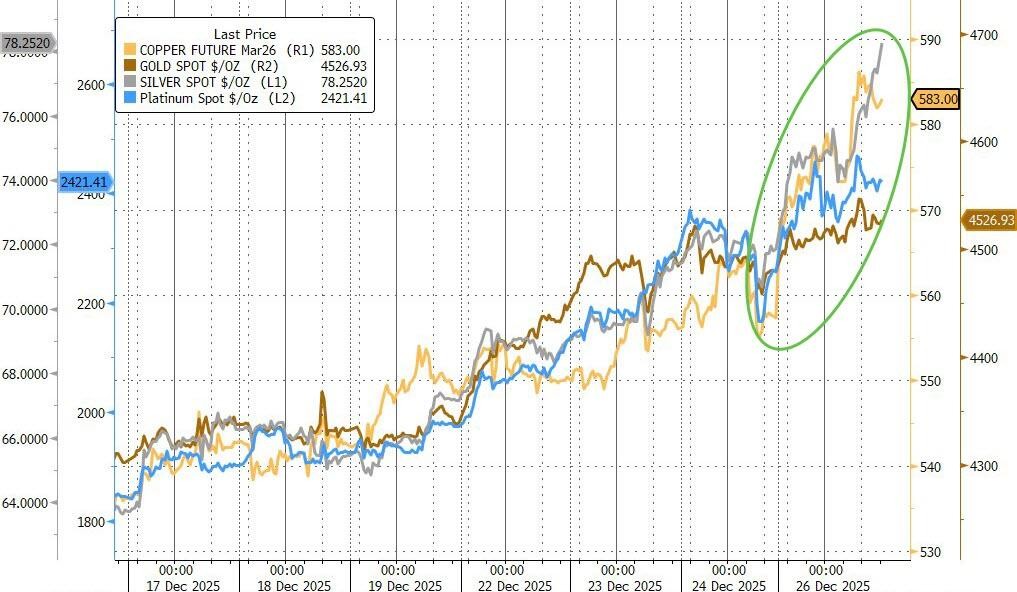 (金銀銅鉑金飆升)
鉑族金屬同樣表現驚人。現貨鉑金大漲 10% 至每盎司 2459.5 美元,創歷史新高,全年漲幅超 170%,是自 1990 年有倫敦基準價以來最大年度漲幅;鈀金也漲逾 11% 至每盎司 1925 美元,全年漲幅已超 111%。
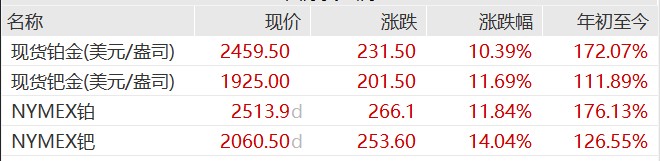
華爾街見聞提及,在鉑金的驚人漲勢背後,來自中國的交易活動起到了助推作用。摩根大通在上週報告中指出,自 11 月 27 日廣州期貨交易所推出鉑金和鈀金期貨以來,其鉑金合約的日均總成交量已增至近 500 萬盎司,近期甚至超過了紐約商品交易所(NYMEX)的成交量。
儘管廣州期貨交易所已於 12 月 18 日宣佈,將非期貨公司會員或客户的鉑金和鈀金合約持倉限額設定為 500 手,但隨後鉑鈀不改強勢,跟隨金屬板塊一同上漲。
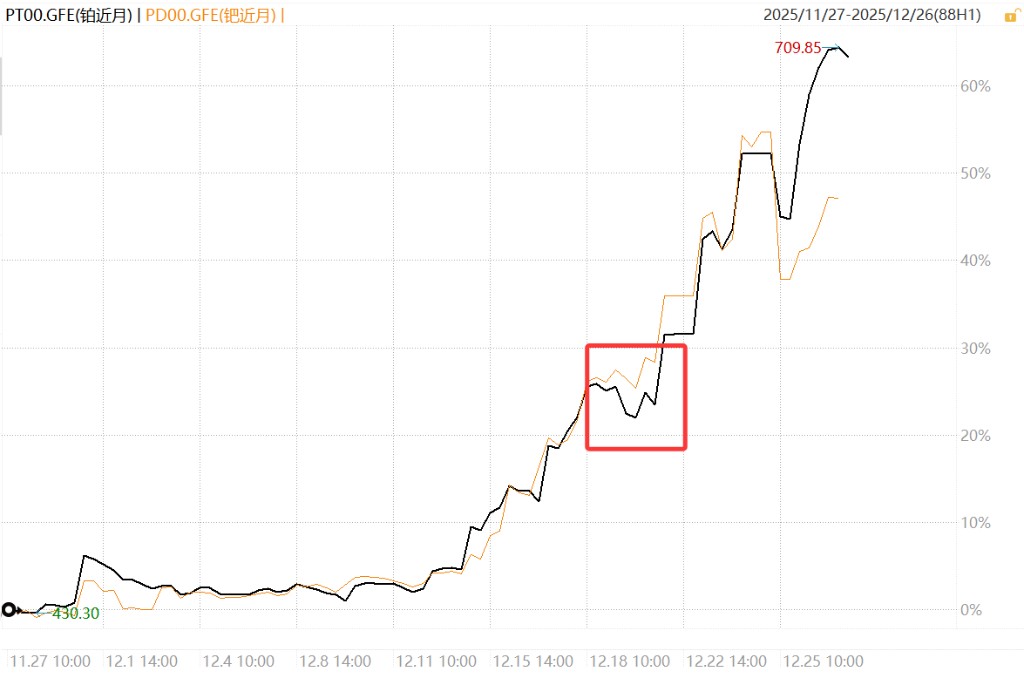 (廣州期貨交易所宣佈持倉限額後,鉑鈀期貨價格短線下挫)
相比於貴金屬的大幅上漲,標普 500 指數全天震盪、收盤微跌,但創下一個月來的最佳單週表現。羅素小盤股指下跌 0.5%,分析認為本週初的軋空動能已經耗盡。防禦性板塊重新受到青睞,而週期性板塊表現落後。
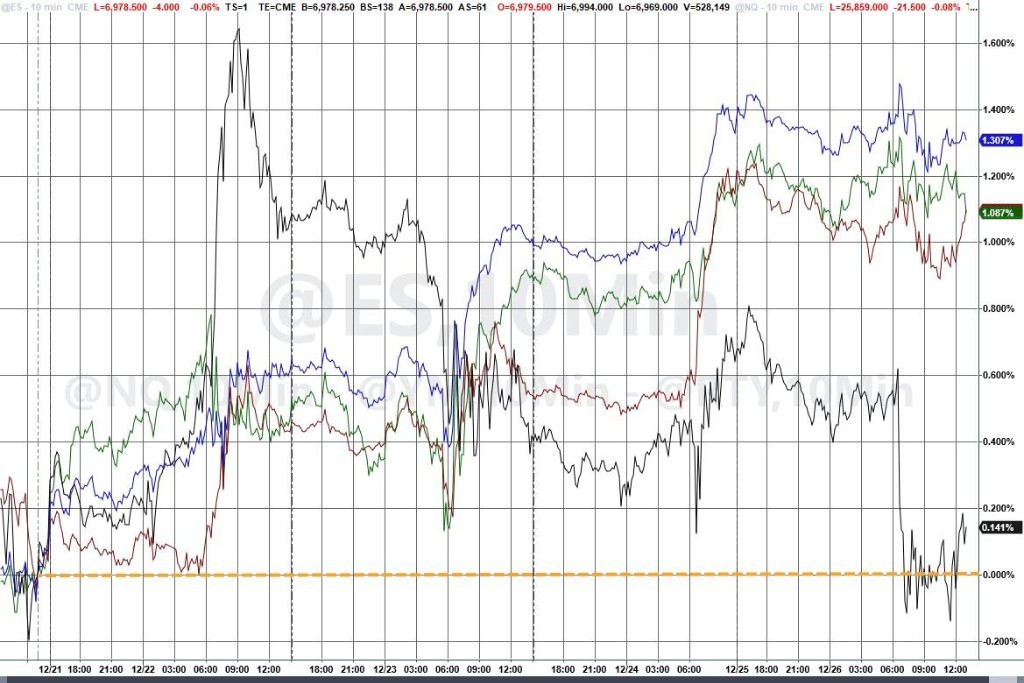 (美股基準股指日內走勢)
債市方面,當日美債整體表現温和。10 年期美債收益率基本持平於 4.13% 附近,2 年期收益率小幅下行。整體來看,債券市場更多是 “被動穩定”,並未對貴金屬的劇烈波動作出明顯對沖反應。
儘管美元指數週五小幅反彈,但從周度角度看,美元收於 10 月初以來的最低點,本週錄得自 6 月以來最差單週表現,這也成為支撐貴金屬行情的重要背景之一。
華爾街見聞提及,澤連斯基稱將於週日與特朗普會面,和平框架協議 “幾乎準備就緒”。投資者迅速開始定價 “和平協議” 可能帶來的後果——如果制裁解除,大量俄羅斯石油可能重返本已供應過剩的全球市場。
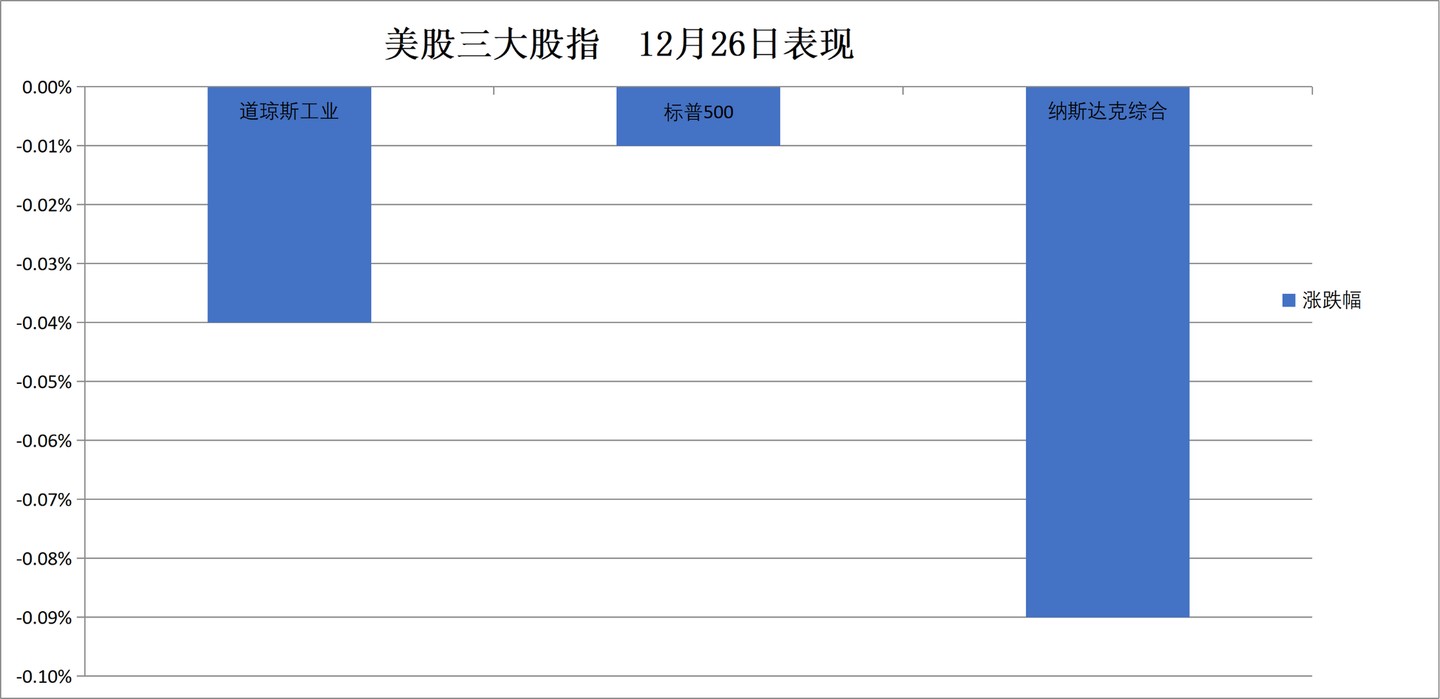
週五美股三大指數微跌,羅素小盤股指跌幅靠前。恐慌指數 VIX 進一步收斂,報 13.47。特斯拉收跌 2.10%,Meta、谷歌 A、蘋果、微軟至多跌 0.64%,亞馬遜則收漲 0.06%,英偉達漲 1.02%。
美股基準股指:
標普 500 指數收跌 0.03%,報 6929.94 點。本週累漲約 1.4%。
道瓊斯工業平均指數收跌 20.19 點,跌幅 0.04%,報 48710.97 點。本週累漲 1.1%。
納指收跌 20.21 點,跌幅 0.09%,報 23593.10 點。本週累漲 1.2%。
羅素 2000 指數收跌 0.54%,報 2534.35 點。本週累漲 1.06%。
恐慌指數 VIX 收跌 3.79%,報 13.47。
美股行業 ETF:
油氣跌 0.75%,可選消費、能源、金融、電信等板塊至多跌 0.4%。
(12 月 26 日 美股各行業板塊 ETF)
科技七巨頭:
美國科技股七巨頭(Magnificent 7)指數跌 0.02%,報 210.09 點,本週累計上漲 1.73%,整體持續走高。
特斯拉收跌 2.10%,Meta、谷歌 A、蘋果、微軟至多跌 0.64%,亞馬遜則收漲 0.06%,英偉達漲 1.02%。
芯片股:
費城半導體指數收跌 0.39%,報 5696.21 點。
AMD 跌 0.02%,台積電漲 1.35%。
中概股:
納斯達克金龍中國指數收漲 0.72%,報 7688.52 點。
- 熱門中概股裏,小鵬收漲 6.2%,蔚來漲 4.1%,理想漲 3.9%,小米漲 2.1%,阿里巴巴漲 1.4%。
其他個股:
伯克希爾哈撒韋 B 類股收跌 0.61%,禮來則收漲 0.07%。
高通收漲 0.02%,Adobe 漲 0.23%,甲骨文漲 0.25%,Salesforce 漲 0.31%,博通漲 0.55%,奈飛漲 0.89%。
美債:
紐約尾盤,美國 10 年期國債收益率跌 0.38 個基點,報 4.1297%,本週累計下跌 1.74 個基點。
兩年期美債收益率跌 2.04 個基點,報 3.4810%,本週累跌 0.24 個基點。
(美國主要期限國債收益率)
俄烏衝突迎來和平曙光,WTI 原油較日高下挫 3.7%。
原油:
WTI 2 月原油期貨收跌 1.61 美元,跌幅 2.76%,報 56.74 美元/桶。
(WTI 原油期貨大跌)
布倫特 2 月原油期貨收跌 2.57%,報 60.64 美元/桶。
天然氣:
NYMEX 1 月天然氣期貨收報 4.3660 美元/百萬英熱單位。
美元輕微反彈 0.08%,本週跌約 0.7%。離岸人民幣盤整於 7.0 整數關口附近。比特幣期貨本週跌超 1.4%,以太坊期貨跌約 2.2%。
美元:
紐約尾盤,ICE 美元指數漲 0.05%,報 98.024 點,本週(四個交易日)累計下跌 0.68%。
彭博美元指數大致持平,報 1200.61 點,本週累跌 0.79%,交投區間為 1210.13-1199.07 點。
(彭博美元指數延續近期上漲趨勢)
非美貨幣:
紐約尾盤,歐元兑美元微跌 0.06%,英鎊兑美元走平。澳元兑美元微漲 0.11%。
美元兑日元漲 0.43%,報 156.51 日元,本週累計下跌 0.78%,日內交投區間為 157.75-155.56 日元。
歐元兑日元漲 0.32%,報 184.35 日元,本週累跌 0.21%;英鎊兑日元漲 0.23%,報 211.322 日元,本週累漲 0.11%。
離岸人民幣:
紐約尾盤,美元兑離岸人民幣報 7.0045 元,較週四紐約尾盤漲 28 點,日內整體交投於 6.9997-7.0085 元區間。
- 本週,離岸人民幣累計上漲 297 點,漲幅 0.42%,週一至週四持續上漲,週五高位震盪。
加密貨幣:
紐約尾盤,CME 比特幣期貨 BTC 主力合約較週四紐約尾盤漲 0.09%,報 87825 美元,本週累計下跌 1.43%。
(比特幣衝高轉跌)
CME 以太幣期貨 DCR 主力合約跌 0.54%,報 2937 美元,本週累跌 2.17%。
紐約期金漲超 1.3%,一度逼近 4600 美元,本週漲 4%。白銀期貨漲超 10,創歷史新高逼近 80 美元關口,紐約銅漲 5% 追隨滬銅創歷史新高的表現。
黃金:
紐約尾盤,現貨黃金漲 1.20%,報 4532.96 美元/盎司,繼續創歷史新高,本週累計上漲 4.50%,週一漲勢顯著,後續持續震盪上行。
COMEX 黃金期貨漲 1.33%,報 4563.00 美元/盎司,00:05 漲至 4584 美元,也創盤中歷史新高,本週累計上漲 4.06%。
白銀:
紐約尾盤,現貨白銀漲 10.07%,報 79.1075 美元/盎司,繼續創歷史新高,本週累漲 17.92%。
COMEX 白銀期貨漲 10.84%,報 79.455 美元/盎司,本週累漲 17.72%。
其他金屬:
紐約尾盤,COMEX 銅期貨漲 5.01%,報 5.8545 美元/磅,00:08 刷新盤中歷史高位至 5.8880 美元——追隨上期所銅價創歷史新高的表現,本週累漲 6.63%。
現貨鉑金漲 8.84%,報 2456.37 美元/盎司,本週累漲 24.61%。
現貨鈀金漲 12.38%,報 1940.52 美元/盎司,繼續逼近 2022 年 11 月 17 日頂部 2083.06 美元和當年頂部 3442.47 美元,本週累漲 13.23%。
