A $12 billion merger turnaround, is ServiceNow retracing SAP's old path?

After years of avoiding large mergers and acquisitions, ServiceNow suddenly launched a buying spree this year, spending at least $12 billion on mergers or strategic investments. This series of actions has raised concerns among investors that the company may begin to rely on deals to stimulate growth, especially considering that CEO Bill McDermott led a series of controversial mergers during his tenure at SAP SE
After years of avoiding large mergers and acquisitions, ServiceNow has suddenly launched a buying spree this year, spending at least $12 billion on acquisitions or strategic investments.
On Tuesday, ServiceNow announced its largest acquisition ever, agreeing to acquire cybersecurity startup Armis for $7.75 billion.
This deal comes just a week after the company completed its $2.8 billion acquisition of Moveworks and a few months after investing $750 million in contact center software provider Genesys.
This series of moves has raised concerns among investors that the company may begin to rely on deals to stimulate growth, especially considering that CEO Bill McDermott previously led a series of controversial acquisitions during his tenure at SAP SE.
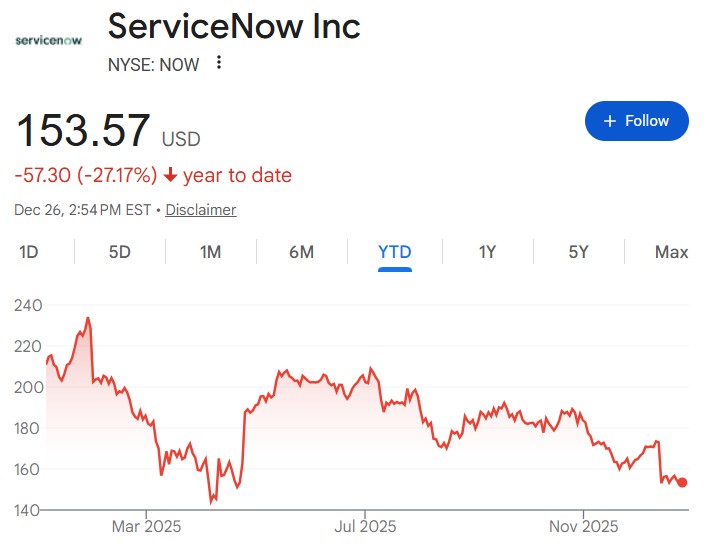
Before news of the Armis deal first broke on December 13, ServiceNow's stock had already fallen 18% this year, and it dropped another 12% afterward. RBC Capital Markets analyst Matthew Hedberg noted that Wall Street is dissatisfied with the company's potential use of acquisitions to boost slowing revenue growth.
(Down over 27% this year)
Record High Transaction Scale
Armis specializes in identifying and tracking security threats to enterprise devices, which strategically aligns with the enterprise IT operations management software sold by ServiceNow. This $7.75 billion deal is ServiceNow's largest to date.
In addition to the three large transactions with disclosed prices, ServiceNow has also completed six other acquisitions this year with undisclosed prices. According to media reports, the company's total spending on acquisitions and investments for the year has exceeded $12 billion.
These transactions evoke memories of McDermott's acquisition strategy during his time at SAP. In 2018, he told CNBC that SAP would not pursue large acquisitions, but a few months later announced the $8 billion acquisition of Qualtrics.
Now, with a similar script playing out at ServiceNow, investors are questioning the sustainability of its growth.
Guggenheim analyst John DiFucci wrote that as McDermott embarks on large-scale transactions again, it feels a bit "familiar." He stated:
This acquisition frenzy seems more like management's attempt to fix the issue of slowing revenue growth through mergers and acquisitions rather than a product enhancement strategy.
Company Growth Under Pressure
ServiceNow has successfully maintained rapid revenue expansion in recent years while many competitors have experienced slowdowns.
The company expects to generate over $13 billion in sales this year, a 21% increase from last year, roughly in line with the revenue growth rate for 2024. However, Wall Street analysts expect that, excluding acquisitions, sales growth in 2026 will be below 20%. **
When McDermott took over ServiceNow in 2019, many expected him to make a big splash in mergers and acquisitions. However, he has tried to indicate that those days are over. McDermott stated in early 2023:
Organic growth is delightful, and we will stick to this path.
Just this month, company executives also indicated that they would focus on "bolt-on" acquisitions, which are small deals that do not require extensive integration work.
In response to investor concerns, a ServiceNow spokesperson stated that comparing McDermott's M&A record at SAP is "completely irrelevant." The spokesperson pointed out:
In the 2010s, the industry was racing to build scaled software-as-a-service businesses in the cloud. Especially for large, established companies, M&A was a necessary tool in that environment, which is why many companies actively pursued acquisitions.
The spokesperson added:
Compared to SAP in the 2010s, ServiceNow is in a fundamentally different and better strategic position. ServiceNow does not need to acquire market appeal or growth through M&A. The company's strategy remains fundamentally unchanged