The fifth set of standards for the Sci-Tech Innovation Board has been further refined, with the first stock in commercial aerospace "Seven Sons Competing for the Throne."

The listing standards for commercial rockets are becoming clearer. On December 26, the Shanghai Stock Exchange released the "Guidelines for the Application of Issuance and Listing Review Rules No. 9..."
The listing standards for commercial rockets are becoming clearer.
On December 26, the Shanghai Stock Exchange released the "Guidelines for the Application of Issuance and Listing Review Rules No. 9 - Commercial Rocket Enterprises Applicable to the Fifth Set of Listing Standards of the Sci-Tech Innovation Board" (hereinafter referred to as the "Guidelines"), which detail the applicable fifth set of listing standards for commercial rocket enterprises.
The fifth set of listing standards mainly requires "market value + phased achievements" and does not set performance thresholds for enterprises, so how to determine phased achievements is key.
The Guidelines clearly state that the phased achievements applicable to the fifth set of listing standards of the Sci-Tech Innovation Board are defined as: "At the time of application, at least achieving the successful launch of a medium to large-sized launch vehicle using reusable technology into orbit for the first time."
This means that thereafter, as long as commercial aerospace companies' reusable rockets reach orbit, they are expected to embark on the path of IPO application on the Sci-Tech Innovation Board. Currently, the fastest IPO process is that of LandSpace Technology Corporation (hereinafter referred to as "LandSpace").
On December 23, China International Capital Corporation submitted the completion report of the IPO counseling work for LandSpace to the Beijing Securities Regulatory Bureau.
Prior to this, LandSpace had just completed the launch of its reusable rocket.
On December 3, LandSpace's Zhuque-3 reusable launch vehicle successfully entered orbit, marking the first attempt in the country for a first-stage recovery launch vehicle.
However, the Zhuque-3 failed to achieve recovery due to an abnormal final ignition of the engine.
"From 40 kilometers above the ground to the last 3 kilometers, the performance was very perfect. At 3 kilometers, we needed to perform a landing ignition, similar to an emergency brake, to reduce the speed to zero when the altitude is zero. But the last brake was not executed well, and the rocket fell, just 40 meters away from 'perfection,'" pointed out Dai Zheng, the chief commander of LandSpace.
Even so, the Zhuque-3 still provided valuable experience for the industry.
With the further clarification of the listing standards for commercial aerospace, LandSpace is expected to become the first commercial aerospace company to strive for the fifth set of listing standards on the Sci-Tech Innovation Board.
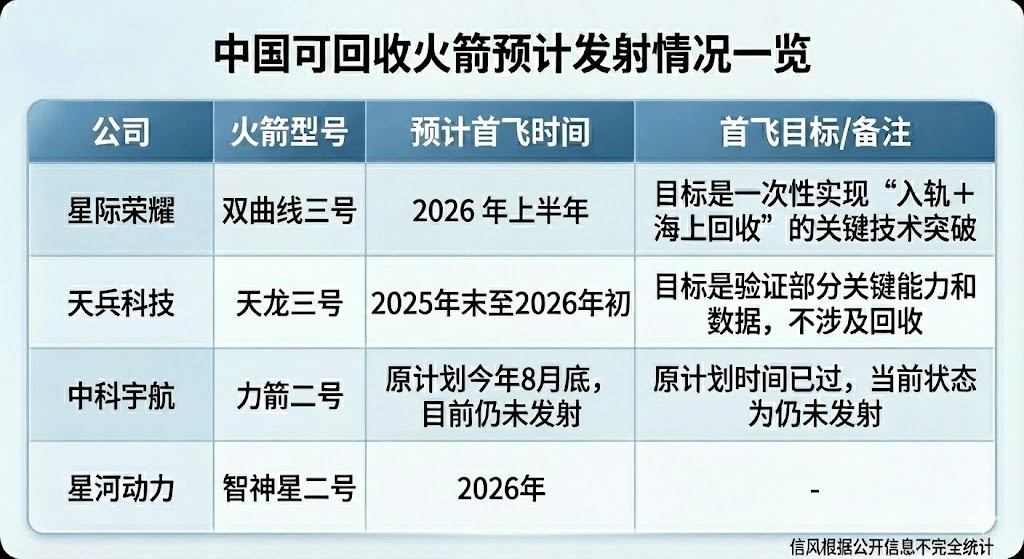
According to incomplete statistics from Xinfeng, in addition to LandSpace, at least six other commercial aerospace companies, including Galaxy Power, Interstellar Glory, Tianbing Technology, Yixin Aerospace, China Academy of Space Technology, and Aisida Aerospace, have entered the IPO counseling period.
If these companies want to apply for the Sci-Tech Innovation Board under the fifth set of listing standards, they still need to achieve the launch of their reusable rockets.
Xinfeng, combined with publicly available information, estimates that the first flight of these companies' reusable rockets is expected to be around 2026. For example, Galaxy Power's Zhishenxing-2 is planned to complete its first flight in 2026, and Interstellar Glory's Hyperbola-3 is expected to execute its first flight mission in the first half of 2026.
As the number of launches increases, China's reusable rockets will get closer to the goal of recovery.