


The national automotive team returns to the center of the table
After reaching one million new energy vehicles, we will start again
Author | Zhou Zhiyu
Editor | Zhang Xiaoling
For a long time, the public discourse in China's automotive industry has been dominated by a specific narrative: private enterprises are the disruptors, the new car-making forces are the challengers, while the large state-owned enterprises have been labeled as "the elephant that is hard to turn around."
In that era of "only speed matters," the outside world was accustomed to scrutinizing automotive state-owned enterprises with a critical eye, believing they were lagging behind in the wave of new energy.
However, this stereotype was shattered at the end of 2025.
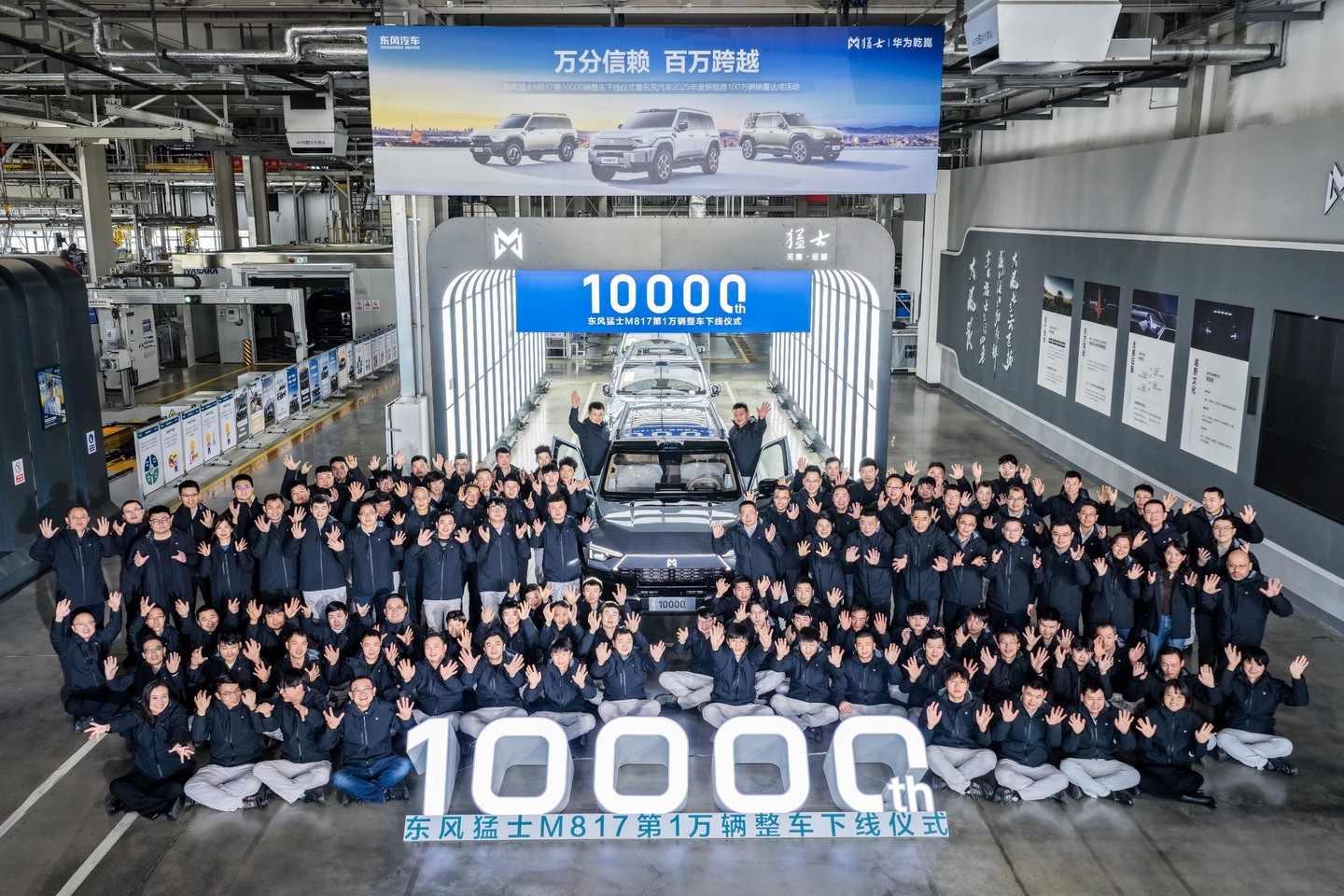
On December 26, when a Dongfeng Warrior M817 slowly rolled off the production line, this moment marked Dongfeng Motor's annual new energy sales reaching 1 million units. In the words of Dongfeng Motor's General Manager and Deputy Party Secretary Feng Changjun, today is a "double happiness." Dongfeng Motor achieved its annual new energy sales target of 1 million units, and the Dongfeng Warrior M817 also celebrated the production of its 10,000th vehicle. This represents the strongest "return to the team" signal released to the market by a long-underestimated "national team" in the landscape of China's automotive industry.
When the "elephant" not only completed its turn but also began to run at full speed, the underlying logic of the industry changed. The Chinese car market in 2026 will no longer be a solo performance by new forces and car manufacturers like BYD and Geely. When the "national team," with its scale effects and new system advantages, returns to the center of the table, the market competition is also heading in a new direction.
More importantly, Dongfeng Motor achieved the "double million" target for new energy and self-owned brand sales. This year, Dongfeng Motor's self-owned brand sales exceeded 1.5 million units, a year-on-year increase of 12%, accounting for 63% of total sales.
Dongfeng has launched a well-structured "combination punch."
The Warrior brand directly penetrated the luxury electric off-road market. The Dongfeng Warrior M817's four core technologies—"Rock Solid Chassis, Warrior Intelligent Off-Road All-Terrain System, Extreme Power, and Armored Body"—broke the consumer stereotype of Dongfeng as a "common car." This also demonstrates the engineering manufacturing capabilities of state-owned enterprises under extreme conditions.
In the high-end new energy market, Voyah has established itself as the "first brand of high-end new energy for state-owned enterprises." By 2025, Voyah's cumulative sales exceeded 300,000 units, achieving the speed of a "national team" in just 7 months from 200,000 to 300,000 units. In terms of product matrix, the Voyah Dreamer has consecutively topped the monthly sales chart in the high-end MPV market for two months from October to November, and the "twin stars" Voyah FREE+ and the new Voyah ZhiYin have also been launched one after another. The full bloom in the SUV, MPV, and sedan markets proves that state-owned enterprises also possess brand premium capabilities to compete with new forces in the automotive market.
In the main market for volume, Dongfeng is no longer passively taking hits. The Dongfeng Yipai, positioned in the mainstream red ocean of 150,000 to 250,000 yuan, directly engages in close combat with BYD Han, Seal, and Tesla. With the launch of models such as Nano 06, 2026 version Nano 01, eπ008 five-seater version, and Fengshen L8, Yipai Technology achieved over 30% growth Technically, Dongfeng has demonstrated the stubbornness of a "science and engineering man." In terms of hybrid technology, Dongfeng's Mahe Power has achieved a thermal efficiency of over 48.09% for its engines, and is even aiming for 50%, providing a strong energy consumption advantage for PHEV and range-extended models; Dongfeng's self-developed solid-state batteries have commenced demonstration operations over 1.5 million kilometers, with a maximum range exceeding 1,000 kilometers; in 2025, Dongfeng will launch the "Tianyuan Intelligent" technology brand, with the Tianyuan Smart Cabin having completed the integration of the full series of DeepSeek large language models, and Dongfeng's "Tianyuan OS" will officially open-source the industry's first "cross-domain middleware" product covering AP standard middleware.
In addition, Dongfeng's reach has extended globally. In the face of extreme domestic competition, Dongfeng Automobile exported over 240,000 vehicles from January to November 2025. The "Let's VOYAH" strategy of Voyah has deeply penetrated the European market, entering over 40 countries including Norway, the Netherlands, and Germany, with the Dongfeng Mengshi 917 even appearing on the streets of Dubai and Switzerland. This ability to "bloom inside the wall and smell good outside" is something many car companies that rely solely on trade exports do not possess.
Achieving an annual sales volume of one million in new energy vehicles means that the logic of competition in the industry is also changing.
Once, advanced intelligent driving was the moat for new forces. However, with Huawei's ADS 4.0 being popularized in models like Voyah, and the implementation of Dongfeng's Tianyuan architecture, intelligence is rapidly becoming a "standard feature," and the test for car companies is no longer just technological leadership, but also systematic capabilities including channels and after-sales service.
As the industry generally predicts that 2026 will enter a brutal "elimination round," systematic capabilities will be the key to determining victory or defeat, and state-owned enterprises like Dongfeng Automobile also possess this strength.
Additionally, Wall Street Journal has learned that in 2026, Dongfeng Automobile's integrated die-casting industrialization project will officially commence production, which includes the world's largest 16,000-ton production line. This means that Dongfeng will have the capacity to produce 200,000 lightweight components annually, gaining stronger pricing power by reducing the number of components and manufacturing costs.
In terms of going global, Dongfeng Automobile will accelerate its "global localization" process in 2026. With the establishment of the Malaysia KD project and the rollout of the S01 verification vehicle from the Egypt factory, Dongfeng Automobile is also systematically going overseas. In future competition, the national team will reshape the value chain globally with standards, technologies, and industrial chain advantages defined by China.
The giant ship has turned around, heading straight for the deep sea. In the upcoming 2026, we may see a more composed, confident, and aggressive Dongfeng. This is not only a reshaping of the market landscape but also an inevitable path for the Chinese automotive industry to transform from "big" to "strong."
