How does the central bank purchase and store gold?
In 2025, the market value of global central bank gold reserves will exceed USD 4 trillion, surpassing the euro to become the second-largest reserve asset. A research report from CITIC Securities reveals that central bank gold purchases are showing a trend of "invisibility": in addition to the traditional London OTC market, countries are increasing their holdings through domestic gold purchases in local currencies and other non-London Bullion Market Association channels. These operations do not use foreign exchange reserves and are difficult to track
As global central bank gold reserves approach levels seen during the Bretton Woods system, their gold purchasing channels and storage strategies are undergoing profound changes.
According to a macro deep report released on December 26 by the analyst team led by Zhou Junzhi from CITIC Construction Investment Securities, 2025 is an unavoidable year in the history of gold. Currently, global central bank gold reserves have reached 36,000 tons, nearing the high levels of the Bretton Woods system era. At market prices, "the value of gold has surpassed $4 trillion." More significantly, "last year, gold accounted for 20% of global foreign exchange reserves, surpassing the 16% of the euro and second only to the 46% of the dollar, becoming the world's second reserve asset."
Against the backdrop of a significant rise in gold prices, central banks, as "an undeniable purchasing force," are attracting high market attention regarding their operational details. The report points out that in recent years, central bank gold purchases have not only been large in scale and rapid in speed but have also exhibited unconventional operations such as "bringing gold home." However, there is often a lack of systematic understanding in the market regarding the micro details of how central banks buy gold and where they store it. In particular, "the data provided by the World Gold Council, which is currently known, does not represent the full picture of central bank gold purchases," as some strategic demand-based increases are hidden outside traditional tracking channels.
The Secret Buyers: How Do Central Banks "Sweep Up" Gold?
CITIC Construction Investment analysts Zhou Junzhi and Chen Yi detailed the micro mechanisms of central bank gold purchases in the report. Central banks mainly increase their gold holdings through two methods: one is through the global over-the-counter (OTC) market, and the other is by purchasing gold produced domestically.
"Non-Physical Movement" in the London OTC Market
The World Gold Council points out that "the most common way for central banks to increase gold for their international reserves is through purchasing gold in the over-the-counter (OTC) market."
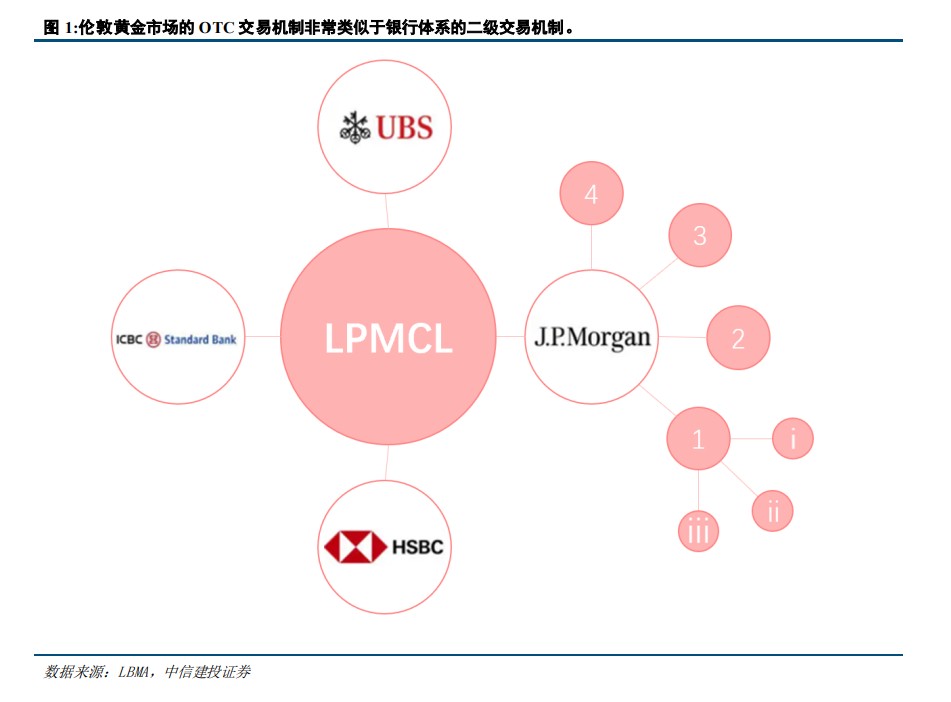
This mainly occurs in the London market, where central banks trade through banks certified by the London Bullion Market Association (LBMA). It is noteworthy that such large-scale transactions are often conducted quietly. The report describes: "In the London market, a large amount of gold trading is completed through 'non-physical movement.' When a central bank buys gold from a counterparty, these gold bars may not physically change location but only transfer ownership within the clearing system."
"Invisible" Local Direct Procurement
In addition to the international market, some resource-rich countries choose "to be close to the water."
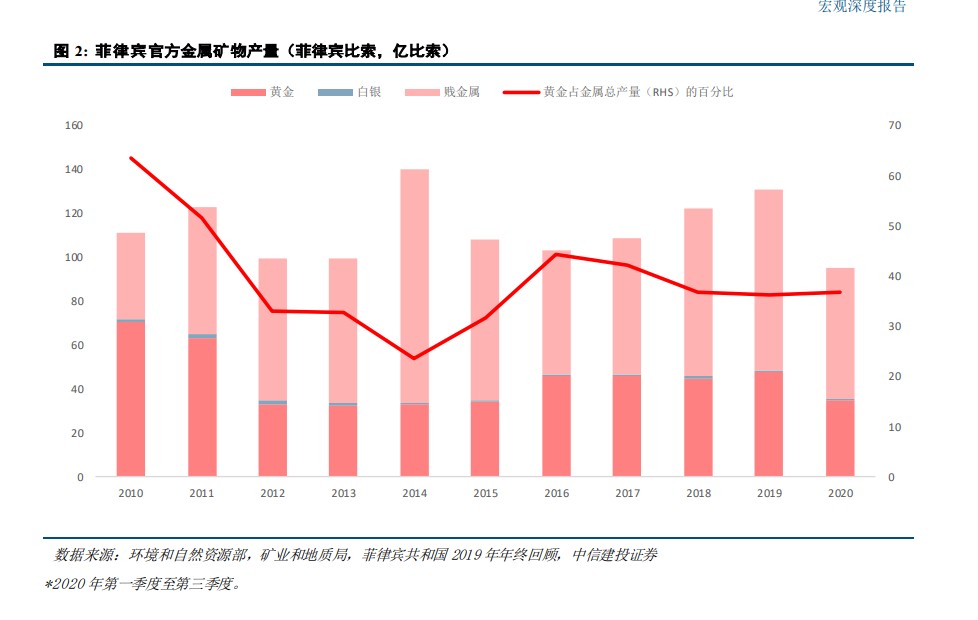
The report cites that the Central Bank of the Philippines "directly purchases unrefined gold from small domestic producers," while the Central Bank of Uzbekistan "has a priority purchasing right for locally produced gold." The key to this model lies in its concealment: "Purchasing gold through non-LBMA channels does not utilize foreign exchange reserves and typically does not result in changes in the amount of U.S. Treasury holdings in the relevant countries. The local direct procurement method usually does not involve changes in trade flows, making tracking relatively more difficult."
 In addition, central banks rarely purchase gold through ETFs. The report emphasizes that due to the requirements for safety and liquidity, "central banks find it difficult to use gold ETFs as a mainstream channel to increase gold exposure," as ETFs introduce credit risks from issuing institutions and custodial banks, which contradicts the "central banks' requirement for 'zero credit risk' for reserve assets."
Where Has the Gold Gone: The Three Pillars of Global Custody
After purchasing gold, storage is another strategic issue. The report points out that "the global gold storage management is a diversified system composed of central banks, commercial banks, and specialized custodial institutions from various countries."
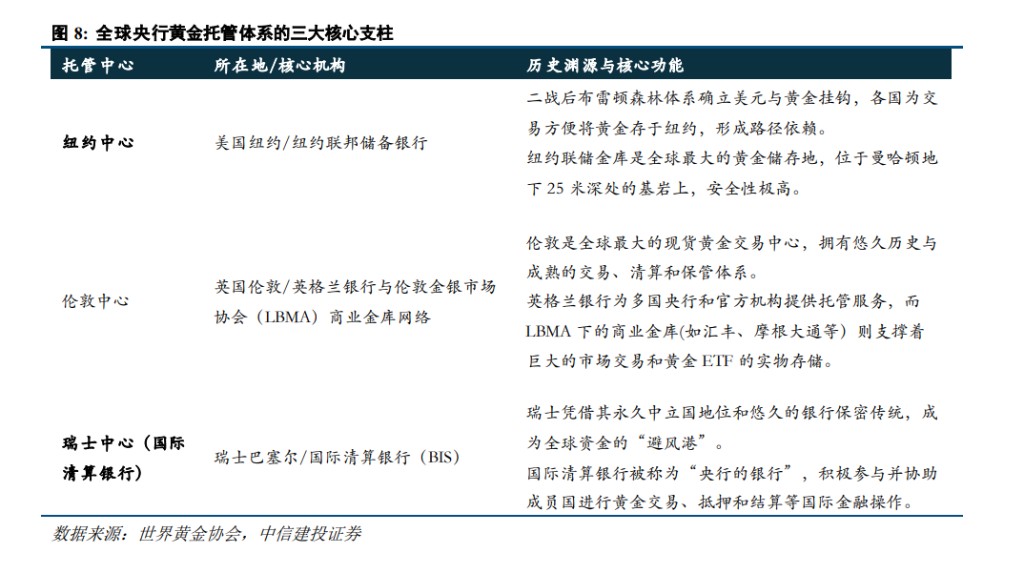
Currently, the global central bank gold custody has formed a three-pillar structure: the Federal Reserve Bank of New York, the Bank of England, and the Bank for International Settlements (BIS). This structure is the result of "historical choices, market practices, and geopolitical interactions."
-
Federal Reserve Bank of New York: Holds the world's largest gold vault. The report states, "After World War II, the Bretton Woods system established a link between the dollar and gold, and countries stored gold in New York for trading convenience, forming a path dependence."
-
Bank of England: As the global center for gold pricing and trading, its vault holds a large amount of official gold.
-
Bank for International Settlements: Known as the "central bank of central banks," it does not operate a vault itself but provides key custody and settlement services.
Although not all countries disclose details, estimates from Singapore precious metals dealer Bunker Group suggest that "the United States and the United Kingdom are the world's largest gold custodians, with the two countries collectively storing about 53% of the world's gold reserves."
Strategic Changes: "Gold Returns Home" and Data Black Box
In terms of storage mode selection, central banks are showing clear strategic differentiation, mainly divided into three models:
-
Domestic Storage (Emphasizing Sovereignty): Such as China, Russia, and France. The report mentions, "The vast majority of our country's gold reserves are stored domestically, with a small amount possibly stored at the Bank for International Settlements or other financial institutions with strategic cooperation for international trading needs."
-
Diversified Storage (Balancing Risks): Such as Germany, Italy, and other European countries, which, due to historical reasons and liquidity management, have their gold spread across New York, London, and other locations.
-
Non-disclosure of Locations: Such as Japan and Thailand.
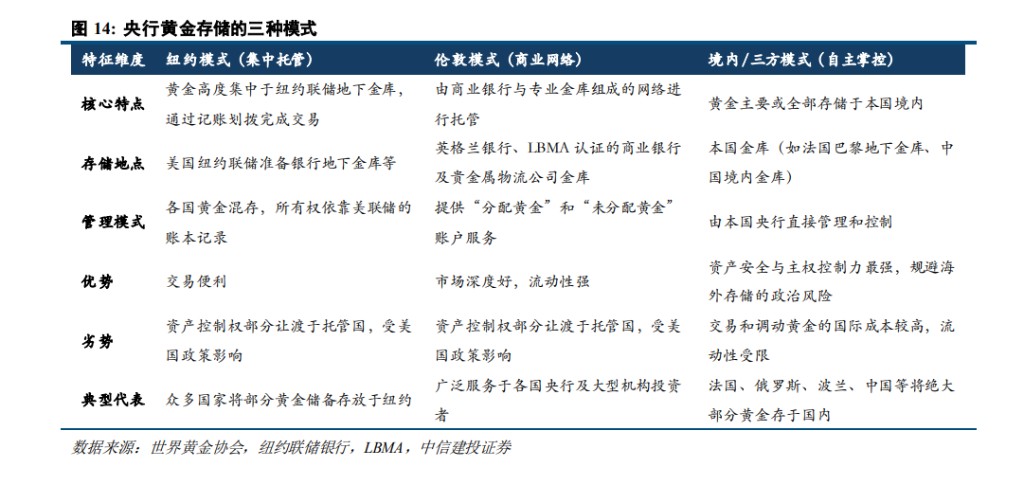
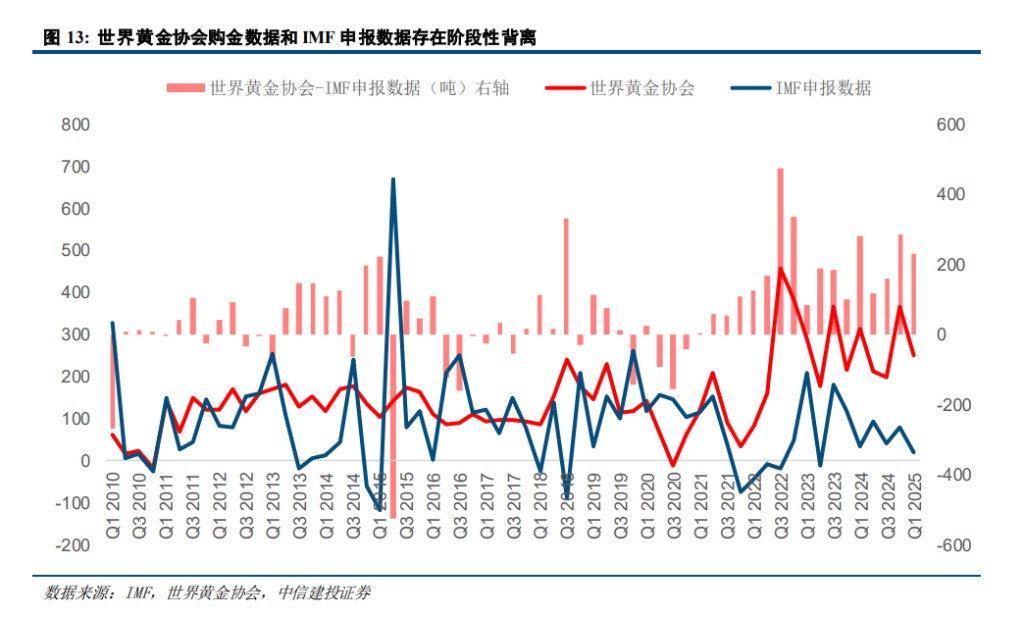
A noteworthy market signal is the trend of "gold returning home." The report points out that "against the backdrop of increased financial sovereignty awareness, central bank gold reserves have also shown a dynamic balance." Typical cases include Germany, which "returned 674 tons of gold in batches from New York and Paris between 2013 and 2017"; and the Reserve Bank of India, which plans to "transfer over 65% of its gold reserves to domestic storage by 2025." This strategic adjustment has led to a "black box" effect in market data. The report analysis indicates that there is a phase divergence between the data from the World Gold Council and the reporting data from the IMF. On one hand, due to security concerns, "some central banks may delay or choose not to disclose their gold purchasing activities, leading to an underestimation in the IMF's 'reported data'"; on the other hand, purchasing channels outside the LBMA system (such as purchasing domestic gold with local currency) are outside the traditional monitoring system. This means that the public data investors see may only represent a part of the true landscape of global central bank gold purchases.