Ed Yardeni 2026 Outlook: The U.S. will not enter a recession, S&P 7700, U.S. Treasury yields exceed 4%, gold price at 6000 USD

Wallstreetcn
2025.12.28 04:31
portai
I'm PortAI, I can summarize articles.

Ed Yardeni stated that we are currently in the "Roaring 2020s," where economic resilience and the leap in AI productivity are expected to drive the S&P 500 to reach 7,700 points by 2026, with a challenge to 10,000 points by the end of this decade. The main investment theme will shift from AI producers to the "493" users that benefit from cost reduction and efficiency improvement. U.S. Treasury yields remain steady above 4%, while gold prices are expected to align with $10,000 in the long term

Recently, Ed Yardeni shared his outlook on the stock, bond, and gold markets for 2026, analyzing the key drivers that may impact these asset classes in the coming year.

Yardeni believes we are in the "Roaring 2020s." Based on earnings per share (EPS) projected to reach $350 by 2027, the S&P 500 index is expected to surge to 7,700 points by the end of 2026 and ultimately challenge the 10,000-point mark by the end of this decade. Meanwhile, the long-term target for gold is also set at $10,000, while precious metals like silver, driven by industrial demand, will also strengthen concurrently.

Yardeni stated that the AI sector has shifted from monopoly to "arms race," with intensified competition narrowing the moats of tech giants. The market logic is undergoing a profound transformation: investment focus will shift from producers of AI technology (the seven giants) to users of AI technology, who have significant potential to enhance profit margins through AI.

Here are the key points summarized:

  • We still believe that by 2026, market gains will spread from the "seven giants" to the impressive "493 companies."

  • The reality is that if AI is indeed genuine, the real beneficiaries may not be the producers of technology, but the users of technology—those companies that leverage technology to improve productivity and increase profit margins.

  • We still belong to the camp that believes the economy has been quite resilient over the past four years. Let’s view this as the story of the "Roaring 2020s."

  • We are confident that as we enter the new year, productivity improvements will lower unit labor cost inflation, allowing us to achieve a 2% inflation rate. If that is the case, the Federal Reserve will not raise interest rates, and no one will be talking about higher rates anymore.

  • Perhaps the bond market will continue to stabilize above 4%.

  • We believe that by the end of 2026, the market will expect EPS of $350 for 2027. Multiply $350 by a price-to-earnings ratio of 22, and you get 7,700 points, which is our target for the S&P 500 index.

  • We still believe that by the end of this decade (i.e., the end of 2029), the S&P index will reach 10,000 points. If the S&P index can achieve this, we believe gold will also reach $10,000 per ounce by the end of this decade.

  • Gold is actually a great way to diversify or balance an S&P portfolio: when the S&P index soars, gold performs modestly; but when the S&P index stagnates, gold performs well.

  • Now I am a bit hesitant about whether I should raise the gold target to $6,000; perhaps I will.

  • Silver is widely used in electronic products, so logically, silver makes more sense than gold, but I believe precious metals as a whole will continue to perform well.

The following is the full text of the Yardeni podcast:

The driving force of U.S. stock earnings is shifting from AI "producers" to "users"

Hello everyone, I am Ed Yardeni. Today is December 22nd, and I think everyone should be preparing for Christmas. I hope you had a pleasant Hanukkah, and the New Year is just around the corner. My wife and I decided to celebrate at home this year, avoiding the crowds at the airport. By the way, the weather is nice today, sunny. Although it's a bit cold—after all, it is winter—but it hasn't snowed. A few days ago, there was some snow, but it all melted after a rain.

Alright, back to the point. The question now is, will this stock market rebound melt away like snow? So far, there are no signs of that. The "Santa Claus rally" seems to be gearing up. There are different definitions of the specific start and end times for the "Santa Claus rally." While everyone agrees it ends at the end of the year, I personally tend to include both November and December in the start time. Over the past 10 years, these two months have typically been quite good for the market, contributing an average of about 4 percentage points to the S&P 500 index. So I think, on average, this is a pretty good "Santa Claus rally." Moreover, the current performance of the S&P 500 seems not only to meet expectations but even to exceed them. The average increase of the S&P 500 over the past 10 years has been about 12%, and we have now risen by 16.5%.

So to reiterate, I believe our "Santa Claus rally" has begun, and from now until the end of the year, it is highly likely that we will not give back much of the gains. In our view, the core driving force of the market is corporate earnings. Analysts remain very bullish. In fact, they are now more optimistic than at the beginning of the year. At the beginning of the year, they were very cautious about earnings prospects and significantly lowered their expectations for the first and second quarters before the earnings season, with quite aggressive downward adjustments. Clearly, they were spooked by Trump's tariff turmoil at that time. I believe some were also frightened by the DeepSeek released in late January. This Chinese company launched an open-source large language model (LLM), which clearly has much lower training costs than the hyperscalers in the U.S. Suddenly, a question arose in the market: since models can be trained with cheaper chips and more cost-effective methods, why are these giants spending so much unnecessary money? During the earnings seasons of the first and second quarters, these cloud computing giants responded. They basically stated, "No, we believe we need these data centers, we need the cutting-edge NVIDIA chips."

Recent developments indicate that OpenAI is not the only player in the large language model space. For a while, the consensus seemed to be that OpenAI, with ChatGPT and Copilot (which is essentially ChatGPT), was definitely the frontrunner. Then Gemini 3 appeared, along with several other LLMs that are also outstanding and comparable in functionality Moreover, Google's Gemini 3 runs on TPU chips instead of GPUs. TPUs are chips developed in-house by them. So suddenly, the competition has become much more intense.

In the past few weeks—perhaps two or three weeks—we have been discussing this topic and using "Game of Thrones" as an analogy: until recently, the "Magnificent Seven" of the U.S. stock market each owned their seven kingdoms, their own territories, surrounded by wide moats, and there was no need for intense competition among them. They operated their own excellent businesses, in a quasi-monopoly state. However, in the past few weeks, the situation has changed, and the current notion is that AI is forcing them to compete with each other. This is what is called the "AI arms race," where everyone is racing to build data centers and continuously launch better and stronger large language models.

People are starting to question: can they really make big money from large language models? Will their huge investments in these data centers yield a return on investment (ROI)? The answer may be yes, but there is a lot of uncertainty involved, and who will be the ultimate winner of this competition is also full of variables. I remember reading a very insightful statement: by the time they build these data centers with the most advanced chips, the equipment may already be outdated because new things are always being developed along the way.

Clearly, there is still some hype involved here. Some tech giants' leaders—like Elon Musk (who owns several companies), Google's head, and I think Jeff Bezos—are saying they are researching building data centers in outer space. Amazon has the capability to launch satellites, and Tesla and SpaceX certainly have that capability as well. But we still believe that by 2026, the market gains will spread from the "Magnificent Seven" to that impressive "493 companies."

We still think that overweighting the information technology and communication services sectors is very difficult. I mean, you can certainly do that, but it means you have to allocate over 45% of your portfolio to these two sectors. Of course, if you want to overweight the "Magnificent Seven," you would need to invest over 30% of your funds solely in these seven stocks. The reality is that if AI is indeed genuine, then the real beneficiaries may not be the producers of technology, but the users of technology—those companies that leverage technology to improve productivity and increase profit margins.

Resilience and Concerns of the U.S. Stock Market Under Massive Fiscal Stimulus

This is clearly an important issue facing the future. Another important issue, of course, is economic performance. I just tried to look for GDP data but couldn't find it. If anyone has seen it, please send me a message to let me know the value. We expect a growth rate of 3.5% for the third quarter, following a growth of 3.8% in the second quarter. I think we will see whether the economy can maintain this growth rate with almost no growth in the labor market. Real wages are still rising, but net hiring has basically dropped to around 30,000 to 60,000 people per month. The market seems to have become accustomed to the idea that this might be the "new normal" for the labor market So currently this doesn't seem to be a problem for the market. However, if the labor market continues to show such a sluggish increase in employment while we start to see retail sales really becoming very weak, then we must worry about consumers—worry about a consumer-led economic slowdown or even worse. This is a question hanging in the future. We still belong to the camp that believes the economy has been quite resilient over the past four years. Let's consider this the story of the "Roaring 2020s."

I just saw the GDP figure for the third quarter come out, and consumer spending is at 3.5%. Okay, thank you, William, thank you very much. This aligns with our expectations, and honestly, the reason it aligns with expectations is that the Atlanta Fed's tracking model has been predicting 3.5%. We rely heavily on their data and believe they do quite well. By the way, we are also paying attention to the Cleveland Fed's inflation Nowcast, which also seems quite accurate, showing a figure closer to 0.3 rather than 0.2 for November. The CPI data for November is good news, but I think everyone has concluded that this might be a bit quirky data because the Bureau of Labor Statistics (BLS) missed a lot of sub-item data.

Finally, of course, there is the question of market direction. If the economy can remain resilient, then valuation multiples may continue to stay around the current 22 times. Typically, during market corrections, valuation multiples plunge. Because while corporate earnings hold up, fears of an economic recession will pull down the price-to-earnings (PE) ratio. But this is just a correction, as there is no real recession happening, and earnings are still growing. Only when a recession truly occurs will you encounter a bear market, at which point you will suffer a double blow: seeing both the PE ratio decline and earnings drop. But if there is no full-blown recession from now until the end of this decade—perhaps there won't be a full-blown recession, but rather a rotational recession in different industries at different times—then overall, consumers can hold up, and capital expenditures can hold up. Of course, no one in our industry really likes the federal deficit, but it is indeed a source of economic stimulus, especially from interest income and social welfare spending, etc.

If that is the case, then valuation multiples should be able to hold up. I believe productivity will continue to improve significantly on this basis, performing better than expected. If so, this will suppress the inflation of unit labor costs, thereby lowering the overall inflation rate. So, we should consider ourselves as optimists regarding the inflation issue.

We have always believed that if it weren't for tariffs, the inflation rate would have already dropped to 2%. I think tariffs have caused inflation to stagnate around 3%. This can be clearly seen in the inflation rate of durable goods—it had originally slightly turned negative into deflation and has now slightly rebounded. This fluctuation determines whether it can drop to 2% or get stuck at 3% without moving. But we are confident that as we enter the new year, improvements in productivity will lower unit labor cost inflation, and we will be able to achieve a 2% inflation rate. If that is the case, the Federal Reserve will not raise interest rates. No one will be talking about higher rates anymore. **

Perhaps the bond market will continue to stabilize above 4%. We still face a deficit issue. You can see that the government seems flustered, even a bit panicked, as they realize that the midterm elections are a big problem. Whether it's Mamdani's victory in New York City, the situation in Virginia, or the several elections won by the Pennsylvania Democrats, it has made the government realize that focusing on tariffs may have been the wrong path; they should have put more energy into lowering prices. Now they are eager to remedy the situation, but it's actually quite difficult to truly bring prices down. Maybe you can lower the prices of certain goods, but you can't pull the overall price level back to where it was.

So, their approach is—as we see, Besant and the president have stated that people will receive $2,000 checks sometime in the first quarter. In addition, due to the "Big Beautiful" bill being retroactive to early last year, people will receive more tax refunds than usual. Therefore, there will be a significant amount of fiscal stimulus in the first and second quarters, which the bond market may not like at all. This inevitably means that the deficit will become larger. So, we may face some shocking situations. Perhaps this is what we should truly be wary of—while all these stimulus measures may keep the economy growing at 3% to 4%, they will also bring side effects.

Yardeni: Gold to Challenge $10,000 in a Decade

Regarding the earnings per share (EPS) of the S&P 500 index, we will have the final data for the fourth quarter in January or February next year, and it looks like this year will be about $270 per share. For 2026, it looks to be about $310 per share, and our estimate for 2027 is $350 per share. We believe that by the end of 2026, the market will expect the EPS for 2027 to reach $350. $350 multiplied by a price-to-earnings ratio of 22 gives you 7,700 points, which is the target level we are predicting for the S&P 500 index.

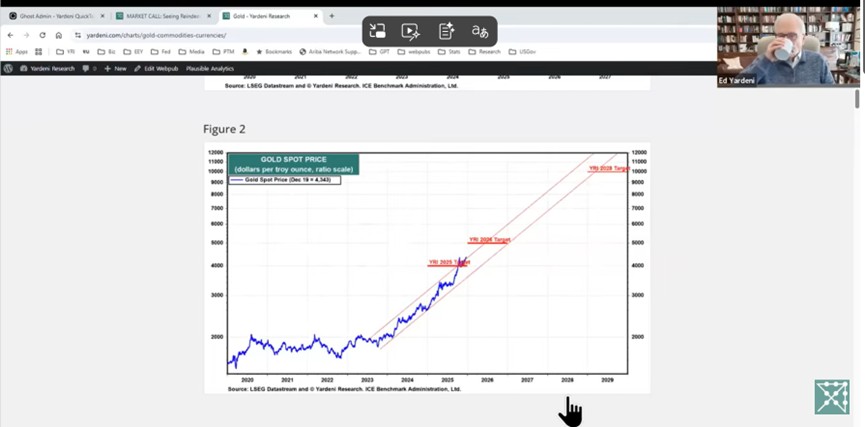
We still believe that by the end of this decade (i.e., the end of 2029), the S&P index will reach 10,000 points. If the S&P index can achieve this, we believe gold will also reach $10,000 per ounce by the end of this decade.

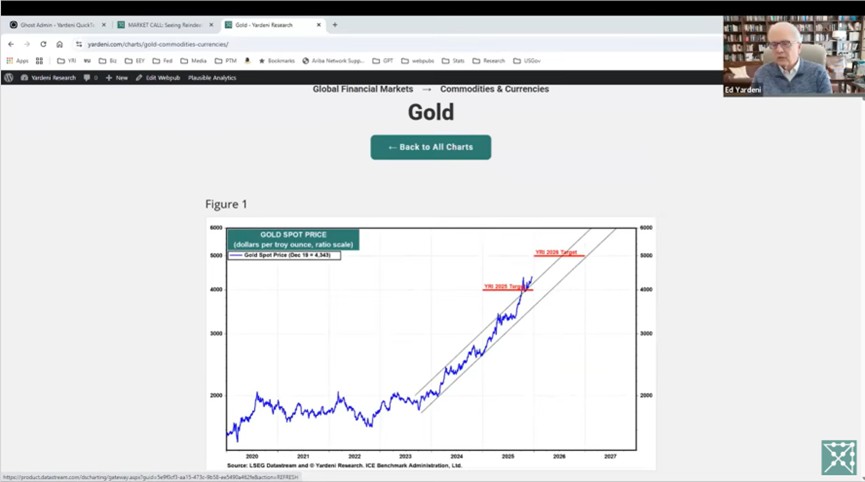
Speaking of gold, I have had questions—I used to be not bullish enough. I thought I was quite bullish, and at that time it did seem so. Earlier this year, gold prices reached around $3,000, and at that time I said it could reach $4,000 by the end of the year. And just now when I looked at the screen, gold prices were already at $4,400, while I originally thought it would only reach $5,000 by the end of next year. Now I'm a bit hesitant about whether I should raise the target to $6,000; maybe I will. I will find some time to sit down and write a brief commentary to update everyone on my views on gold.

However, let's find some fun— I think we always have a good time together. Although sometimes I mess things up here, let's see if we can present it smoothly. Let's take a look at some charts

This is a gold price chart. By the way, I appreciate so many people attending, and I think many of you might be listening while on vacation at the beach. We call these charts "Web Pubs," and they are available on our website. This one is about gold. Here you can see the trend of gold heading towards the end of 2027. We are taking a "Roaring 2020s" perspective. This is the chart. You can see that when the gold price breaks through this level into the $3,000 range, we start talking about reaching $4,000 by the end of the year. Now we are there, and today we set a new historical high.

Some say this is due to Venezuela, but clearly, there are many factors driving up the gold price. None of these factors are particularly scientific, nor can they be put into a formula or shown to have a direct correlation on a chart—except for one. I will show you that shortly. So, looking at $5,000 by the end of the year, it may be adjusted upward soon, and then looking at $10,000.

Now, let’s look at a chart that we can say is our original, which is a slightly more analytical or logical chart.

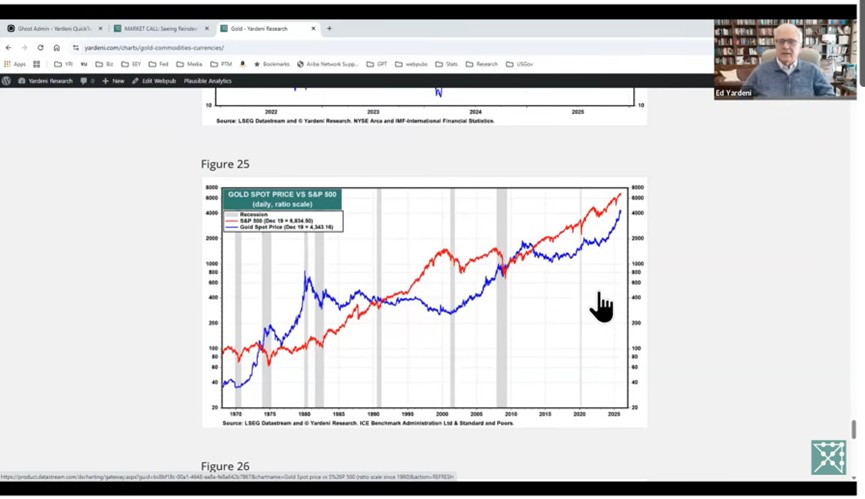
In the early 1970s, Nixon closed the gold window, and then the gold price took off. At that time, it was about $40 per ounce. It really took off, increasing fivefold. This shows you the explosive power of gold. Then it pulled back a bit, and then it rose again to $800, which is a 20-fold increase. That was amazing. Then we encountered the Hunt brothers' silver crisis, and the gold price plummeted, halving. But even so, compared to the starting price, it was still a huge increase. After that, the gold price continued to decline, and people became tired of gold.

Meanwhile, the stock market—by the way, both are on the exact same scale—makes it look like a horse race, you know who is leading. Gold was the winner before, then it declined. Meanwhile, the S&P index continued to rise, making money for people, while gold did not. Then we welcomed that big bull market at the end of the 1990s. When the S&P index was so interesting, who wanted to hold gold?

But then the S&P index became less interesting, probably in the last decade or so. Meanwhile, gold resumed its rise, looking like it went from about $300 to $2,000. That is quite a significant increase. Then we went through another period of stagnation. And here, we see the gold price starting to catch up with the S&P 500 index again.

You will notice that there is an inverse relationship between the S&P index and gold. There is no statistical significance in this, as there are actually only three observations, but it does indicate that gold is actually a good way to diversify or balance an S&P portfolio: when the S&P index soars, gold performs flat; But when the S&P index is stagnant, gold performs well.

Now we face this "horse race": gold is at 4,400 points, while the S&P 500 index is close to 6,900 points. Our thought is that if the S&P index reaches 10,000 points by the end of this decade, gold may also have a chance to get there. This could be some sort of global rebalancing — you know, when people have made a lot of money in the stock market, they might feel nervous for some reason, decide to take profits, and invest some of that profit into gold. Or, it could be a completely false relationship that will fail one day. I've encountered this before; I can show you a chart with astonishing correlation, and then it suddenly stops working. For example, we once found a good inverse relationship between gold prices and the yields of Treasury Inflation-Protected Securities (TIPS), which worked for a while and then failed.

But in any case, this chart is currently our preferred fundamental and technical basis for explaining gold's movements.

"Roaring 2020s": S&P 500 Moves Toward 10,000 Points

Let's first take a look at the latest market commentary. No morning briefing today, let's give everyone a break. After all, not everyone treats market analysis as a hobby like I do; some people really treat it as work and need to catch their breath. While we enjoy doing this work at Yardeni Research, the holiday season is upon us.

Now I want to focus on the S&P 500 index. I previously mentioned that by the end of this decade (the 2020s), the S&P 500 will reach 10,000 points. We have discussed this viewpoint before.

Look at the year-to-date performance of the S&P 500 index this year. We have experienced an extraordinary roller coaster ride, which turned out to be a huge buying opportunity. Although we were thrown for a loop several times during this process — the index started at 7,000 points and may have dropped to 6,400 points or even lower in between — I still remain bullish because the market performance is actually below our predicted year-end level.

Subsequently, like others here, we realized that the tariff issue might not be as destructive as initially thought. I had believed the government wanted to resolve this issue before summer to focus on the midterm elections. You know, politics is a messy business, not black and white. Then, the Supreme Court will rule on the constitutionality of all this in January, which raises the question of how the government will clean up the mess.

But in the meantime, the stock market has experienced a roaring good year. "Roaring 2020s," "Roaring 2025." The previous sell-off brought the market back to its 10-year average level. As I mentioned earlier, the 10-year average return rate has risen from about 8% to around 12.5%, an increase of about 4.5 percentage points. Now we are recovering lost ground, with the return rate closer to 16.2% rather than 12.3%. If the final return rate is 16.2%, 17%, or 18%, it will mark the third consecutive year of double-digit growth. The growth rate has exceeded 20% in the past two years, and this year may be slightly below 20%. Moreover, we expect another 10% growth next year. In other words, we will see four consecutive years of double-digit growth Of course, there is no refund guarantee, but we are quite confident about this. Looking back at history, you will find that there have been instances of consecutive growth for three or even four years, so this is not crazy.

Equally not crazy are the industry analysts' expectations for earnings. This is the earnings per share. We monitor this data weekly. We try to illustrate the "E" (earnings) in the expected price-to-earnings ratio (P/E) through this chart. We use forward earnings, which is the time-weighted average of this year and next year. By the end of the year, this number will converge towards the expectations for the following year. The current expectation is about $312 per share, while next year's expectation is $357 per share. We estimate it to be around $350.

So analysts are quite bullish. You can see that the data for 2024 is stabilizing, as is 2025 and 2026, but they are very excited about 2027 and relatively optimistic about 2026, which we broadly agree with. This aligns with the optimistic "Roaring 2020s" scenario.

Looking at revenue, the revenue expectations from 2025 to 2026 and then to 2027 show that revenue will grow by 7% in the next two years. A 7% growth rate seems very high, as the average revenue growth rate is usually around 4.5%. However, if you agree with the "Roaring 2020s" scenario of no recession, then the average excluding recession periods will obviously be higher than 4.5%. I haven't done the specific calculations, but it's easy to reach 7%. A 7% growth rate is broadly consistent with global nominal economic activity. In short, these companies in the S&P 500 are very good at generating revenue.

This is the profit margin, which is expected to reach a record 15.4% by 2027. According to analyst expectations, it will rise to 14.3%. This is the forward profit margin. Ultimately, this again confirms the "Roaring 2020s" scenario. This is not just my personal vision; although it aligns with my vision, it is actually a common view among analysts. I don't think I influenced them to buy into this concept; rather, they have recognized it from their own perspectives.

Looking at this year's quarterly data. In the first quarter, analysts were scared by tariffs and lowered their expectations, but the actual performance was much better—this is the so-called "earnings hook." In the second quarter, they cut growth rate expectations even more, and the actual situation was again much better. Later on, they grasped the pattern and thought, "Okay, we are no longer so afraid of tariffs and bad news." So they held their ground. By the third quarter, the results were astonishingly good.

Now, in the fourth quarter, they are actually raising expectations. I wonder if a government shutdown will bring us another turning point; perhaps we will feel disappointed in January or February. Or the bond market might be unhappy with the government's large payments. You know, I am always looking for things to worry about. One cannot always be blindly optimistic, or if you are going to be optimistic, at least consider where things might go wrong. That is exactly what we are trying to do.

This is the growth rate of the S&P index for 2026, which has been rising recently. Analysts are quite bullish. This is our updated comparison of the forward earnings of the S&P 500 index with the "other 493 companies." You can see that the S&P 500 has been boosted by the "Magnificent Seven" of U.S. stocks, but those "impressive 493 companies" are also performing quite well

Q&A Session

I have more content, but it's still being organized. When there isn't so much data, I will write it into a report and send it to you. This is the Wilshire Index outperforming expectations in 2026. We are also doing the same analysis on earnings. You have seen this chart, which shows that mid-cap and small-cap stocks have been performing mediocrely, while the S&P 500 has been very strong.

Alright, let's quickly answer a few questions. One day I will keep all of this within half an hour.

Question 1: About sectors benefiting from AI

Q: You have previously mentioned three sectors that you believe will perform best in the S&P: healthcare, finance, and industrials. Does this still hold? Two questions: do you think these sectors will benefit more from AI advancements than others? Are there other sectors that could outperform technology and communication sectors?

A: Yes, I still have a positive outlook on these three sectors. The answer is yes. I believe they have tremendous potential to leverage AI technology and other existing technologies to improve productivity. We all know the inefficiencies in healthcare, and that is changing. Previously, when you went to see a doctor, you had to fill out information on an iPad; now, more and more can be done using a smartphone. There is a system in New York called Epic, and if you unfortunately visited two or three hospitals, for example, getting a kidney stone removed here and an appendectomy there, you used to have to run around to get your records. Not anymore; all records are in one place.

As for Sam Altman (CEO of OpenAI) always saying that if we had enough data centers now, we could cure cancer, I think he might be a bit overhyping it. But I do believe this has significant implications for accelerating the processing of medical data and drawing conclusions (whether in drug development or disease diagnosis).

Question 2: About gold and silver

Q: What is the positioning of investors in gold? Is it underweight or overweight?

A: I have no idea. I can only tell you that there was a story for a while that central banks of countries not aligned with U.S. geopolitical interests decided to stockpile gold in large quantities.

But I have been appearing on Indian television shows two or three times a week recently (don’t ask me how I manage that; maybe because I stay up late). Last night, I reiterated my bullish prediction for gold to reach $10,000 per ounce. Maybe the rebound in gold this morning has something to do with me? I don’t mind imagining that. In fact, Indians have always regarded gold as a must-have asset.

Q: Can you talk about your views on silver?

A: “Hi-Yo Silver! Away!” (This is a classic line from The Lone Ranger). That’s the story over there. The fundamentals for silver are stronger than for gold. Silver has a wide range of applications in electronics, so logically, silver makes more sense than gold, but I believe precious metals as a whole will continue to perform well.

Question 3: About future risks

Q: Last question, will the "Roaring 2020s" end in tragedy like the 1920s? Answer: This is indeed a good question to end today with. I mentioned before that whenever I talk about the "Roaring 2020s," the rebuttal I get is, "That era doesn't end well." One of my responses is: If the ending is destined to be bad, you better make some money before it arrives and cash out to hedge against it.

But seriously, history tends to repeat itself, sometimes just rhyming. I believe the cause of the Great Depression was the Smoot-Hawley Tariff Act passed in May 1930. The stock market did not completely crash in 1929. Although it experienced a significant sell-off, it rebounded by 50%, returning to the levels of April of the previous year by May 1930. So where was the big problem? The big problem was the passage of the Smoot-Hawley Act, which was when the real crash began. Global stock markets plummeted, commodity prices fell sharply, and there were widespread defaults on mortgages and debts. That was the reason.

We just went through a stress test. Some people compare Trump's actions to the Smoot-Hawley Tariff Act, but the global economy did not experience massive retaliation, world trade did not come to a halt, and we did not truly de-globalize; rather, we experienced a rebalancing of globalization.

So, I don't think it will end in tragedy. But to be honest, when I pay attention to geopolitical dynamics, I am a bit concerned that the 2030s might resemble the 1930s. Clearly, there have already been some historical comparisons. But for now, I tend to think that the "Roaring 2020s" have been going well so far. If this can succeed, let's try to look forward to the "Roaring 2030s" and consider "the tragedy of the 1930s repeating itself" as a risk factor in the 2030s—hopefully a low-probability risk.

Well, with this relatively optimistic view, I wish everyone a Happy New Year. Thank you, and best wishes for everything