OpenAI partners with Amazon, while Microsoft is buying the Anthropic model... The nine major AI giants in 2025 are in a complete mess

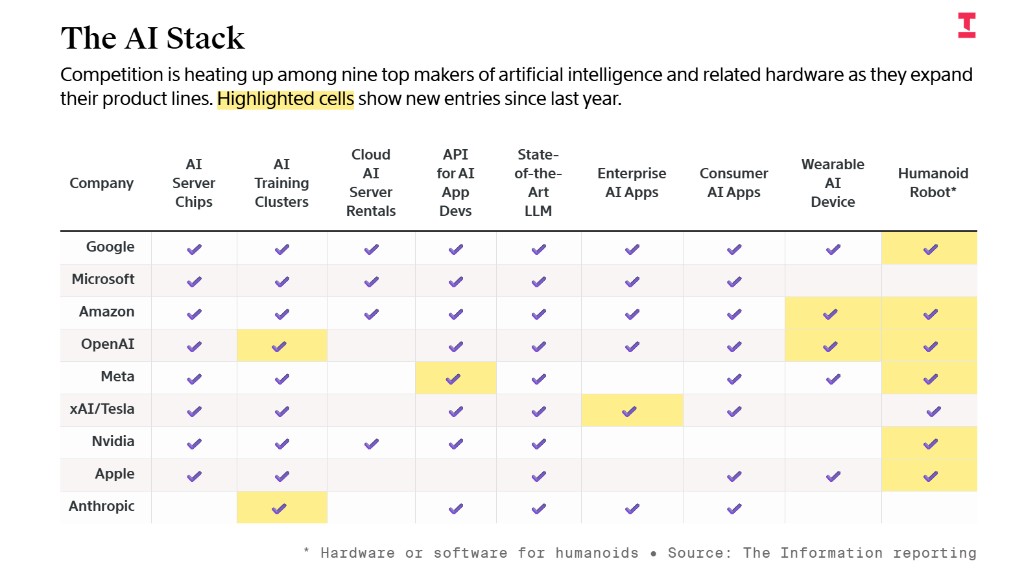
In 2025, the AI industry will enter the "full-stack" integration year, with nine major players expanding their humanoid robot and hardware landscape while becoming entangled in more complex interdependencies. Google, with TPU and Gemini 3, becomes a core supplier; OpenAI breaks free from its reliance on Microsoft through multi-cloud collaboration; Meta leads in devices but faces setbacks in models; xAI and Anthropic are quickly catching up. This deep restructuring of the industry chain prompts all parties to redefine competitive boundaries in the pursuit of independence and mutual checks and balances
The year 2025 can be called the year of industry consolidation for AI giants. According to a report by technology media The Information on the 29th, nine major tech companies, including Google, Meta, OpenAI, and Anthropic, have comprehensively expanded their AI "full-stack" capabilities over the past year, with almost all participants beginning to delve into humanoid robotics technology. However, this race for independence has made them increasingly interdependent.
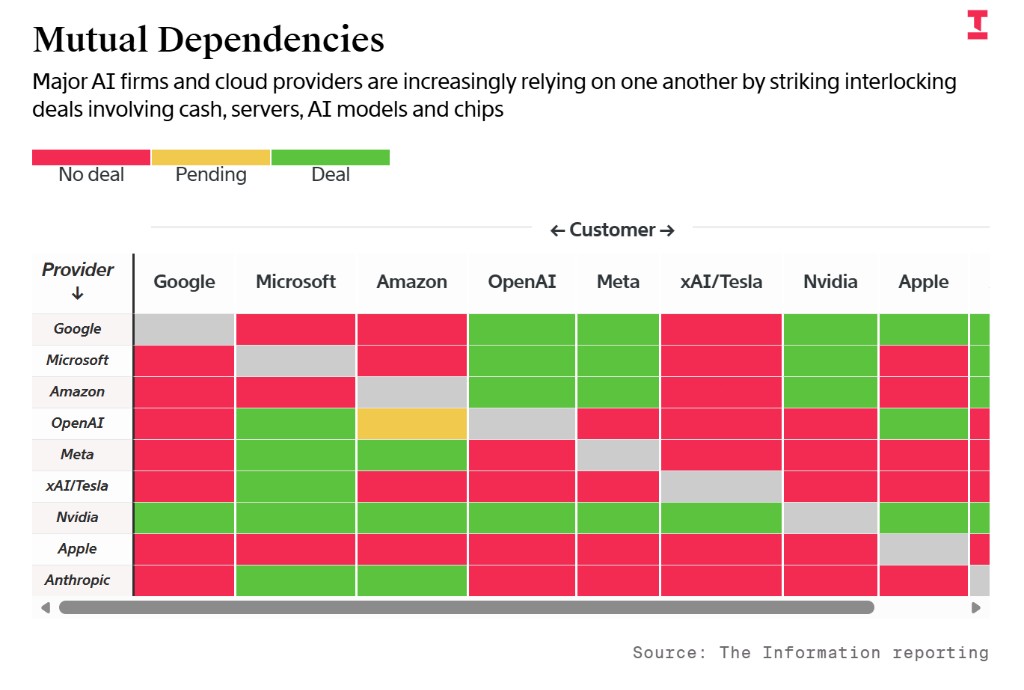
The industrial landscape has undergone significant changes. OpenAI has expanded its cloud service collaboration from Microsoft to Amazon, reaching a $38 billion server cooperation agreement. Meanwhile, Microsoft has turned to leasing servers to Anthropic and has procured Anthropic models for products like Office 365 Copilot, even though it can obtain models for free through its partnership with OpenAI.
Google has emerged as the biggest winner in this melee, having secured a $20 billion order from Anthropic for its tensor processing units (TPUs) and is in talks with Meta for a chip supply agreement. The company is also set to begin large-scale provision of NVIDIA servers to OpenAI in 2025, becoming a technology supplier for at least five competitors.
This industrial reshuffling is reshaping the competitive boundaries of the AI market. Companies are attempting to reduce costs and dependence on key suppliers like NVIDIA by controlling more segments of the supply chain, but new alliances have entangled them in more complex conflicts of interest.

Google Establishes Technological Supply Dominance
Google solidified its leading position in the AI full-stack in 2025. The company's TPU chip business achieved breakthrough progress, with Anthropic placing a $20 billion order, and Meta also seeking to reach a usage agreement. This marks the first time Google has sold TPUs to other cloud service providers, and employees from competitors like OpenAI have revealed that these chips significantly reduce costs for Google in its AI business.
Google's advantage in the large language model field is equally evident. The Gemini 3 released by the company in 2025, trained on TPUs, is considered to reach industry-leading levels. In addition to technological leadership, Google has also reached an agreement with its long-time business partner Apple to support Siri queries, effectively replacing the previous role of OpenAI.
This supplier role places Google in a unique position. The company both leases TPUs and other cloud servers to developers and is set to provide NVIDIA servers to OpenAI on a large scale in 2025, leaving room for potential future sales or leases of TPUs to OpenAI. Google currently provides technical services to at least five competitors.

OpenAI Breaks Free from Microsoft Dependency
OpenAI's strategic focus in 2025 is to expand its cloud service relationships beyond Microsoft. The company has reached a $38 billion server agreement with Amazon, which may also include a significant cash component, and both parties plan to collaborate in the e-commerce sector. OpenAI also announced larger-scale agreements with Microsoft Azure and Oracle Cloud.
On the hardware and product front, OpenAI has launched ambitious plans. The company invested $6.5 billion in equity to acquire a design team led by former Apple Chief Designer Jony Ive to develop wearable AI devices. Although the products may not hit the market until 2027, OpenAI has already laid out plans in several areas, including smart glasses, smart speakers, wearable pins, and digital recording devices.
OpenAI has also begun developing or controlling server clusters for technology research and development, attempting to gain more autonomy at the infrastructure level. These initiatives indicate that the company is filling in the gaps in the AI stack to compete for the rapidly growing consumer and enterprise AI service market.
Meta Leads in Devices but Lags in Models
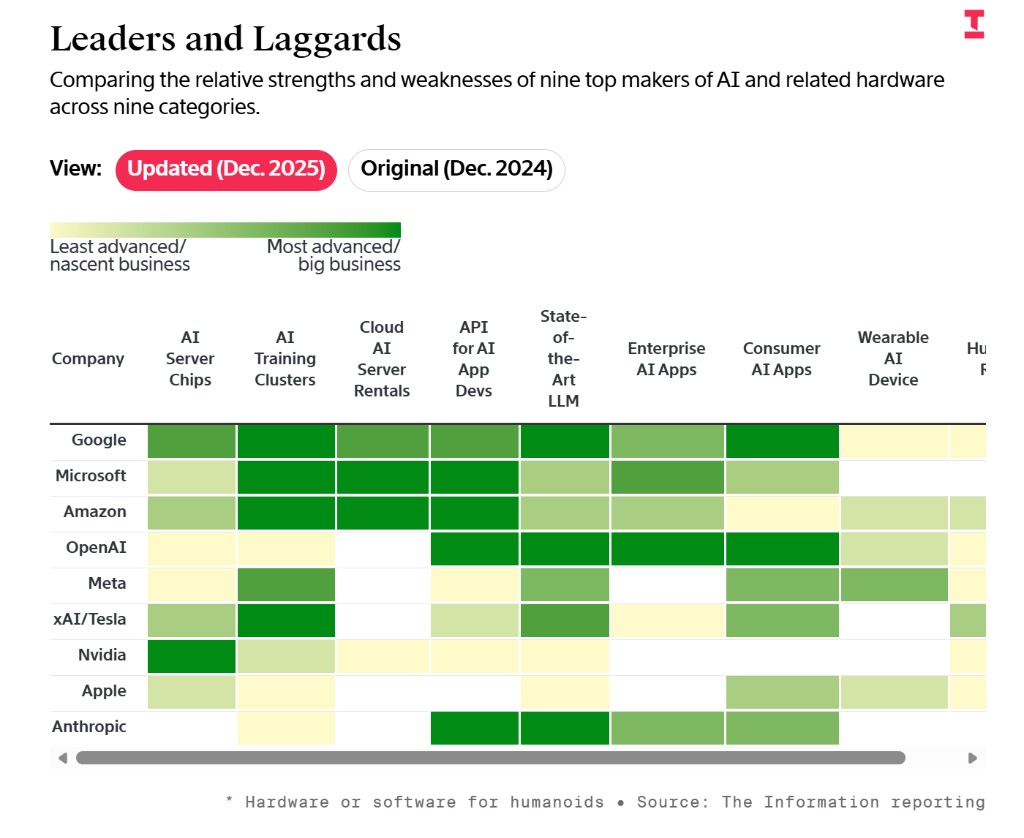
Meta has made significant progress in AI hardware devices, with its Meta glasses allowing the company to far surpass competitors like Apple in AI-driven devices, although this remains a niche market. The company has also released an application programming interface (API) to sell the Llama model directly to customers, fulfilling previous expectations.
However, Meta has encountered setbacks in core technology. Llama 4 failed to achieve significant performance improvements and could not compete with existing AI model leaders, causing the company to fall behind in developing its own state-of-the-art models. To turn the situation around, Meta is making significant talent acquisitions in 2025, expecting improvements in 2026.
Meta is seeking more technological collaborations to address its shortcomings. The company is negotiating an agreement with Google to use TPUs, attempting to enhance its AI training capabilities through external chip resources. This strategic shift reflects the pressure Meta faces in developing its own models.
xAI and Anthropic Rapidly Catching Up
xAI has made progress in multiple areas. The company has improved the quality of its large language models and its training clusters based on NVIDIA, although its LLM still lags behind Google, OpenAI, and Anthropic in most real-world application scenarios. xAI's Grok supports key features for the X application, enhancing the experience for many users, especially in interpreting previously difficult-to-understand posts.
Grok also seems to attract users looking to access adult content through chatbots. xAI is developing an enterprise AI application called Macrohard—this is a semantic inversion of Microsoft. Elon Musk's other company, Tesla, appears to be in a leading position among major AI companies in the humanoid robot field, although its Optimus robot still faces challenges such as "hand issues."
Anthropic's product business is reportedly thriving according to its undisclosed financial data. The company has made progress with both enterprise and individual clients and has established significant collaborations with Microsoft—Microsoft rents NVIDIA servers for it while procuring Anthropic models for products like Office 365 Copilot Anthropic has also launched an ambitious plan to develop or control server clusters.

Humanoid Robots as the New Battleground
2025 can be called the year of robots, at least for major AI companies. Anthropic, Meta, and xAI are refining their AI hardware and software product lines, while almost all participants have begun developing humanoid robot technology.
This shift reflects the current competitive landscape of AI and embodies the vision of humanoid robots operating in every factory and home. Google, Amazon, and OpenAI are all taking steps to develop humanoid robot software or hardware, although they are still in the early stages and face significant challenges. Google, Amazon, and NVIDIA currently seem to be focusing on software development.
Amazon is also making significant moves in wearable AI devices, advancing in the form of augmented reality glasses. These emerging industries represent the next growth point that AI companies hope to participate in, while gaining more revenue or long-term cost savings by controlling a more complete AI "full stack."
Microsoft's Chip Progress and NVIDIA's Adjustments
The only significant progress Microsoft has made in the server chip field comes from its ongoing development of the Maia chip, but it still lags behind most competitors. The company's strategy is more reflected in adjustments to cloud services and partnerships—continuing to serve as the primary cloud service provider for OpenAI while expanding cooperation with Anthropic.
NVIDIA has exited direct competition with Amazon AWS, Google Cloud, and Microsoft Azure through a recent reorganization, although it has not completely left the market. This adjustment reflects the fierce competition in the cloud services market and the repositioning of industry divisions.
Although companies are striving to reduce their dependence on key suppliers like NVIDIA, NVIDIA's GPUs still play a central role in AI training. Google, Microsoft, and Amazon are all offering server leasing services based on NVIDIA chips to other companies, demonstrating the lasting importance of this chip manufacturer in the industry chain